Han van Kasteren – författare
Visar alla böcker från författaren Han van Kasteren. Handla med fri frakt och snabb leverans.
5 produkter
Transportation Biofuels
Pathways for Production
Av Alwin Hoogendoorn, Han van Kasteren
Inbunden, 2020
2657 kr
Lägg i varukorg
The transportation industry is still largely reliant on fossil fuels, whose use and extraction have significant environmental costs. Biofuels produced from renewable resources biomass offer a more sustainable alternative. However, it is important that production methods should be energy efficient …
Transportation Biofuels
Pathways for Production
Av Han van Kasteren, Alwin Hoogendoorn
E-bok, 2020
2428 kr
Lägg i varukorg
The transportation industry is still largely reliant on fossil fuels, whose use and extraction have significant environmental costs. Biofuels produced from renewable resources biomass offer a more sustainable alternative. However, it is important that production methods should be energy efficient …
Transportation Biofuels
Pathways for Production
Av Han van Kasteren, Alwin Hoogendoorn
E-bok, 2020
2376 kr
Lägg i varukorg
The transportation industry is still largely reliant on fossil fuels, whose use and extraction have significant environmental costs. Biofuels produced from renewable resources biomass offer a more sustainable alternative. However, it is important that production methods should be energy efficient …
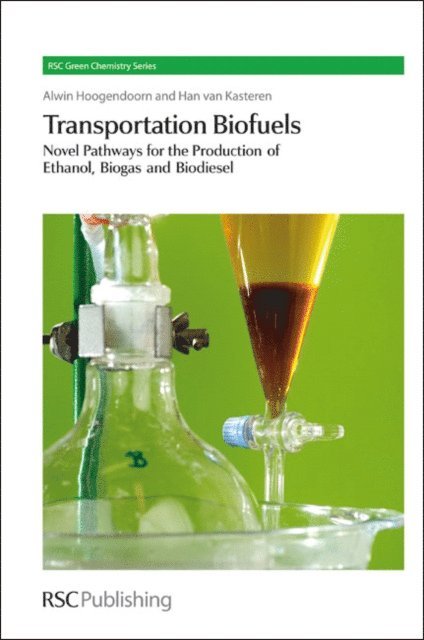
Transportation Biofuels
Novel Pathways for the Production of Ethanol
Av Alwin Hoogendoorn, Han van Kasteren
Inbunden, 2010
2251 kr
Lägg i varukorg
Current world fossil oil production is struggling to meet demand and may even show a decline after 2010. It is therefore necessary to develop new energy efficient production pathways for transportation biofuels. This book offers an insight into three promising and innovative pathways for the …
Transportation Biofuels
Novel Pathways for the Production of Ethanol
Av Han van Kasteren, Alwin Hoogendoorn
E-bok, 2010
1988 kr
Lägg i varukorg
Current world fossil oil production is struggling to meet demand and may even show a decline after 2010. It is therefore necessary to develop new energy efficient production pathways for transportation biofuels. This book offers an insight into three promising and innovative pathways for the …