Hans Freudenthal – författare
Visar alla böcker från författaren Hans Freudenthal. Handla med fri frakt och snabb leverans.
17 produkter
17 produkter
E-bok
PDF, Engelska, 20051 977 kr
Läs direkt efter köp
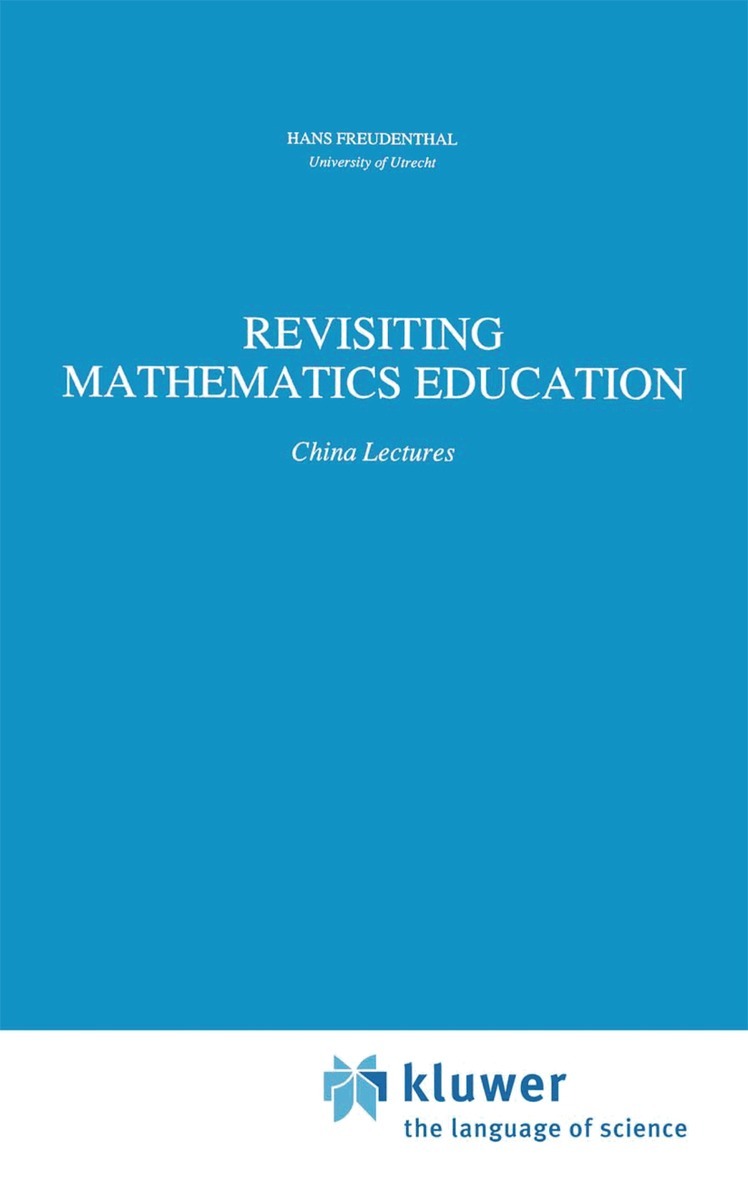
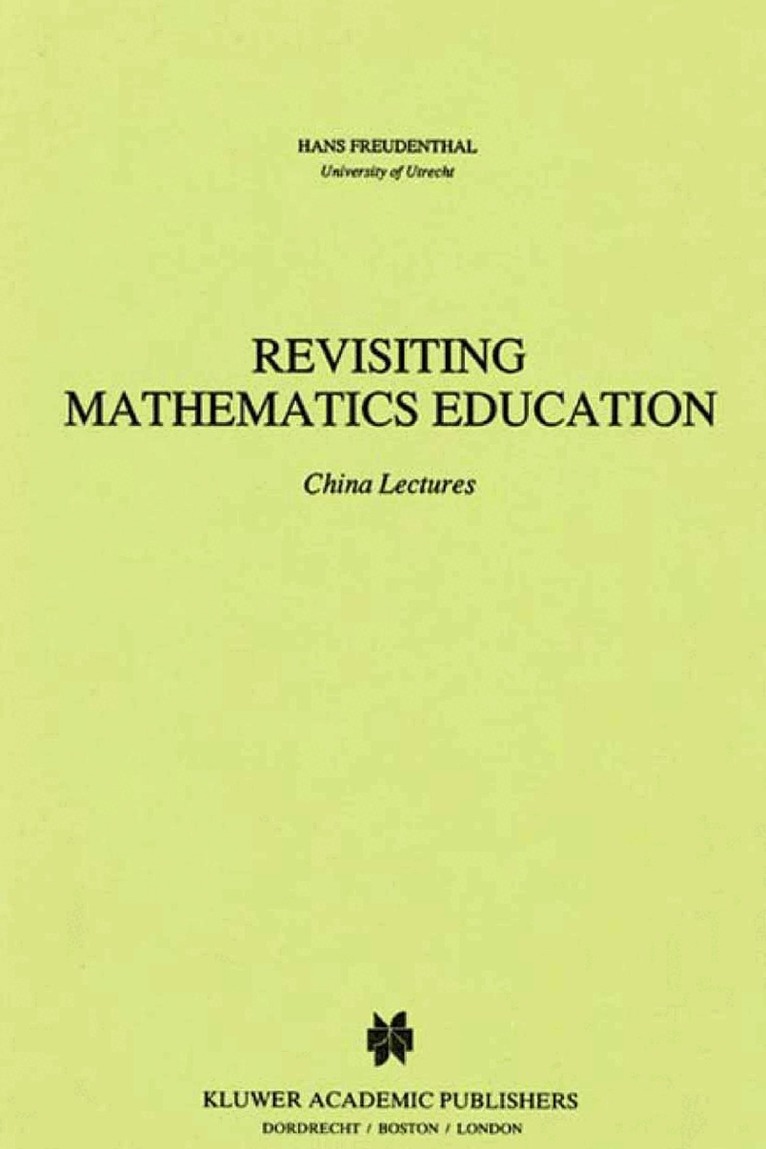
This book is a product of love and respect. If that sounds rather odd I initially apologise, but let me explain why I use those words. The original manuscript was of course Freudenthal’s, but his colleagues have carried the project through to its conclusion with love for the man, and his ideas, and with a respect developed over years of communal effort. Their invitation to me to write this Preface e- bles me to pay my respects to the great man, although I am probably incurring his wrath for writing a Preface for his book without his permission! I just hope he understands the feelings of all colleagues engaged in this particular project. Hans Freudenthal died on October 13th, 1990 when this book project was well in hand. In fact he wrote to me in April 1988, saying “I am thinking about a new book. I have got the sub-title (China Lectures) though I still lack a title”. I was astonished. He had retired in 1975, but of course he kept working. Then in 1985 we had been helping him celebrate his 80th birthday, and although I said in an Editorial Statement in Educational Studies in Mathematics (ESM) at the time “we look forward to him enjoying many more years of non-retirement” I did not expect to see another lengthy manuscript.
E-bok
PDF, Engelska, 20073 046 kr
Läs direkt efter köp
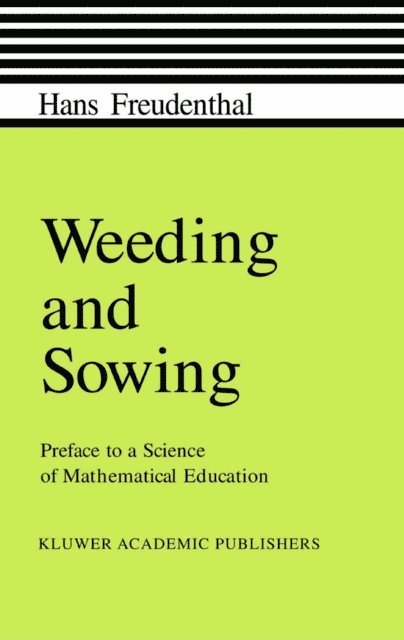
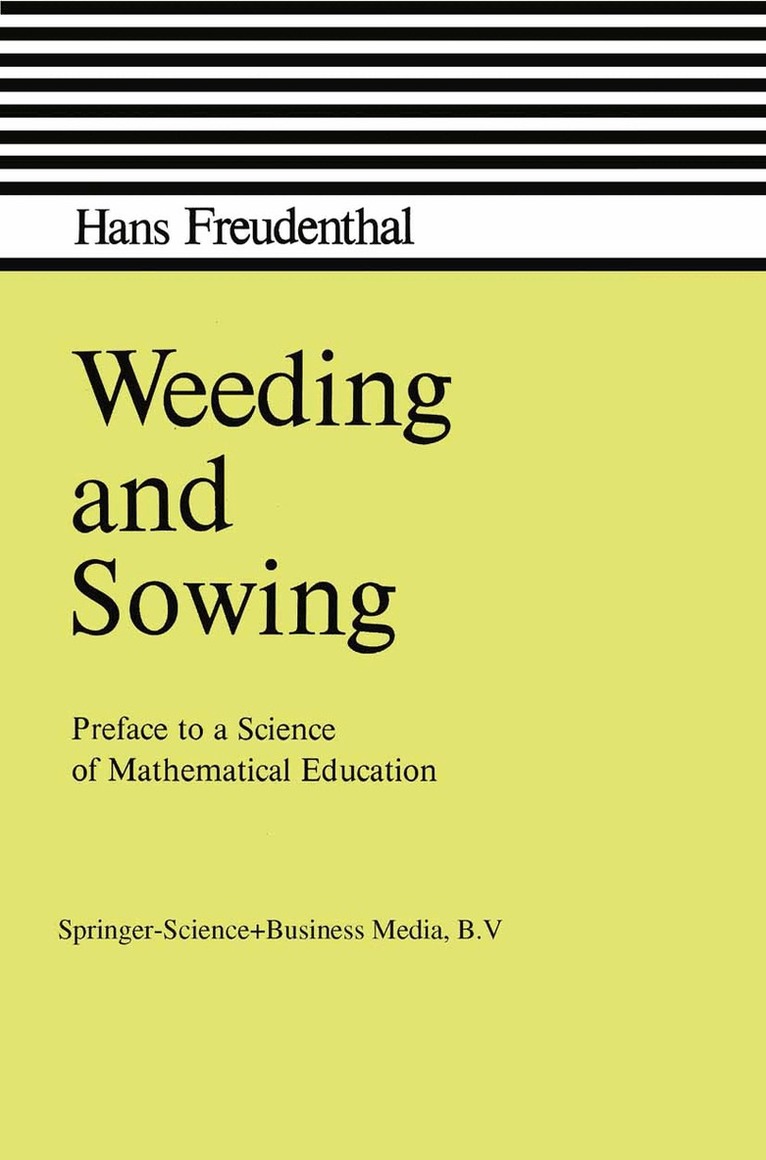
A title that sounds like poetry, and a subtitle that seems to contradict the title! But the subtitle is right, and originally it was just the title. A strange subtitle, isn’t it? Preface to a Science of Mathematical Education. All sciences – in their prenatal stage – have known this kind of literature: only the term used was not ‘Preface’, but, for instance, ‘Prolegomena’, which * means the same though it sounds less provisional. In fact such works were thicker than the present one, by up to ten times. There is much more that can be said about a science before it comes into being than after; with the first results comes modesty. This is the preface to a book that will never be written: not by me, nor by anybody else. Once a science of mathematical education exists, it will get the preface it deserves. Nevertheless this preface – or what for honesty’s sake I have labelled so – must fulfil a function: the function of accelerating the birth of a science of mathematical education, which isseriously impeded by the unfounded view that such already exists. Against this view I have to argue: it rests on a wrong estimation – both over and under estimation at the same time – of what is to be considered as science.
E-bok
PDF, Engelska, 20053 046 kr
Läs direkt efter köp
The launch ofa new book series is always a challenging eventn ot only for the Editorial Board and the Publisher, but also, and more particularly, for the first author. Both the Editorial Board and the Publisher are delightedt hat the first author in this series isw ell able to meet the challenge. Professor Freudenthal needs no introduction toanyone in the Mathematics Education field and it is particularly fitting that his book should be the first in this new series because it was in 1968 that he, and Reidel, produced the first issue oft he journal Edu cational Studies in Mathematics. Breakingfresh ground is therefore nothing new to Professor Freudenthal and this book illustrates well his pleasure at such a task. To be strictly correct the ‘ground’ which he has broken here is not new, but aswith Mathematics as an Educational Task and Weeding and Sowing, it is rather the novelty oft he manner in which he has carried out his analysis which provides us with so many fresh perspectives. It is our intention that this new book series should provide those who work int he emerging discipline of mathematicseducation with an essential resource, and at a time of considerable concern about the whole mathematics cu rriculum this book represents just such resource. ALAN J. BISHOP Managing Editor vii A LOOK BACKWARD AND A LOOK FORWARD Men die, systems last.
Del 9 - Mathematics Education Library
Revisiting Mathematics Education
China Lectures
Inbunden, Engelska, 1991
1 619 kr
This book is a product of love and respect. If that sounds rather odd I initially apologise, but let me explain why I use those words. The original manuscript was of course Freudenthal’s, but his colleagues have carried the project through to its conclusion with love for the man, and his ideas, and with a respect developed over years of communal effort. Their invitation to me to write this Preface e- bles me to pay my respects to the great man, although I am probably incurring his wrath for writing a Preface for his book without his permission! I just hope he understands the feelings of all colleagues engaged in this particular project. Hans Freudenthal died on October 13th, 1990 when this book project was well in hand. In fact he wrote to me in April 1988, saying “I am thinking about a new book. I have got the sub-title (China Lectures) though I still lack a title”. I was astonished. He had retired in 1975, but of course he kept working. Then in 1985 we had been helping him celebrate his 80th birthday, and although I said in an Editorial Statement in Educational Studies in Mathematics (ESM) at the time “we look forward to him enjoying many more years of non-retirement” I did not expect to see another lengthy manuscript.
E-bok
PDF, Engelska, 2014756 kr
Läs direkt efter köp
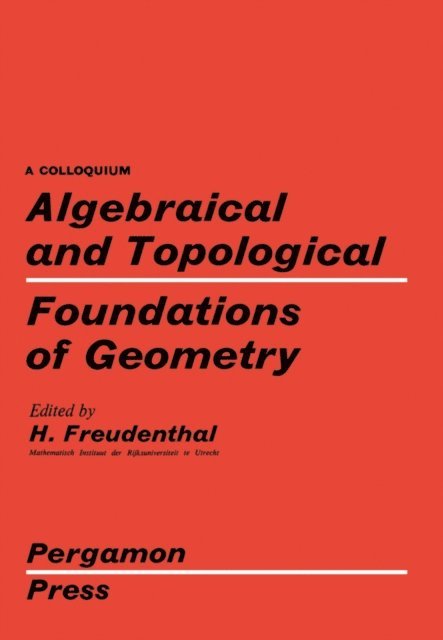
Algebraical and Topological Foundations of Geometry contains the proceedings of the Colloquium on Algebraic and Topological Foundations of Geometry, held in Utrecht, the Netherlands in August 1959. The papers review the algebraical and topological foundations of geometry and cover topics ranging from the geometric algebra of the Möbius plane to the theory of parallels with applications to closed geodesies. Groups of homeomorphisms and topological descriptive planes are also discussed. Comprised of 26 chapters, this book introduces the reader to the theory of parallels with applications to closed geodesies; groups of homeomorphisms; complemented modular lattices; and topological descriptive planes. Subsequent chapters focus on collineation groups; exceptional algebras and exceptional groups; the connection between algebra and constructions with ruler and compasses; and the use of differential geometry and analytic group theory methods in foundations of geometry. Von Staudt projectivities of Moufang planes are also considered, and an axiomatic treatment of polar geometry is presented. This monograph will be of interest to students of mathematics.
E-bok
PDF, Engelska, 2014979 kr
Läs direkt efter köp
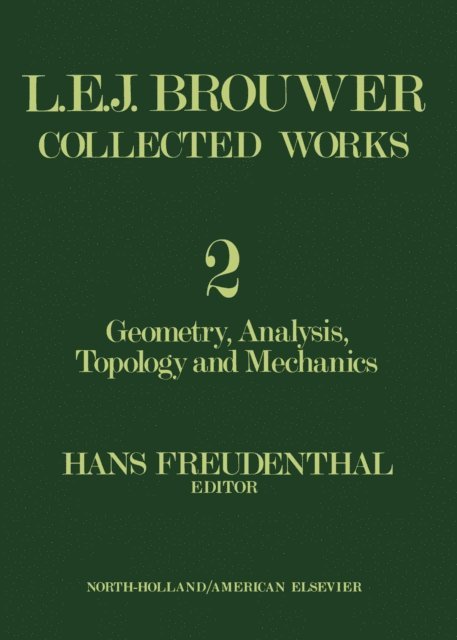
L. E. J. Brouwer Collected Works, Volume 2: Geometry, Analysis, Topology, and Mechanics focuses on the contributions and principles of Brouwer on geometry, topology, analysis, and mechanics, including non-Euclidean spaces, integrals, and surfaces. The publication first ponders on non-Euclidean spaces and integral theorems, lie groups, and plane transition theorem. Discussions focus on remarks on multiple integrals, force field of the non-Euclidean spaces with negative curvature, difference quotients and differential quotients, characterization of the Euclidean and non-Euclidean motion groups, and continuous one-one transformations of surfaces in themselves. The book also takes a look at vector fields on surfaces and new methods in topology, including continuous vector distributions on surfaces and orthogonal trajectories of the orbits of a one parameter plane projective group. The book then ponders on mechanics and topology of surfaces, as well as the motion of a particle on the bottom of a rotating vessel under the influence of gravitational force. The publication is a valuable reference for researchers interested in geometry, topology, analysis, and mechanics.
1 634 kr
Skickas inom 10-15 vardagar
Proceedings of the Colloquium sponsored by the Division of Philosophy of Sciences of the International Union of History and Philosophy of Sciences organized at Utrecht, January 1960.
Inbunden, Engelska, 1972
3 260 kr
Skickas inom 10-15 vardagar
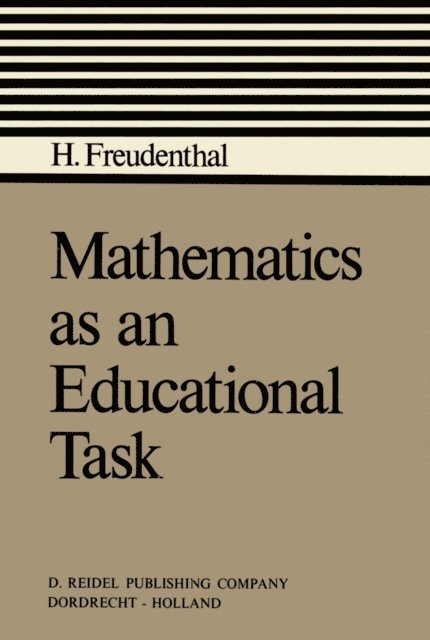
Like preludes, prefaces are usually composed last. Putting them in the front of the book is a feeble reflection of what, in the style of mathe matics treatises and textbooks, I usually call thf didactical inversion: to be fit to print, the way to the result should be the inverse of the order in which it was found; in particular the key definitions, which were the finishing touch to the structure, are put at the front. For many years I have contrasted the didactical inversion with the thought-experiment. It is true that you should not communicate your mathematics to other people in the way it occurred to you, but rather as it could have occurred to you if you had known then what you know now, and as it would occur to the student if his learning process is being guided. This in fact is the gist of the lesson Socrates taught Meno's slave. The thought-experi ment tries to find out how a student could re-invent what he is expected to learn. I said about the preface that it is a feeble reflection of the didactical inversion. Indeed, it is not a constituent part of the book. It can even be torn out. Yet it is useful. Firstly, to the reviewer who then need not read the whole work, and secondly to the author himself, who like the composer gets an opportunity to review the Leitmotivs of the book.
Häftad, Engelska, 1972
3 260 kr
Skickas inom 10-15 vardagar
Like preludes, prefaces are usually composed last. Putting them in the front of the book is a feeble reflection of what, in the style of mathe matics treatises and textbooks, I usually call thf didactical inversion: to be fit to print, the way to the result should be the inverse of the order in which it was found; in particular the key definitions, which were the finishing touch to the structure, are put at the front. For many years I have contrasted the didactical inversion with the thought-experiment. It is true that you should not communicate your mathematics to other people in the way it occurred to you, but rather as it could have occurred to you if you had known then what you know now, and as it would occur to the student if his learning process is being guided. This in fact is the gist of the lesson Socrates taught Meno's slave. The thought-experi ment tries to find out how a student could re-invent what he is expected to learn. I said about the preface that it is a feeble reflection of the didactical inversion. Indeed, it is not a constituent part of the book. It can even be torn out. Yet it is useful. Firstly, to the reviewer who then need not read the whole work, and secondly to the author himself, who like the composer gets an opportunity to review the Leitmotivs of the book.
Inbunden, Engelska, 1977
2 393 kr
Skickas inom 10-15 vardagar
A title that sounds like poetry, and a subtitle that seems to contradict the title! But the subtitle is right, and originally it was just the title. A strange subtitle, isn’t it? Preface to a Science of Mathematical Education. All sciences – in their prenatal stage – have known this kind of literature: only the term used was not ‘Preface’, but, for instance, ‘Prolegomena’, which * means the same though it sounds less provisional. In fact such works were thicker than the present one, by up to ten times. There is much more that can be said about a science before it comes into being than after; with the first results comes modesty. This is the preface to a book that will never be written: not by me, nor by anybody else. Once a science of mathematical education exists, it will get the preface it deserves. Nevertheless this preface – or what for honesty’s sake I have labelled so – must fulfil a function: the function of accelerating the birth of a science of mathematical education, which isseriously impeded by the unfounded view that such already exists. Against this view I have to argue: it rests on a wrong estimation – both over and under estimation at the same time – of what is to be considered as science.
Häftad, Engelska, 1980
2 393 kr
Skickas inom 10-15 vardagar
A title that sounds like poetry, and a subtitle that seems to contradict the title! But the subtitle is right, and originally it was just the title. A strange subtitle, isn’t it? Preface to a Science of Mathematical Education. All sciences – in their prenatal stage – have known this kind of literature: only the term used was not ‘Preface’, but, for instance, ‘Prolegomena’, which * means the same though it sounds less provisional. In fact such works were thicker than the present one, by up to ten times. There is much more that can be said about a science before it comes into being than after; with the first results comes modesty. This is the preface to a book that will never be written: not by me, nor by anybody else. Once a science of mathematical education exists, it will get the preface it deserves. Nevertheless this preface – or what for honesty’s sake I have labelled so – must fulfil a function: the function of accelerating the birth of a science of mathematical education, which isseriously impeded by the unfounded view that such already exists. Against this view I have to argue: it rests on a wrong estimation – both over and under estimation at the same time – of what is to be considered as science.
Del 1 - Mathematics Education Library
Didactical Phenomenology of Mathematical Structures
Inbunden, Engelska, 1983
2 176 kr
Skickas inom 10-15 vardagar
The launch ofa new book series is always a challenging eventn ot only for the Editorial Board and the Publisher, but also, and more particularly, for the first author. Both the Editorial Board and the Publisher are delightedt hat the first author in this series isw ell able to meet the challenge. Professor Freudenthal needs no introduction toanyone in the Mathematics Education field and it is particularly fitting that his book should be the first in this new series because it was in 1968 that he, and Reidel, produced the first issue oft he journal Edu cational Studies in Mathematics. Breakingfresh ground is therefore nothing new to Professor Freudenthal and this book illustrates well his pleasure at such a task. To be strictly correct the ‘ground’ which he has broken here is not new, but aswith Mathematics as an Educational Task and Weeding and Sowing, it is rather the novelty oft he manner in which he has carried out his analysis which provides us with so many fresh perspectives. It is our intention that this new book series should provide those who work int he emerging discipline of mathematicseducation with an essential resource, and at a time of considerable concern about the whole mathematics cu rriculum this book represents just such resource. ALAN J. BISHOP Managing Editor vii A LOOK BACKWARD AND A LOOK FORWARD Men die, systems last.
Del 1 - Mathematics Education Library
Didactical Phenomenology of Mathematical Structures
Häftad, Engelska, 1986
2 393 kr
Skickas inom 10-15 vardagar
The launch ofa new book series is always a challenging eventn ot only for the Editorial Board and the Publisher, but also, and more particularly, for the first author. Both the Editorial Board and the Publisher are delightedt hat the first author in this series isw ell able to meet the challenge. Professor Freudenthal needs no introduction toanyone in the Mathematics Education field and it is particularly fitting that his book should be the first in this new series because it was in 1968 that he, and Reidel, produced the first issue oft he journal Edu cational Studies in Mathematics. Breakingfresh ground is therefore nothing new to Professor Freudenthal and this book illustrates well his pleasure at such a task. To be strictly correct the ‘ground’ which he has broken here is not new, but aswith Mathematics as an Educational Task and Weeding and Sowing, it is rather the novelty oft he manner in which he has carried out his analysis which provides us with so many fresh perspectives. It is our intention that this new book series should provide those who work int he emerging discipline of mathematicseducation with an essential resource, and at a time of considerable concern about the whole mathematics cu rriculum this book represents just such resource. ALAN J. BISHOP Managing Editor vii A LOOK BACKWARD AND A LOOK FORWARD Men die, systems last.
Del 9 - Mathematics Education Library
Revisiting Mathematics Education
China Lectures
Häftad, Engelska, 2010
1 634 kr
Skickas inom 10-15 vardagar
This book is a product of love and respect. If that sounds rather odd I initially apologise, but let me explain why I use those words. The original manuscript was of course Freudenthal’s, but his colleagues have carried the project through to its conclusion with love for the man, and his ideas, and with a respect developed over years of communal effort. Their invitation to me to write this Preface e- bles me to pay my respects to the great man, although I am probably incurring his wrath for writing a Preface for his book without his permission! I just hope he understands the feelings of all colleagues engaged in this particular project. Hans Freudenthal died on October 13th, 1990 when this book project was well in hand. In fact he wrote to me in April 1988, saying “I am thinking about a new book. I have got the sub-title (China Lectures) though I still lack a title”. I was astonished. He had retired in 1975, but of course he kept working. Then in 1985 we had been helping him celebrate his 80th birthday, and although I said in an Editorial Statement in Educational Studies in Mathematics (ESM) at the time “we look forward to him enjoying many more years of non-retirement” I did not expect to see another lengthy manuscript.
E-bok
PDF, Engelska, 20123 809 kr
Läs direkt efter köp
Like preludes, prefaces are usually composed last. Putting them in the front of the book is a feeble reflection of what, in the style of mathe matics treatises and textbooks, I usually call thf didactical inversion: to be fit to print, the way to the result should be the inverse of the order in which it was found; in particular the key definitions, which were the finishing touch to the structure, are put at the front. For many years I have contrasted the didactical inversion with the thought-experiment. It is true that you should not communicate your mathematics to other people in the way it occurred to you, but rather as it could have occurred to you if you had known then what you know now, and as it would occur to the student if his learning process is being guided. This in fact is the gist of the lesson Socrates taught Meno''s slave. The thought-experi ment tries to find out how a student could re-invent what he is expected to learn. I said about the preface that it is a feeble reflection of the didactical inversion. Indeed, it is not a constituent part of the book. It can even be torn out. Yet it is useful. Firstly, to the reviewer who then need not read the whole work, and secondly to the author himself, who like the composer gets an opportunity to review the Leitmotivs of the book.
1 977 kr
Läs direkt efter köp
1 634 kr
Skickas inom 10-15 vardagar
Proceedings of the Colloquium sponsored by the Division of Philosophy of Sciences of the International Union of History and Philosophy of Sciences organized at Utrecht, January 1960.