Hans-Hermann Hohmann – författare
Visar alla böcker från författaren Hans-Hermann Hohmann. Handla med fri frakt och snabb leverans.
5 produkter
5 produkter
Inbunden, Engelska, 2019
2 244 kr
Skickas inom 10-15 vardagar
Soviet scholars have apparently stayed clear of meaningful analysis of such touchy subjects as interdependence and conflict in the relationship between economics and politics. Very little has been published on this issue—no surprise in a system that controls centrally both politics and the economy, with an emphasis on rapid economic development. The absence of meaningful Soviet research led the Federal Institute for East European and International Studies in Cologne to sponsor an international interdisciplinary conference on the subject. Contributions to the resulting book cover three main areas. The first includes the impact of traditional Russian political culture on contemporary Soviet economic thinking and behavior, the rank of economic aims in the priority system of Soviet politics, and the function of economic institutions in the implementation of political aims. The second concerns the role of political lobbies in the economy and repercussions of economic change for Soviet politics. Foreign economic relations and the USSR's foreign policy make up the third area. The concluding discussion reviews the state of international research and identifies areas for future study.
Häftad, Engelska, 2020
656 kr
Skickas inom 10-15 vardagar
This book discusses the impact of traditional Russian political culture on contemporary Soviet economic thinking and behaviour and the rank of economic aims in the priority system of Soviet politics. It focuses on foreign economic relations and the USSR's foreign policy.
E-bok
PDF, Engelska, 2019752 kr
Läs direkt efter köp
Soviet scholars have apparently stayed clear of meaningful analysis of such touchy subjects as interdependence and conflict in the relationship between economics and politics. Very little has been published on this issue—no surprise in a system that controls centrally both politics and the economy, with an emphasis on rapid economic development. The absence of meaningful Soviet research led the Federal Institute for East European and International Studies in Cologne to sponsor an international interdisciplinary conference on the subject. Contributions to the resulting book cover three main areas. The first includes the impact of traditional Russian political culture on contemporary Soviet economic thinking and behavior, the rank of economic aims in the priority system of Soviet politics, and the function of economic institutions in the implementation of political aims. The second concerns the role of political lobbies in the economy and repercussions of economic change for Soviet politics. Foreign economic relations and the USSR''s foreign policy make up the third area. The concluding discussion reviews the state of international research and identifies areas for future study.
E-bok
Engelska, 2019752 kr
Läs direkt efter köp
Soviet scholars have apparently stayed clear of meaningful analysis of such touchy subjects as interdependence and conflict in the relationship between economics and politics. Very little has been published on this issue—no surprise in a system that controls centrally both politics and the economy, with an emphasis on rapid economic development. The absence of meaningful Soviet research led the Federal Institute for East European and International Studies in Cologne to sponsor an international interdisciplinary conference on the subject. Contributions to the resulting book cover three main areas. The first includes the impact of traditional Russian political culture on contemporary Soviet economic thinking and behavior, the rank of economic aims in the priority system of Soviet politics, and the function of economic institutions in the implementation of political aims. The second concerns the role of political lobbies in the economy and repercussions of economic change for Soviet politics. Foreign economic relations and the USSR''s foreign policy make up the third area. The concluding discussion reviews the state of international research and identifies areas for future study.
E-bok
PDF, Engelska, 2013779 kr
Läs direkt efter köp
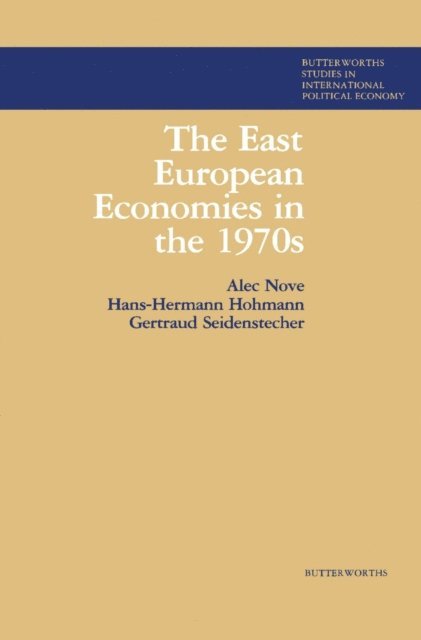
The East European Economies in the 1970s reviews the development of economic policy in Eastern Europe in the 1970s. This book includes individual country studies that compare and contrast both the aims of economic development and the results of the growth process, as well as the instruments employed in economic policy. More specifically, this book examines what has happened during the past decade after the fundamental changes in economic policy that occurred in the 1960s. This text is comprised of 10 chapters; the first of which provides a background on economic reform in Eastern Europe during the 1970s. Attention then turns to the economic policy, methods, and performance of the USSR after 1970. The chapters that follow focus on the German Democratic Republic, Poland, Czechoslovakia, Hungary, Bulgaria, Romania, and Yugoslavia. This book concludes with a discussion on the economic system of Albania in the 1970s, focusing on the country''s conservative radicalism, agriculture, and sharp disputes on economic policy between 1974 and 1976. Throughout the book, the emphasis is on how the ""process of reconstruction within the system"" has led to increasing differentiation of aims, institutions, and instruments of economic policy between individual countries. This book will be of interest to political science students, political scientists, political economists, and policy analysts.