Hans Teitler – författare
Visar alla böcker från författaren Hans Teitler. Handla med fri frakt och snabb leverans.
5 produkter
5 produkter
Del 9 - Philological and Historical Commentary on Ammianus Marcellinus
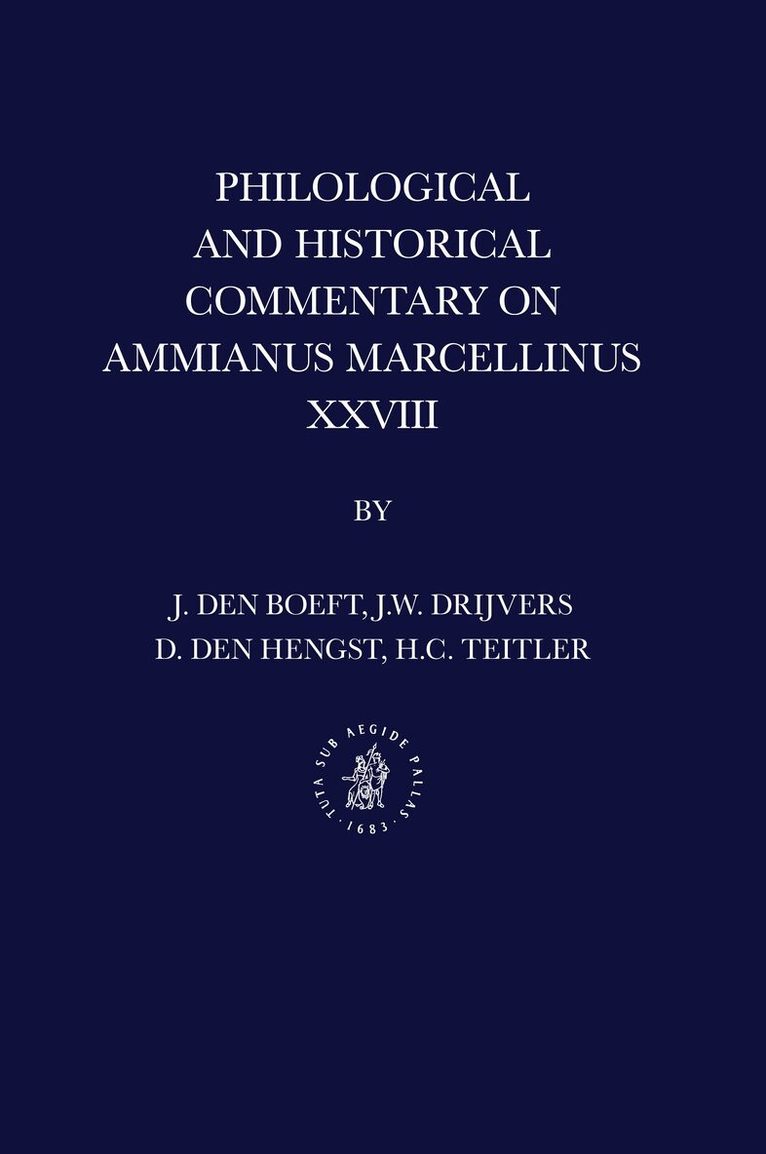
Philological and Historical Commentary on Ammianus Marcellinus XXVIII
Inbunden, Engelska, 2011
2 932 kr
Skickas inom 5-8 vardagar
In Book 28 Ammianus describes the military activity of Valentinian on the Rhine. The historian speaks with admiration about his efforts to strengthen the northwestern border of the empire. He shows a similar esteem for the general Theodosius, who re-established order in Britain. However, in the greater part of Book 28 there is an air of gloom. Ammianus writes reluctantly about the judicial terror inflicted on the Roman aristocracy by powerful magistrates. In his digression about Roman manners he speaks with contempt about the senatorial elite and the Roman plebs, because they fail to live up to the standards of their ancestors. The final chapter illustrates the disastrous effects of the mismanagement of the province of Tripolis by corrupt officials.
E-bok
PDF, Engelska, 20113 190 kr
Läs direkt efter köp
In Book 28 Ammianus describes the military activity of Valentinian on the Rhine. The historian speaks with admiration about his efforts to strengthen the northwestern border of the empire. He shows a similar esteem for the general Theodosius, who re-established order in Britain. However, in the greater part of Book 28 there is an air of gloom. Ammianus writes reluctantly about the judicial terror inflicted on the Roman aristocracy by powerful magistrates. In his digression about Roman manners he speaks with contempt about the senatorial elite and the Roman plebs, because they fail to live up to the standards of their ancestors. The final chapter illustrates the disastrous effects of the mismanagement of the province of Tripolis by corrupt officials.
Del 10 - Philological and Historical Commentary on Ammianus Marcellinus
Philological and Historical Commentary on Ammianus Marcellinus XXIX
Inbunden, Engelska, 2013
3 016 kr
Skickas inom 5-8 vardagar
Book 29 opens with the judicial terror in Antioch following the discovery of a plot against the emperor in the East, Valens, who played an active role in hunting down and executing the culprits. The account of these internal troubles is balanced by two long chapters at the end of the book dealing with warfare in Africa and Central Europe. The general Theodosius mercilessly crushed the revolt of the Moorish prince Firmus, while the emperor in the West, Valentinian, had to deal with violent invasions of the Quadi and the Sarmatians. The two central chapters are devoted to different aspects of Valentinian’s character, his cruelty on the one hand, his diligence in reinforcing the border defenses on the other.
E-bok
PDF, Engelska, 20132 897 kr
Läs direkt efter köp
Book 29 opens with the judicial terror in Antioch following the discovery of a plot against the emperor in the East, Valens, who played an active role in hunting down and executing the culprits. The account of these internal troubles is balanced by two long chapters at the end of the book dealing with warfare in Africa and Central Europe. The general Theodosius mercilessly crushed the revolt of the Moorish prince Firmus, while the emperor in the West, Valentinian, had to deal with violent invasions of the Quadi and the Sarmatians. The two central chapters are devoted to different aspects of Valentinian's character, his cruelty on the one hand, his diligence in reinforcing the border defenses on the other.
E-bok
PDF, Engelska, 20072 970 kr
Läs direkt efter köp
Book 26 of Ammianus' Res Gestae is the first of the hexad which deals with the rule of the emperors Valentinian and Valens (364-378). In the first five chapters Ammianus describes the election of Valentinian, who appointed his brother Valens as his co-ruler, and subsequently divided the empire into an eastern and a western part. The next chapters deal with the revolt of Procopius. They offer the most detailed account of a coup d' etat in Roman historiography. The memory of Julian, whose death was the central theme of the preceding book, is still very much alive. None of the three protagonists of Book 26 was remotely his equal. His loss meant a turn for the worse in the history of Rome.