Happymon Jacob - Böcker
Visar alla böcker från författaren Happymon Jacob. Handla med fri frakt och snabb leverans.
3 produkter
3 produkter
770 kr
Skickas inom 3-6 vardagar
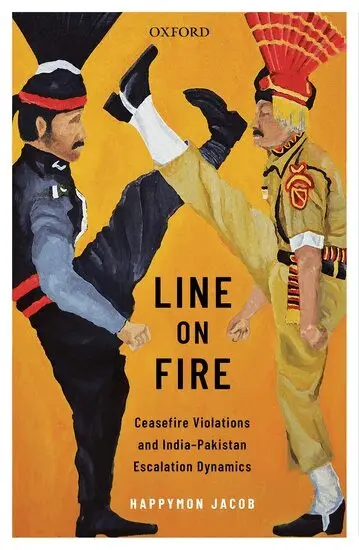
India-Pakistan border in Jammu and Kashmir has witnessed repeated ceasefire violations over the past decade. Indeed, with the new low in the relations between India and Pakistan, ceasefire violations have gone up exponentially. These have the potential to not only begin a crisis but also escalate an ongoing crisis. To make things worse, in the event of major violations, political leadership on either side often engage in high-pitched rhetoric some of which even have nuclear undertones. Using fresh empirical data and oral history evidence, this book explains the causes of ceasefire violations on the Jammu and Kashmir border, and establishes a relationship between ceasefire violations and crisis escalation between India and Pakistan. In doing so, the book further nuances the existing arguments about the escalatory dynamics between the two South Asian nuclear rivals. Furthermore, the book explains ceasefire violations using the concept of 'autonomous military factors'.
India After Nonalignment
The Quest to Become a Pole in International Politics
Inbunden, Engelska, 2026
1 633 kr
Kommande
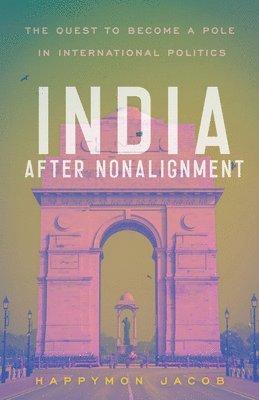
The deep roots of India's changing role in international affairsIn 1947, India's adoption of a strategy of nonalignment was primarily seen as a way to preserve the country's sovereignty and independence amid Cold War rivalry. But what if preservation was actually ambition?India After Nonalignment traces the history and evolution of India's foreign policy to uncover a century-old aspiration: the nation's ambition to become a distinct pole––a center of power, norms, and geopolitical activity––in a multipolar world. Using a fresh conceptual framework, Jacob examines how India's old nonalignment policy, ongoing aversion to military alliances, and recent enactment of strategic autonomy have collectively been driven by this deeply rooted desire to become a consequential and unique actor in foreign affairs. He discusses India's paradigm shift from a reactive posture to a proactive role in shaping international norms and culture, the balance of power, and the future implications of these aspirations for its foreign policy behavior.As the country's growing power and geopolitical significance make its ambitions more explicit, Jacob provides the perspective necessary for scholars, students, and other readers interested in international relations and South Asian studies to better understand how India perceives its journey in the international system.
504 kr
Kommande
The deep roots of India's changing role in international affairsIn 1947, India's adoption of a strategy of nonalignment was primarily seen as a way to preserve the country's sovereignty and independence amid Cold War rivalry. But what if preservation was actually ambition?India After Nonalignment traces the history and evolution of India's foreign policy to uncover a century-old aspiration: the nation's ambition to become a distinct pole––a center of power, norms, and geopolitical activity––in a multipolar world. Using a fresh conceptual framework, Jacob examines how India's old nonalignment policy, ongoing aversion to military alliances, and recent enactment of strategic autonomy have collectively been driven by this deeply rooted desire to become a consequential and unique actor in foreign affairs. He discusses India's paradigm shift from a reactive posture to a proactive role in shaping international norms and culture, the balance of power, and the future implications of these aspirations for its foreign policy behavior.As the country's growing power and geopolitical significance make its ambitions more explicit, Jacob provides the perspective necessary for scholars, students, and other readers interested in international relations and South Asian studies to better understand how India perceives its journey in the international system.