Harald Müller – författare
Visar alla böcker från författaren Harald Müller. Handla med fri frakt och snabb leverans.
3 produkter
3 produkter
E-bok
PDF, Engelska, 2013595 kr
Läs direkt efter köp
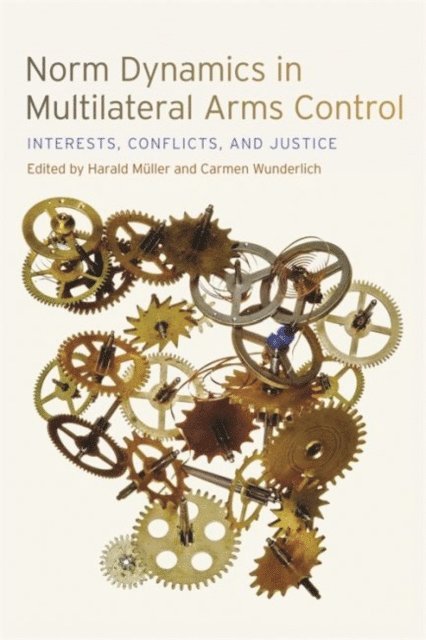
This volume comprehensively covers a range of issues related to dynamic norm change in the current major international arms control regimes related to nuclear, biological,and chemical weapons; small arms and light weapons; cluster munitions; and antipersonnel mines. Arms control policies of all of the key established and rising state actors are considered, as well as those of nonaligned countries, nongovernmental organizations, and international governing bodies.Recent studies on multilateral arms control tend to focus mostly on "structure," by which opportunities and constraints for action are created. This volume pays equal attention to "agency," through which opportunities and constraints to produce change or maintain the status quo are handled. In addition-and in greater depth than in recent studies-the volume acknowledges the force of moral and ethical impulses (alongside such factors as political, legal, and technological change) in the evolution of arms control norms.The volume begins with a look at the structure of regimes, at the conflicts residing in these structures, and at the dynamic processes in which these conflicts are worked out. The impact of extrinsic factors on norm dynamics is considered next, including technological change and shifts in attitudes and power structures. Essays on the role of agency in driving norm change conclude the volume, with a particular focus on norm entrepreneurship and the importance of acknowledging the competing justice claims surrounding norm-change efforts.Contributors: Una Becker-Jakob, Alexis Below, Marco Fey, Giorgio Franceschini, Andrea Hellmann, Gregor Hofmann, Friederike Klinke, Daniel MÜller, Harald MÜller, Franziska PlÜmmer, Carsten Rauch, Judith Reuter, Elvira Rosert, Annette Schaper, Hans-Joachim Schmidt, Tabea Seidler-Diekmann, Simone Wisotzki, Carmen Wunderlich.
E-bok
PDF, Engelska, 2016774 kr
Läs direkt efter köp
The Middle East is a hot spot of proliferation. It contains one state assumed to possess nuclear weapons, several states that tried and failed to develop a military nuclear capability, one state under suspicion of trying to do so, and it is the world region that witnessed the most frequent and severe employment of chemical weapons since the end of World War I. Notwithstanding, not a single arms control regime concerning weapons of mass destruction (WMD) covers the region as a whole. Instead we have seen several proliferation-related military operations which have rather contributed to destabilization than served non-proliferation. This volume, written under the auspices of the EU Consortium for Non-Proliferation and Disarmament determines the current state of diplomatic efforts to establish a WMD free zone in the Middle East. In doing so, it provides insights into central actors’ conflicting political positions, thereby explaining the stalemate of efforts to negotiate a WMD-free zone. Chapters written by renowned experts from academia and policy-oriented think tanks, as well as by next-generation Middle East and arms control experts, introduce the subject to the reader, give background information about arms control initiatives, provide technical expertise, and endeavour to make proposals for arms control measures in support of the creation of a Middle East WMD-free zone.
E-bok
Engelska, 2016774 kr
Läs direkt efter köp
The Middle East is a hot spot of proliferation. It contains one state assumed to possess nuclear weapons, several states that tried and failed to develop a military nuclear capability, one state under suspicion of trying to do so, and it is the world region that witnessed the most frequent and severe employment of chemical weapons since the end of World War I. Notwithstanding, not a single arms control regime concerning weapons of mass destruction (WMD) covers the region as a whole. Instead we have seen several proliferation-related military operations which have rather contributed to destabilization than served non-proliferation. This volume, written under the auspices of the EU Consortium for Non-Proliferation and Disarmament determines the current state of diplomatic efforts to establish a WMD free zone in the Middle East. In doing so, it provides insights into central actors’ conflicting political positions, thereby explaining the stalemate of efforts to negotiate a WMD-free zone. Chapters written by renowned experts from academia and policy-oriented think tanks, as well as by next-generation Middle East and arms control experts, introduce the subject to the reader, give background information about arms control initiatives, provide technical expertise, and endeavour to make proposals for arms control measures in support of the creation of a Middle East WMD-free zone.