Harold Stewart – författare
Visar alla böcker från författaren Harold Stewart. Handla med fri frakt och snabb leverans.
9 produkter
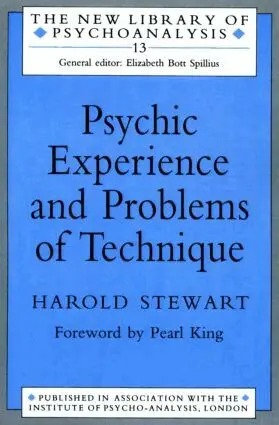
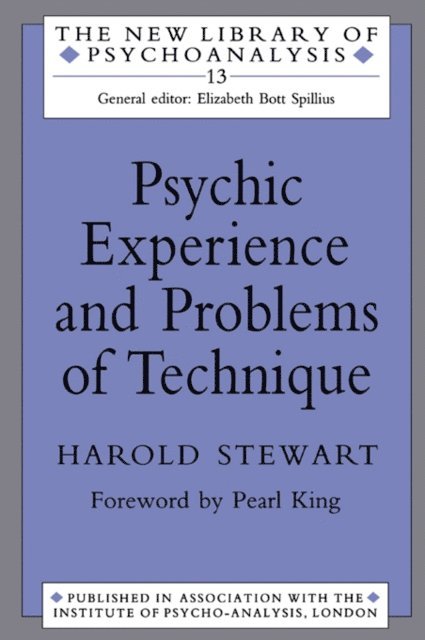
Psychic Experience and Problems of Technique
Häftad, 1991
630 kr
Lägg i varukorg
Harold Stewart, a distinguished psychoanalyst of more than 30 years' experience, began his medical career as a general practitioner. He was drawn first towards hypnotherapy, then to psychoanalysis, as a more sensitive, productive and far-reaching method of exploring patients' problems.In this book …
Michael Balint
Object Relations, Pure and Applied
Av Andrew Elder, Robert Gosling m. fl.
Häftad, 1996
713 kr
Lägg i varukorg
Whilst Michael Balint's applied work is widely known, many of his theoretical contributions have been incorporated into everyday analysis without due recognition of their source. In this account of his thinking, Harold Stewart evaluates the extent of Balint's contribution to psychoanalysis and …
Michael Balint
Object Relations, Pure and Applied
Av Harold Stewart, Robert Gosling m. fl.
E-bok, 2003
772 kr
Lägg i varukorg
Whilst Michael Balint''s applied work is widely known, many of his theoretical contributions have been incorporated into everyday analysis without due recognition of their source. In this account of his thinking, Harold Stewart evaluates the extent of Balint''s contribution to psychoanalysis and …
Michael Balint
Object Relations, Pure and Applied
Av Harold Stewart, Robert Gosling m. fl.
E-bok, 2003
772 kr
Lägg i varukorg
Whilst Michael Balint''s applied work is widely known, many of his theoretical contributions have been incorporated into everyday analysis without due recognition of their source. In this account of his thinking, Harold Stewart evaluates the extent of Balint''s contribution to psychoanalysis and …
Psychic Experience and Problems of Technique
E-bok, 2003
642 kr
Lägg i varukorg
Harold Stewart, a distinguished psychoanalyst of more than 30 years'' experience, began his medical career as a general practitioner. He was drawn first towards hypnotherapy, then to psychoanalysis, as a more sensitive, productive and far-reaching method of exploring patients'' problems. In this …
Psychic Experience and Problems of Technique
E-bok, 2003
628 kr
Lägg i varukorg
Harold Stewart, a distinguished psychoanalyst of more than 30 years'' experience, began his medical career as a general practitioner. He was drawn first towards hypnotherapy, then to psychoanalysis, as a more sensitive, productive and far-reaching method of exploring patients'' problems. In this …
Psychic Experience and Problems of Technique
Inbunden, 2017
1779 kr
Lägg i varukorg
Harold Stewart, a distinguished psychoanalyst of more than 30 years' experience, began his medical career as a general practitioner. He was drawn first towards hypnotherapy, then to psychoanalysis, as a more sensitive, productive and far-reaching method of exploring patients' problems.In this book …
Net of Fireflies
E-bok, 2011
193 kr
Lägg i varukorg
A Net of Fireflies is a superb collection of classic haiku composed by the leading writers of this delicate but intricate art form. With over three Japanese hundred haiku poems written over five centuries, the book is a thorough introduction to the unique world of Japanese haiku. Thirty-three full …
Chime of Windbells
E-bok, 2011
153 kr
Lägg i varukorg
A Year of Japanese Haiku in English Verse. Harold Stewart is an Australian poet who lives in Kyoto. His first anthology of Japanese haiku was published as A Net of Fireflies. This is his second. He has also written Phoenix Wings, Orpheus, and New Phoenix Wings Praise for Chime of Windbells : "…a …