
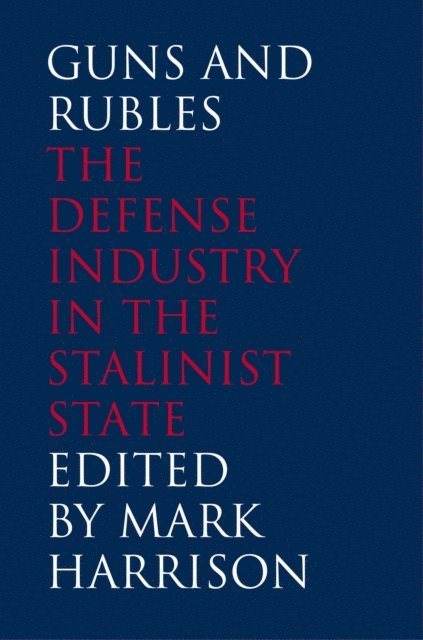
For this book a distinguished team of economists and historians—R. W. Davies, Paul R. Gregory, Andrei Markevich, Mikhail Mukhin, Andrei Sokolov, and Mark Harrison—scoured formerly closed Soviet archives to discover how Stalin used rubles to make guns. Focusing on various aspects of the defense industry, a top-secret branch of the Soviet economy, the volume’s contributors uncover new information on the inner workings of Stalin’s dictatorship, military and economic planning, and the industrial organization of the Soviet economy. Previously unknown details about Stalin’s command system come to light, as do fascinating insights into the relations between Soviet public and private interests. The authors show that defense was at the core of Stalin’s system of rule; single-minded management of the defense sector helped him keep his grip on power.
This book offers a practical but conceptually grounded view of the future of sponsorship. It is based on the reality that the world of sponsorship marketing is far too focused on impressions, logos, and ''money can''t buy experiences'' — experiences which are miraculously secured with money. The author asks questions such as: ''Do any corporate sponsors really believe that more logos are what their consumers want?'' and, ''do organizations selling sponsorship believe they have nothing more valuable to sell than digital and physical signage?''In a culmination of real-life experiences, industry learnings and third-party professional research, What Sponsors Want provides expert-supported arguments to show that the traditional bronze, silver and gold packages of sponsorship belong to a model of the past. In outlining the conceptual model for successful sponsorship, this book provides five key principles of what sponsors want for you to take on your next sponsorship challenge.
The papers brought together in this volume represent a decade of advances in the historical political economy of defence, dictatorship, and warfare. They address defining events and institutions of the world in the twentieth century: economic consequences of repression and violence, the outcomes of two world wars, and the rise and fall of communism. They cross traditional disciplinary boundaries, combining a broad sweep with close attention to measurement and narrative detail; offering insights into these issues from economics, history, political science, and statistics; and demonstrating in action the value of a multi-disciplinary approach.The author was one of the first economists to leverage the opening of former Soviet archives. He has led international projects that reinvented the quantitative economics of the two world wars and contributed significantly to historical Soviet studies. In 2012, he shared with Andrei Markevich the Russian National Prize for Applied Economics, which was awarded in recognition of their research.
For this book a distinguished team of economists and historians—R. W. Davies, Paul R. Gregory, Andrei Markevich, Mikhail Mukhin, Andrei Sokolov, and Mark Harrison—scoured formerly closed Soviet archives to discover how Stalin used rubles to make guns. Focusing on various aspects of the defense industry, a top-secret branch of the Soviet economy, the volume’s contributors uncover new information on the inner workings of Stalin’s dictatorship, military and economic planning, and the industrial organization of the Soviet economy. Previously unknown details about Stalin’s command system come to light, as do fascinating insights into the relations between Soviet public and private interests. The authors show that defense was at the core of Stalin’s system of rule; single-minded management of the defense sector helped him keep his grip on power.

This book offers a practical but conceptually grounded view of the future of sponsorship. It is based on the reality that the world of sponsorship marketing is far too focused on impressions, logos, and ''money can''t buy experiences'' — experiences which are miraculously secured with money. The author asks questions such as: ''Do any corporate sponsors really believe that more logos are what their consumers want?'' and, ''do organizations selling sponsorship believe they have nothing more valuable to sell than digital and physical signage?''In a culmination of real-life experiences, industry learnings and third-party professional research, What Sponsors Want provides expert-supported arguments to show that the traditional bronze, silver and gold packages of sponsorship belong to a model of the past. In outlining the conceptual model for successful sponsorship, this book provides five key principles of what sponsors want for you to take on your next sponsorship challenge.
The papers brought together in this volume represent a decade of advances in the historical political economy of defence, dictatorship, and warfare. They address defining events and institutions of the world in the twentieth century: economic consequences of repression and violence, the outcomes of two world wars, and the rise and fall of communism. They cross traditional disciplinary boundaries, combining a broad sweep with close attention to measurement and narrative detail; offering insights into these issues from economics, history, political science, and statistics; and demonstrating in action the value of a multi-disciplinary approach.The author was one of the first economists to leverage the opening of former Soviet archives. He has led international projects that reinvented the quantitative economics of the two world wars and contributed significantly to historical Soviet studies. In 2012, he shared with Andrei Markevich the Russian National Prize for Applied Economics, which was awarded in recognition of their research.