Harsh S. Dhiman – författare
1 185 kr
Skickas inom 10-15 vardagar
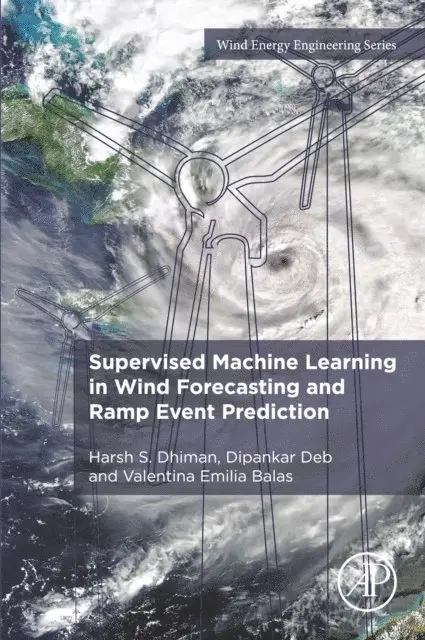
Supervised Machine Learning in Wind Forecasting and Ramp Event Prediction provides an up-to- date overview on the broad area of wind generation and forecasting, with a focus on the role and need of Machine Learning in this emerging field of knowledge. Various regression models and signal decomposition techniques are presented and analyzed, including least-square, twin support and random forest regression, all with supervised Machine Learning. The specific topics of ramp event prediction and wake interactions are addressed in this book, along with forecasted performance.
Wind speed forecasting has become an essential component to ensure power system security, reliability and safe operation, making this reference useful for all researchers and professionals researching renewable energy, wind energy forecasting and generation.
Features various supervised machine learning based regression models Offers global case studies for turbine wind farm layouts Includes state-of-the-art models and methodologies in wind forecasting1 648 kr
Läs direkt efter köp
2 322 kr
Skickas inom 5-8 vardagar
2 562 kr
Läs direkt efter köp
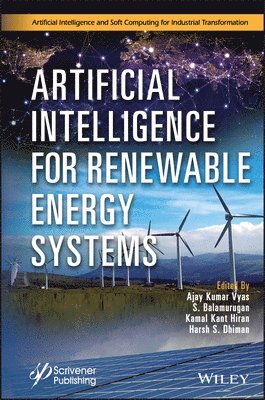
Renewable energy systems, including solar, wind, biodiesel, hybrid energy, and other relevant types, have numerous advantages compared to their conventional counterparts. This book presents the application of machine learning and deep learning techniques for renewable energy system modeling, forecasting, and optimization for efficient system design.
Due to the importance of renewable energy in today’s world, this book was designed to enhance the reader’s knowledge based on current developments in the field. For instance, the extraction and selection of machine learning algorithms for renewable energy systems, forecasting of wind and solar radiation are featured in the book. Also highlighted are intelligent data, renewable energy informatics systems based on supervisory control and data acquisition (SCADA); and intelligent condition monitoring of solar and wind energy systems. Moreover, an AI-based system for real-time decision-making for renewable energy systems is presented; and also demonstrated is the prediction of energy consumption in green buildings using machine learning. The chapter authors also provide both experimental and real datasets with great potential in the renewable energy sector, which apply machine learning (ML) and deep learning (DL) algorithms that will be helpful for economic and environmental forecasting of the renewable energy business.
Audience
The primary target audience includes research scholars, industry engineers, and graduate students working in renewable energy, electrical engineering, machine learning, information & communication technology.
2 562 kr
Läs direkt efter köp
Renewable energy systems, including solar, wind, biodiesel, hybrid energy, and other relevant types, have numerous advantages compared to their conventional counterparts. This book presents the application of machine learning and deep learning techniques for renewable energy system modeling, forecasting, and optimization for efficient system design.
Due to the importance of renewable energy in today’s world, this book was designed to enhance the reader’s knowledge based on current developments in the field. For instance, the extraction and selection of machine learning algorithms for renewable energy systems, forecasting of wind and solar radiation are featured in the book. Also highlighted are intelligent data, renewable energy informatics systems based on supervisory control and data acquisition (SCADA); and intelligent condition monitoring of solar and wind energy systems. Moreover, an AI-based system for real-time decision-making for renewable energy systems is presented; and also demonstrated is the prediction of energy consumption in green buildings using machine learning. The chapter authors also provide both experimental and real datasets with great potential in the renewable energy sector, which apply machine learning (ML) and deep learning (DL) algorithms that will be helpful for economic and environmental forecasting of the renewable energy business.
Audience
The primary target audience includes research scholars, industry engineers, and graduate students working in renewable energy, electrical engineering, machine learning, information & communication technology.
1 073 kr
Skickas inom 10-15 vardagar
1 379 kr
Läs direkt efter köp
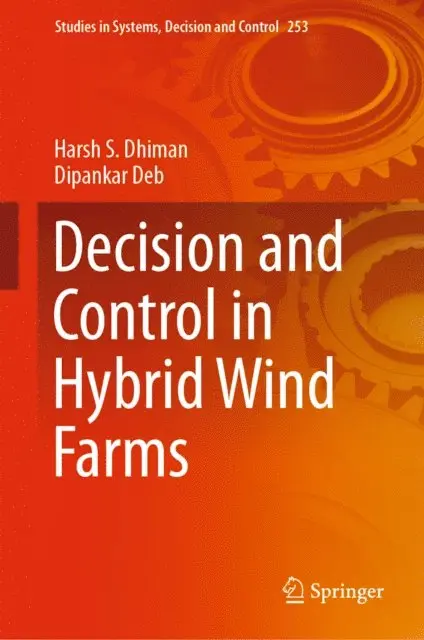
This book focuses on two of the most important aspects of wind farm operation: decisions and control. The first part of the book deals with decision-making processes, and explains that hybrid wind farm operation is governed by a set of alternatives that the wind farm operator must choose from in order to achieve optimal delivery of wind power to the utility grid. This decision-making is accompanied by accurate forecasts of wind speed, which must be known beforehand. Errors in wind forecasting can be compensated for by pumping power from a reserve capacity to the grid using a battery energy storage system (BESS). Alternatives based on penalty cost are assessed using certain criteria, and MCDM methods are used to evaluate the best choice. Further, considering the randomness in the dynamic phenomenon in wind farms, a fuzzy MCDM approach is applied during the decision-making process to evaluate the best alternative for hybrid wind farm operation. Case studies from wind farms in theUSA are presented, together with numerical solutions to the problem.
In turn, the second part deals with the control aspect, and especially with yaw angle control, which facilitates power maximization at wind farms. A novel transfer function-based methodology is presented that controls the wake center of the upstream turbine(s); lidar-based numerical simulation is carried out for wind farm layouts; and an adaptive control strategy is implemented to achieve the desired yaw angle for upstream turbines. The proposed methodology is tested for two wind farm layouts. Wake management is also implemented for hybrid wind farms where BESS life enhancement is studied. The effect of yaw angle on the operational cost of BESS is assessed, and case studies for wind farm datasets from the USA and Denmark are discussed. Overall, the book provides a comprehensive guide to decision and control aspects for hybrid wind farms, which are particularly important from an industrial standpoint.
1 073 kr
Skickas inom 10-15 vardagar