Hartmut König – författare
Visar alla böcker från författaren Hartmut König. Handla med fri frakt och snabb leverans.
13 produkter
13 produkter
Inbunden, Engelska, 1997
1 667 kr
Skickas inom 10-15 vardagar
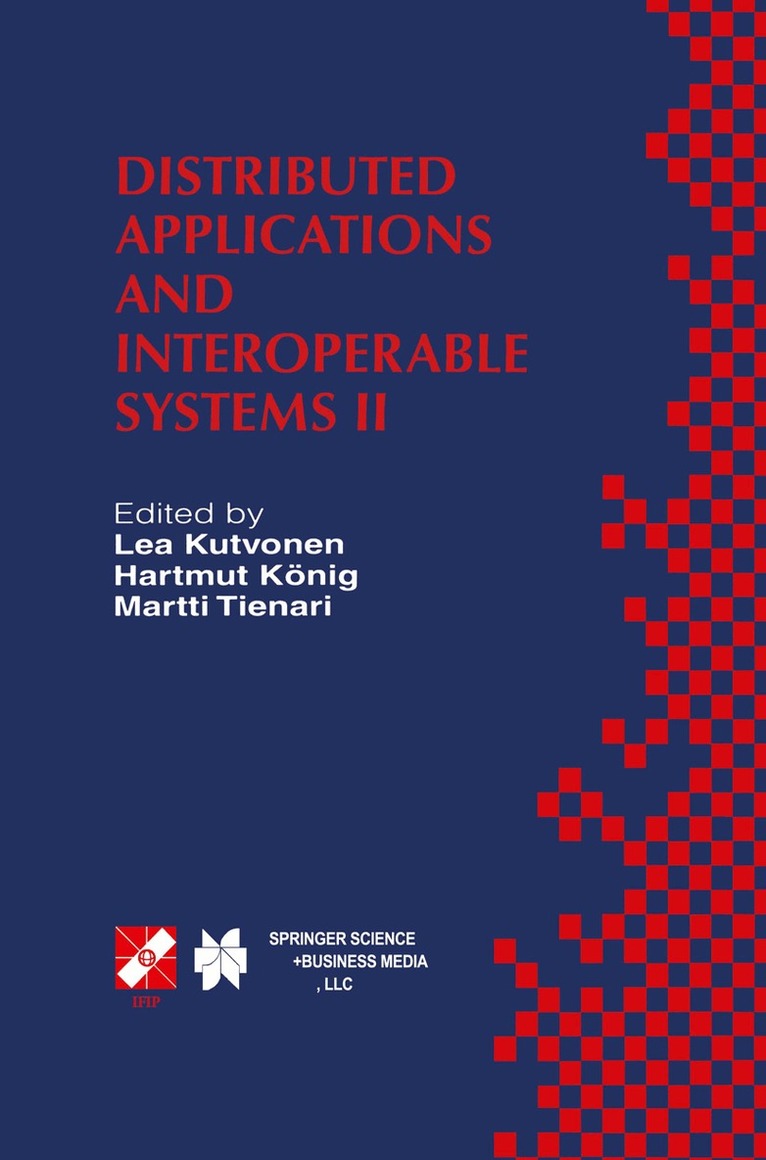
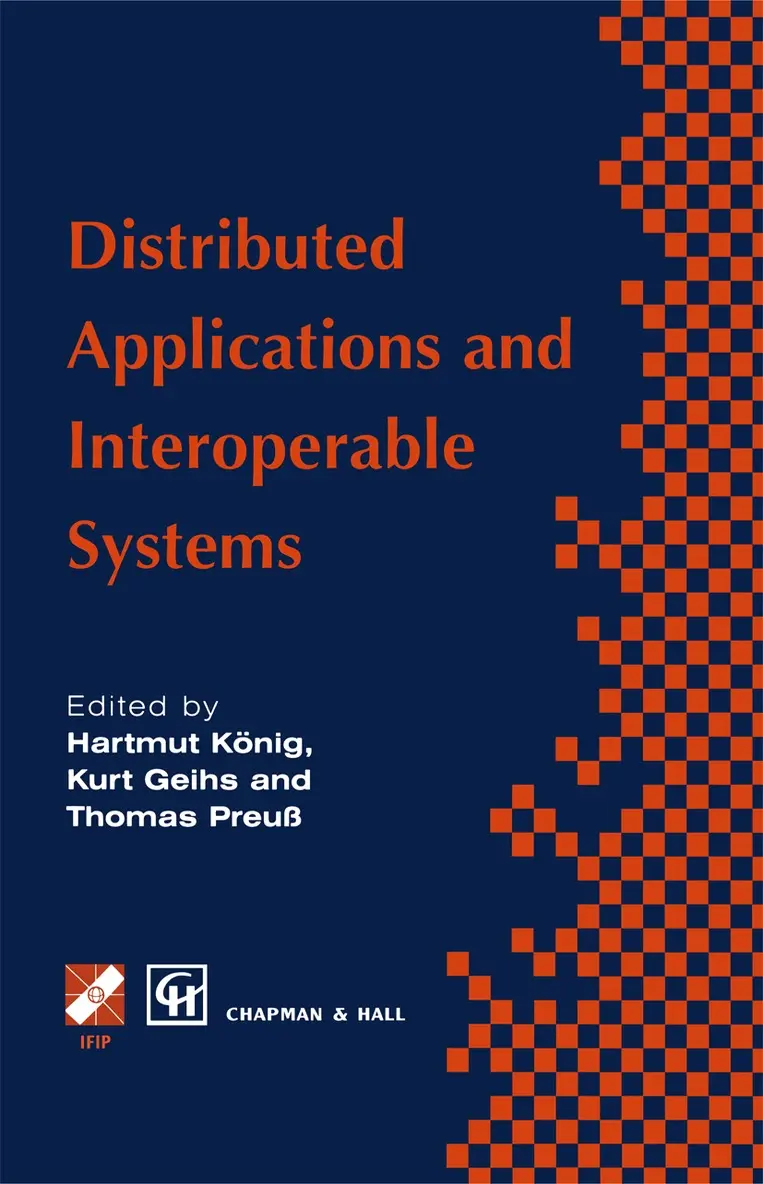
Distribution and interoperability in heterogeneous computing environments are the key requirements for state-of-the-art information processing systems. Distributed applications are making a critical contribution in many application sectors, such as office automation, finance, manufacturing, telecommunications, aerospace, and transportation. Users demand support for the construction, integration and management of their application systems as well as for the interoperability of independent application components. DAIS '97 provides a forum for researchers, application designers and users to review, discuss and learn about new approaches and concepts in the fields of distributed applications. DAIS '97 will especially focus on the interoperability between different applications and services, different implementations of the same and of different distributed platforms.
Inbunden, Engelska, 2002
1 605 kr
Skickas inom 10-15 vardagar
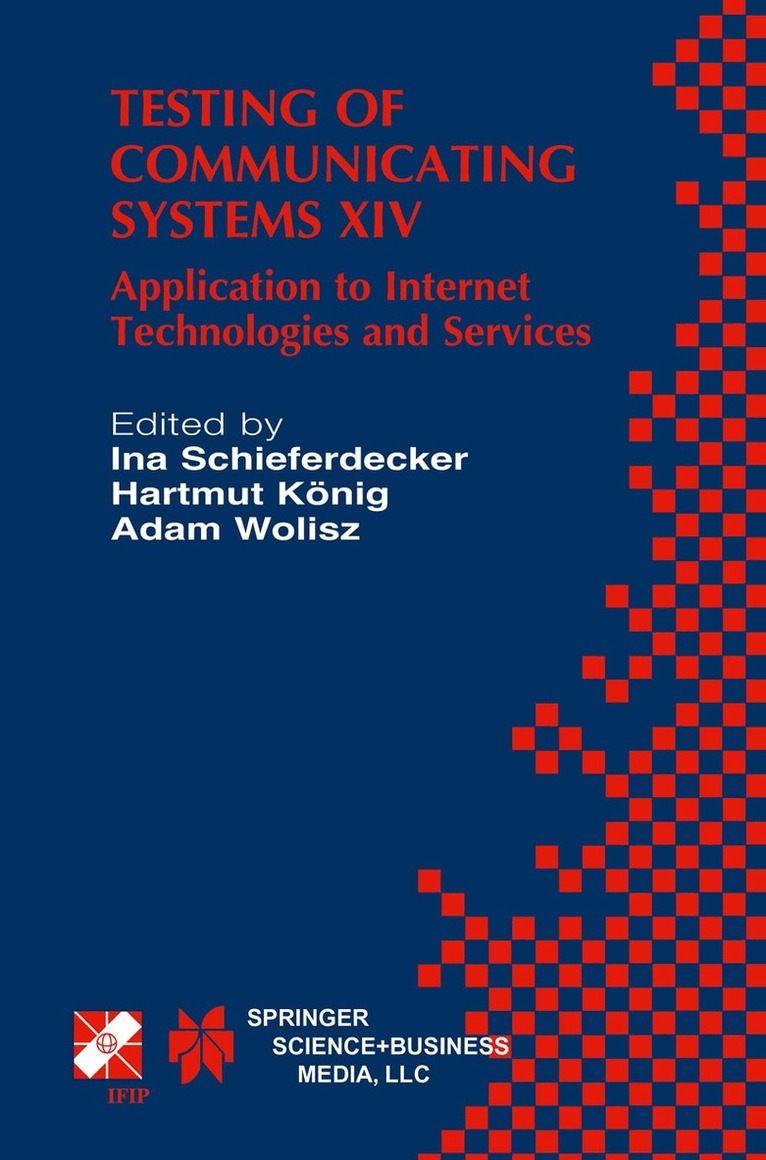
Testing of Communicating Systems XIV presents the latest international results in both the theory and industrial practice of the testing of communicating systems, ranging from tools and techniques for testing to test standards, frameworks, notations, algorithms, fundamentals of testing, and industrial experiences and issues. The tools and techniques discussed apply to conformance testing, interoperability testing, performance testing, Internet protocols and applications, and multimedia and distributed systems in general. The topics covered in this volume include: + Testing TCP/IP; + Testing Internet systems; + Interoperability testing; + Test automation; + Test generation and selection; + Testing distributed systems; + FSM-based testing; + Applications of TTCN-3; and + Industrial sessions. This volume contains the papers presented at the 14th International Conference on Testing of Communicating Systems (TestCom 2002), which was sponsored by the International Federation for Information Processing (IFIP) and held in Berlin, Germany, in March 2002. The conference program presents the state of the art in research concerning the testing of communicating systems.This is an important research area in the development of computer networks and distributed applications where much activity is currently in progress. The TestCom series of conferences is one of the main international forums where these important findings are reported. Testing of Communicating Systems XIV is essential reading for engineers, designers, managers of IT products and services, and all researchers interested in advancing the technology of engineering Internet frameworks, systems, services, and applications for reliability and quality.
Inbunden, Engelska, 1999
1 653 kr
Skickas inom 10-15 vardagar
Mastering interoperability in a computing environment consisting of different operating systems and hardware architectures is a key requirement which faces system engineers building distributed information systems. Distributed applications are a necessity in most central application sectors of the contemporary computerized society, for instance, in office automation, banking, manufacturing, telecommunication and transportation. This book focuses on the techniques available or under development, with the goal of easing the burden of constructing reliable and maintainable interoperable information systems. The topics covered in this book include: management of distributed systems; frameworks and construction tools; open architectures and interoperability techniques; experience with platforms like CORBA and RMI; language interoperability (e.g. Java); agents and mobility; quality of service and fault tolerance; workflow and object modelling issues; and electronic commerce. The book contains the proceedings of the International Working Conference on Distributed Applications and Interoperable Systems II (DAIS'99), which was held June 28-July 1, 1999 in Helsinki, Finland.It was sponsored by the International Federation of Information Processing (IFIP). The conference programme presents the state of the art in research concerning distributed and interoperable systems. This is a topical research area where much activity is in progress. Interesting new aspects and innovative contributions are still arising regularly. The DAIS series of conferences is one of the main international forums where these important findings are reported.
644 kr
Skickas inom 5-8 vardagar
Del 15 - IFIP Advances in Information and Communication Technology
Distributed Applications and Interoperable Systems II
IFIP TC6 WG6.1 Second International Working Conference on Distributed Applications and Interoperable Systems (DAIS’99)June 28–July 1, 1999, Helsinki, Finland
Häftad, Engelska, 2013
1 653 kr
Skickas inom 10-15 vardagar
Mastering interoperability in a computing environment consisting of different operating systems and hardware architectures is a key requirement which faces system engineers building distributed information systems. Distributed applications are a necessity in most central application sectors of the contemporary computerized society, for instance, in office automation, banking, manufacturing, telecommunication and transportation. This book focuses on the techniques available or under development, with the goal of easing the burden of constructing reliable and maintainable interoperable information systems. The topics covered in this book include: Management of distributed systems; Frameworks and construction tools; Open architectures and interoperability techniques; Experience with platforms like CORBA and RMI; Language interoperability (e.g. Java); Agents and mobility; Quality of service and fault tolerance; Workflow and object modelling issues; and Electronic commerce. The book contains the proceedings of the International Working Conference on Distributed Applications and Interoperable Systems II (DAIS'99), which was held June 28-July 1, 1999 in Helsinki, Finland. It was sponsored by the International Federation of Information Processing (IFIP). The conference program presents the state of the art in research concerning distributed and interoperable systems. This is a topical research area where much activity is currently in progress. Interesting new aspects and innovative contributions are still arising regularly. The DAIS series of conferences is one of the main international forums where these important findings are reported.
Engelska, 2013
625 kr
Skickas inom 5-8 vardagar
Häftad, Engelska, 2013
1 605 kr
Skickas inom 10-15 vardagar
Testing of Communicating Systems XIV presents the latest international results in both the theory and industrial practice of the testing of communicating systems, ranging from tools and techniques for testing to test standards, frameworks, notations, algorithms, fundamentals of testing, and industrial experiences and issues. The tools and techniques discussed apply to conformance testing, interoperability testing, performance testing, Internet protocols and applications, and multimedia and distributed systems in general.
Del 35 - Informatik, Kybernetik, Rechentechnik
Kommunikationsprotokolle
Inbunden, Tyska, 1990
2 200 kr
Skickas inom 3-6 vardagar
Inbunden, Tyska, 2017
280 kr
Skickas inom 3-6 vardagar
Häftad, Tyska, 2003
455 kr
Skickas inom 10-15 vardagar
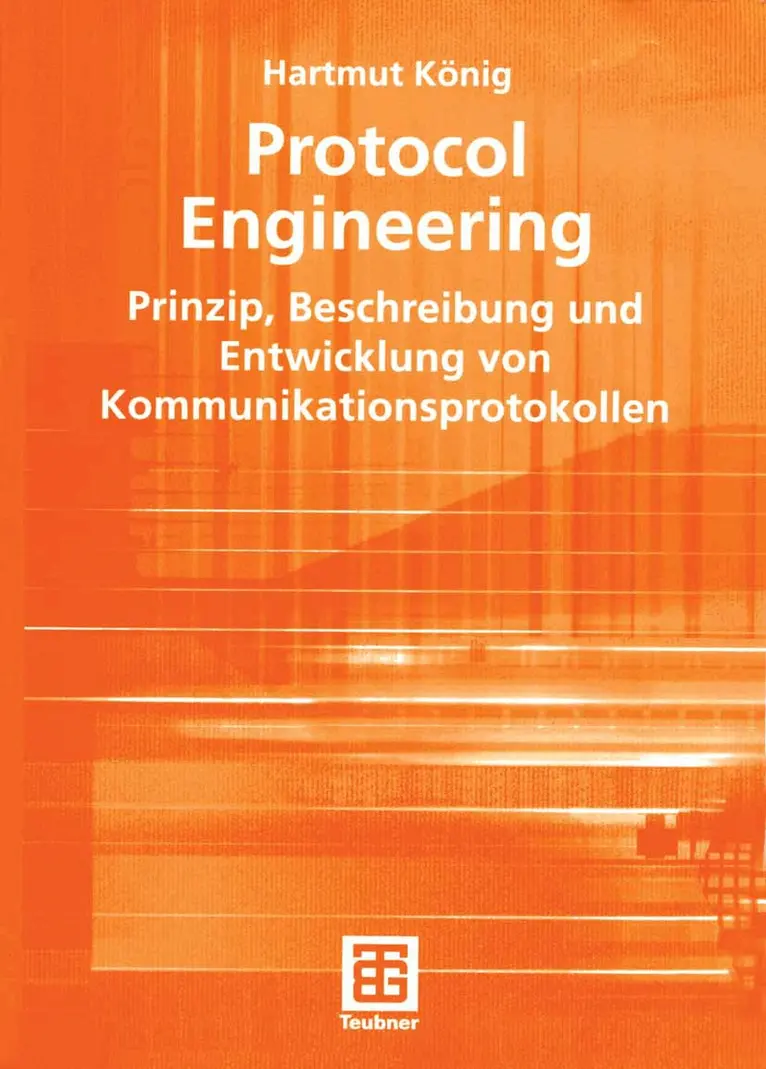
Das Buch fuhrt in die Grundlagen des Protocol Engineerings ein. Es stellt die Funktionsweise von Kommunikationsprotokollen, die Methoden und Techniken fur ihre Beschreibung sowie die Phasen der Protokollentwicklung vor. Es werden sowohl praktische als auch theoretische Aspekte des Protocol Engineerings untersucht.
Häftad, Engelska, 2003
556 kr
Skickas inom 10-15 vardagar
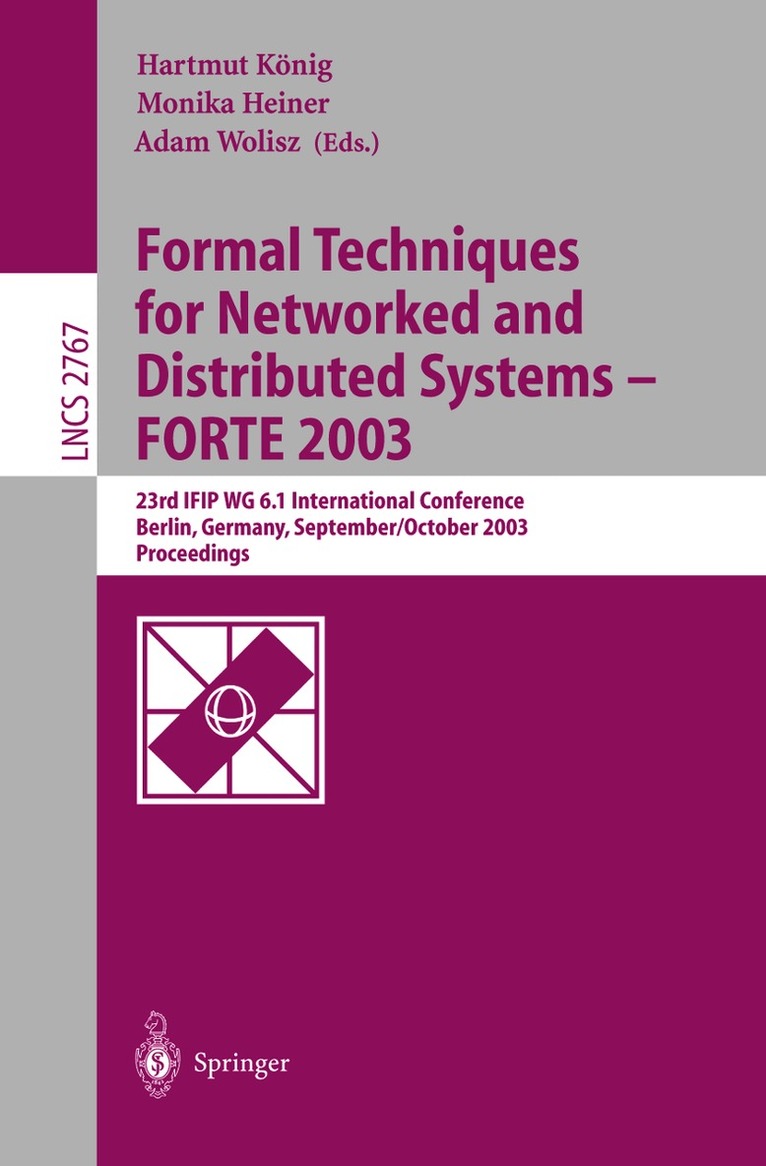
This book constitutes the refereed proceedings of the 23rd IFIP WG 6.1 International Conference on Formal Techniques for Networked and Distributed Systems, FORTE 2003, held in Berlin, Germany in September/October 2003.The 24 revised full papers presented together with 3 invited papers were carefully reviewed and selected from 55 submissions. The papers are organized in topical sections on application of formal description techniques (FDTs), verification, timed automata, verification of security protocols, testing, and FDT-based design.
Inbunden, Engelska, 2012
885 kr
Skickas inom 10-15 vardagar
Communication protocols form the operational basis of computer networks and telecommunication systems. They are behavior conventions that describe how communication systems interact with each other, defining the temporal order of the interactions and the formats of the data units exchanged – essentially they determine the efficiency and reliability of computer networks. Protocol Engineering is an important discipline covering the design, validation, and implementation of communication protocols.Part I of this book is devoted to the fundamentals of communication protocols, describing their working principles and implicitly also those of computer networks. The author introduces the concepts of service, protocol, layer, and layered architecture, and introduces the main elements required in the description of protocols using a model language. He then presents the most important protocol functions. Part II deals with the description of communication protocols, offering an overview of the various formal methods, the essence of Protocol Engineering. The author introduces the fundamental description methods, such as finite state machines, Petri nets, process calculi, and temporal logics, that are in part used as semantic models for formal description techniques. He then introduces one representative technique for each of the main description approaches, among others SDL and LOTOS, and surveys the use of UML for describing protocols. Part III covers the protocol life cycle and the most important development stages, presenting the reader with approaches for systematic protocol design, with various verification methods, with the main implementation techniques, and with strategies for their testing, in particular with conformance and interoperability tests, and the test description language TTCN. The author uses the simple data transfer example protocol XDT (eXample Data Transfer) throughout the book as a reference protocolto exemplify the various description techniques and to demonstrate important validation and implementation approaches.The book is an introduction to communication protocols and their development for undergraduate and graduate students of computer science and communication technology, and it is also a suitable reference for engineers and programmers. Most chapters contain exercises, and the author's accompanying website provides further online material including a complete formal description of the XDT protocol and an animated simulation visualizing its behavior.
Häftad, Engelska, 2014
885 kr
Skickas inom 10-15 vardagar
Communication protocols form the operational basis of computer networks and telecommunication systems. They are behavior conventions that describe how communication systems interact with each other, defining the temporal order of the interactions and the formats of the data units exchanged – essentially they determine the efficiency and reliability of computer networks. Protocol Engineering is an important discipline covering the design, validation, and implementation of communication protocols.Part I of this book is devoted to the fundamentals of communication protocols, describing their working principles and implicitly also those of computer networks. The author introduces the concepts of service, protocol, layer, and layered architecture, and introduces the main elements required in the description of protocols using a model language. He then presents the most important protocol functions. Part II deals with the description of communication protocols, offering an overview of the various formal methods, the essence of Protocol Engineering. The author introduces the fundamental description methods, such as finite state machines, Petri nets, process calculi, and temporal logics, that are in part used as semantic models for formal description techniques. He then introduces one representative technique for each of the main description approaches, among others SDL and LOTOS, and surveys the use of UML for describing protocols. Part III covers the protocol life cycle and the most important development stages, presenting the reader with approaches for systematic protocol design, with various verification methods, with the main implementation techniques, and with strategies for their testing, in particular with conformance and interoperability tests, and the test description language TTCN. The author uses the simple data transfer example protocol XDT (eXample Data Transfer) throughout the book as a reference protocolto exemplify the various description techniques and to demonstrate important validation and implementation approaches.The book is an introduction to communication protocols and their development for undergraduate and graduate students of computer science and communication technology, and it is also a suitable reference for engineers and programmers. Most chapters contain exercises, and the author's accompanying website provides further online material including a complete formal description of the XDT protocol and an animated simulation visualizing its behavior.