Harvey J. Greenberg – författare
Visar alla böcker från författaren Harvey J. Greenberg. Handla med fri frakt och snabb leverans.
4 produkter
4 produkter
Inbunden, Engelska, 2004
1 114 kr
Skickas inom 10-15 vardagar
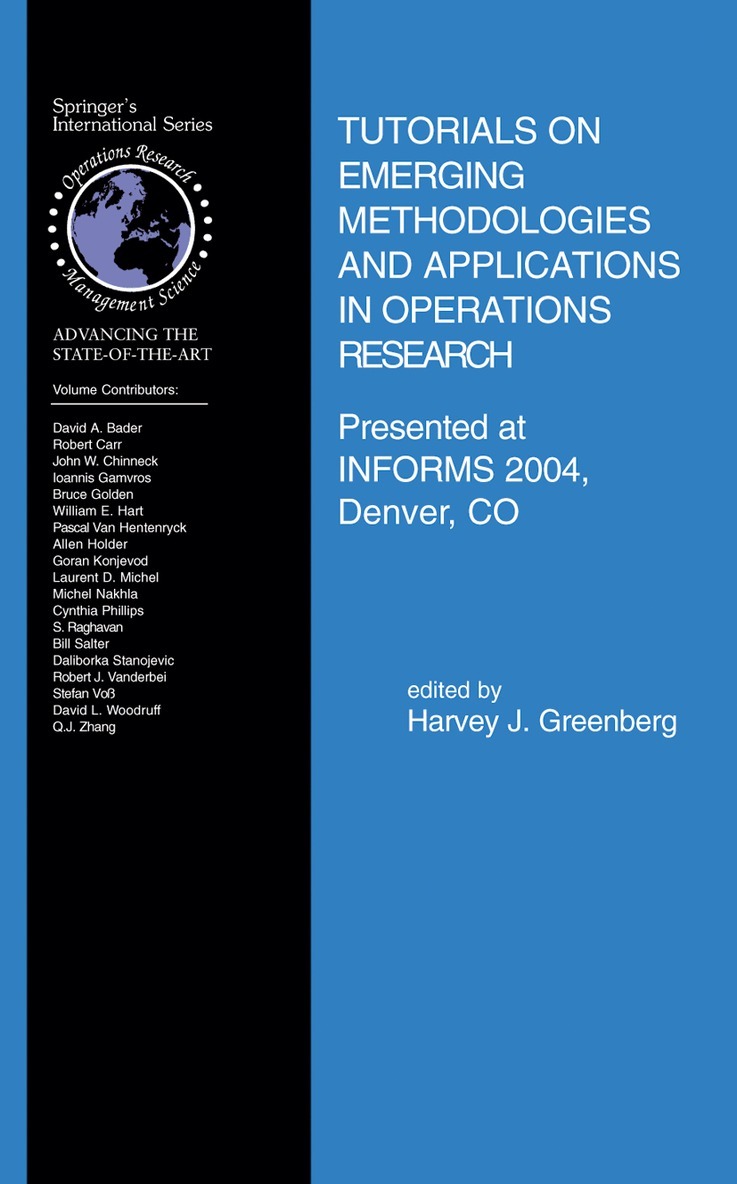
The primary purpose of Tutorials on Emerging Methodologies and Applications in Operations Research is to provide a reference for practitioners and academics who seek a clear, concise presentation of developing methodologies, hence providing themselves with the capability to apply these methods to new problems. The field of Operations Research is always changing. Its changes are driven by the technology it uses and that it extends, and the applications that it affects. Relevant changes in the field have a permanent effect on the conduct of OR and are vital to anyone who wants to be current in the field. Each chapter presents a new developing methodology in Operations Research. Each chapter examines each topic with clarity and depth, and organizes the examination around the following questions: (1) What the developing methodology basically is about? (2) Why is it important? and (3) Where can I learn more?
E-bok
PDF, Engelska, 20061 367 kr
Läs direkt efter köp
This volume reflects the theme of the INFORMS 2004 Meeting in Denver: Back to OR Roots. Emerging as a quantitative approach to problem-solving in World War II, our founders were physicists, mathematicians, and engineers who quickly found peace-time uses. It is fair to say that Operations Research (OR) was born in the same incubator as computer science, and it has spawned many new disciplines, such as systems engineering, health care management, and transportation science. Although people from many disciplines routinely use OR methods, many scientific researchers, engineers, and others do not understand basic OR tools and how they can help them. Disciplines ranging from finance to bioengineering are the beneficiaries of what we do — we take an interdisciplinary approach to problem-solving. Our strengths are modeling, analysis, and algorithm design. We provide a quanti- tive foundation for a broad spectrum of problems, from economics to medicine, from environmental control to sports, from e-commerce to computational - ometry. We are both producers and consumers because the mainstream of OR is in the interfaces. As part of this effort to recognize and extend OR roots in future probl- solving, we organized a set of tutorials designed for people who heard of the topic and want to decide whether to learn it. The 90 minutes was spent addre- ing the questions: What is this about, in a nutshell? Why is it important? Where can I learn more? In total, we had 14 tutorials, and eight of them are published here.
Häftad, Engelska, 2010
1 512 kr
Skickas inom 10-15 vardagar
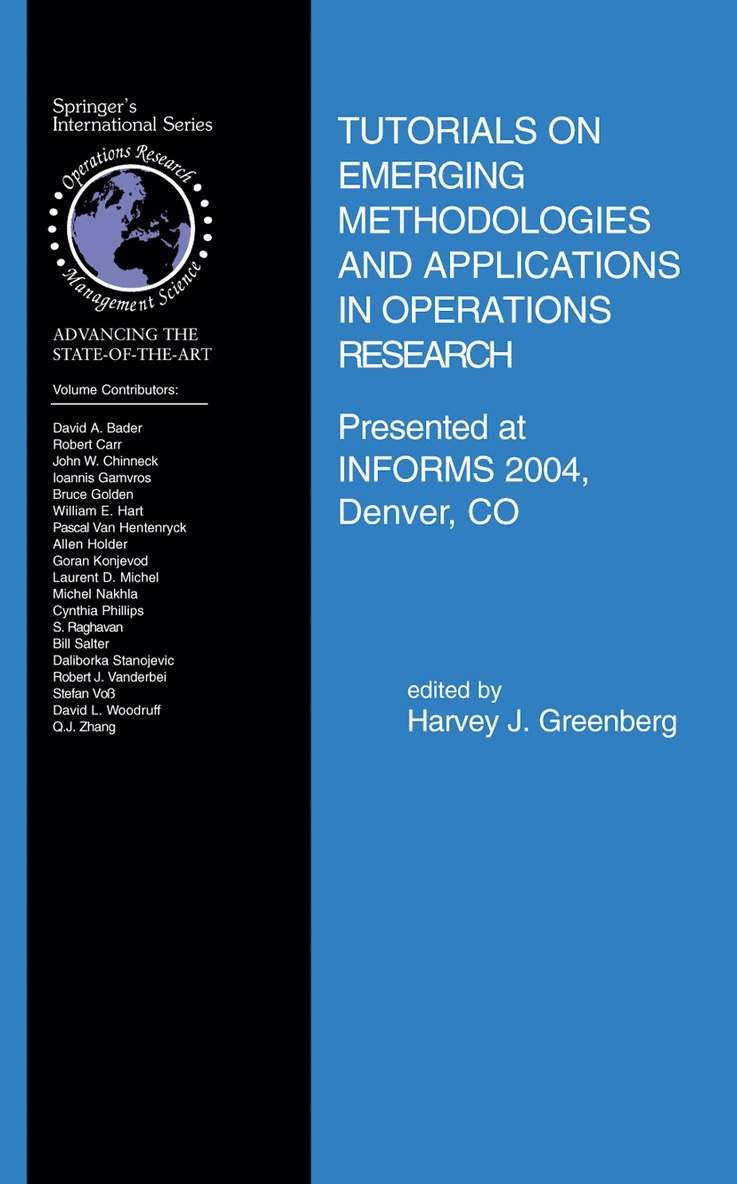
The primary purpose of Tutorials on Emerging Methodologies and Applications in Operations Research is to provide a reference for practitioners and academics who seek a clear, concise presentation of developing methodologies, hence providing themselves with the capability to apply these methods to new problems. The field of Operations Research is always changing. Its changes are driven by the technology it uses and that it extends, and the applications that it affects. Relevant changes in the field have a permanent effect on the conduct of OR and are vital to anyone who wants to be current in the field. Each chapter presents a new developing methodology in Operations Research. Each chapter examines each topic with clarity and depth, and organizes the examination around the following questions: (1) What the developing methodology basically is about? (2) Why is it important? and (3) Where can I learn more?
E-bok
PDF, Engelska, 2014988 kr
Läs direkt efter köp
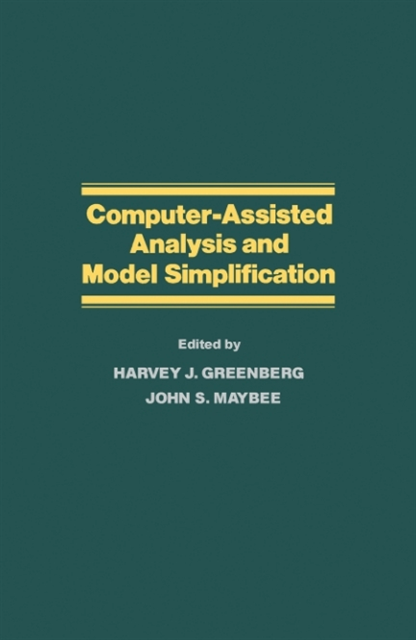
Computer-Assisted Analysis and Model Simplification deals with problems associated with the implementation, understanding, and management of large-scale, computer-resident models. This book focuses on five general research areas—structural modeling, qualitative economics, mathematical programming systems, relational databases, and combinatorics. In these topics, this compilation discusses the scope of computer-assisted analysis and model, structural models and graph theory, and qualitative stability of matrices and economic theory. The strong sign-solvability and weak satisfiability, automatic identification of embedded structure in large-scale optimization models, and query systems for linear programming models are also deliberated. This publication is a good source for students, specialists, and researchers interested in computer-assisted analysis and model simplification.