Harvey P. Mandel - Böcker
Visar alla böcker från författaren Harvey P. Mandel. Handla med fri frakt och snabb leverans.
5 produkter
5 produkter
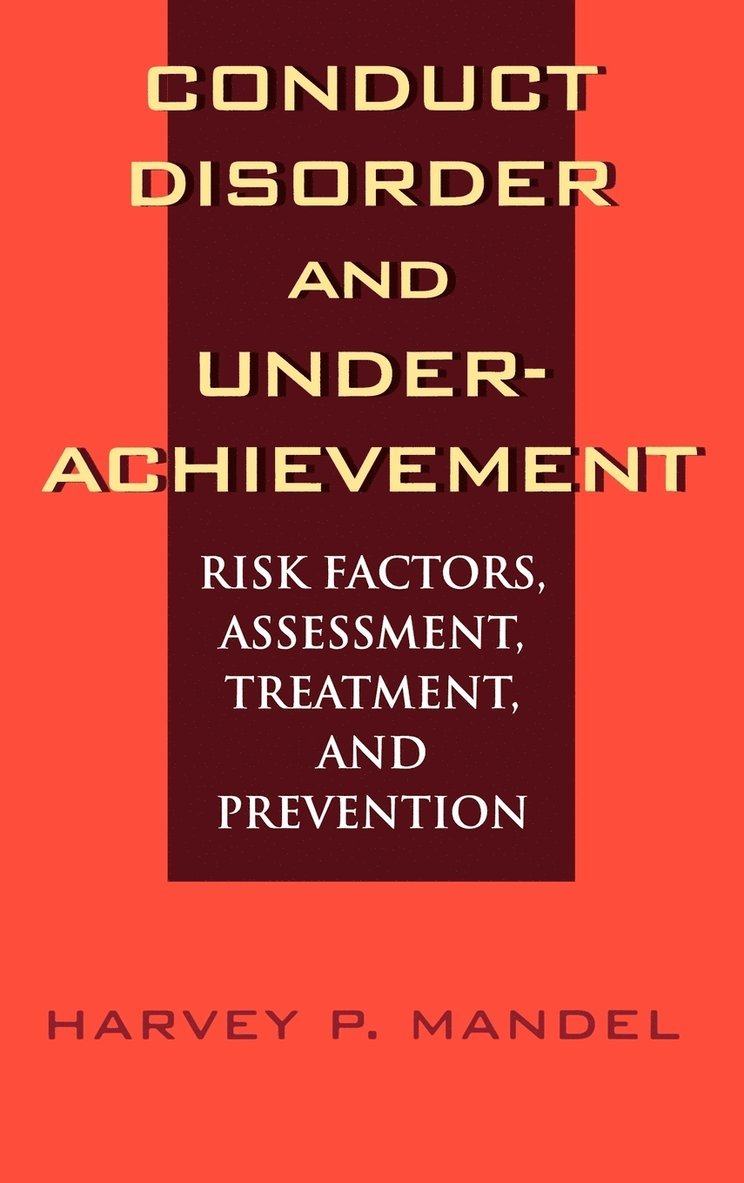
Conduct Disorder and Underachievement
Risk Factors, Assessment, Treatment, and Prevention
Inbunden, Engelska, 1997
1 745 kr
Skickas inom 7-10 vardagar
conduct disorder and under-achievement The young people who are the subject of this book are responsiblefor a disproportionate amount of difficulty for society. They arethe chronic rule-breakers and bullies. They may threaten,intimidate, manipulate, steal, and use violence to get what theywant. Many are drug abusers and drug dealers. Most have problems with self-control and self-discipline. Nearlyall of them are academic underachievers. Unfortunately, they arealso incredibly resistant to psychological intervention. Exhibitinga range of behaviors grouped under the DSM rubric "ConductDisorder," these children and adolescents are legion and theirnumbers continue to grow at an alarming rate. In Conduct Disorder and Underachievement, a leading authority on CDunderachievers explores the causes, assessment, treatment, andprevention of disruptive behavioral problems in underachievingchildren and adolescents. He summarizes many of the assessmenttools developed for CD underachievers and provides a unique,comprehensive risk-factor model which can be used to help identifydisorder problems before they occur. And, perhaps most importantly,he describes a dynamic cognitive/developmental treatment modelwhich has proven to be extraordinarily successful with certaintypes of CD underachievers. Conduct Disorder and Underachievement offers new hope for findingpsychological solutions to one of today's most pressing socialproblems. Much has been unearthed in recent years about the origins anddevelopment of conduct disorder (CD) in children and adolescents.Yet there is still considerable disagreement about the roleacademic underachievement plays in CD. Is underachievement acontributing factor to or a result of CD? While the jury is stillout on this issue, one thing is certain: eventually, therelationship between them becomes a dialectical one--bad grades andantisocial behavior usually go hand in hand. Can this seeminglyfacile observation provide the basis for interventions with certaintypes of conduct disorders? In Conduct Disorder andUnderachieve-ment, a leading authority on underachievement answersthat question with a resounding "Yes" and demonstrates how. Dr. Mandel begins with a thorough review of the latest researchfindings on the etiology, assessment, and treatment of conductdisorder in children and adolescents. From there, the focus narrowsto issues of CD underachievement. While most forms of conductdisorder and underachievement are discussed, the clinical emphasisis on less severely disturbed children for whom underachievement isstill manageable but, if left unchecked, can lead to more severeconduct problems. Through the window of two case histories completewith test results and diagnostic interviews, Dr. Mandel exploresthe full range of assessment issues, critically examinespredominant treatment strategies, and provides helpful preventionguidelines. In the prescriptive portion of the book, the author delineates acognitively oriented approach to treating CD underachievers. Heespouses a treatment strategy based on the assumption that, fromone case to the next, underachievement may either contribute to orresult from conduct disorder. The most constructive approach,therefore, is to reconstruct the unfolding of individual scenariosand then determine what can be done to mend fractured developmentalpathways. Through a series of therapy excerpts which take thereader inside a treatment session, Dr. Mandel brings to vivid lifethe issues that must be dealt with, the struggles that must beovercome, and the complex interactions that develop between childand therapist during therapeutic intervention. Combining a comprehensive review of the latest findings with adynamic new approach to intervention, Conduct Disorder andUnderachievement is a valuable resource for mental healthprofessionals, guidance counselors, and educators who deal withthis increasingly common problem.
326 kr
Skickas inom 5-8 vardagar
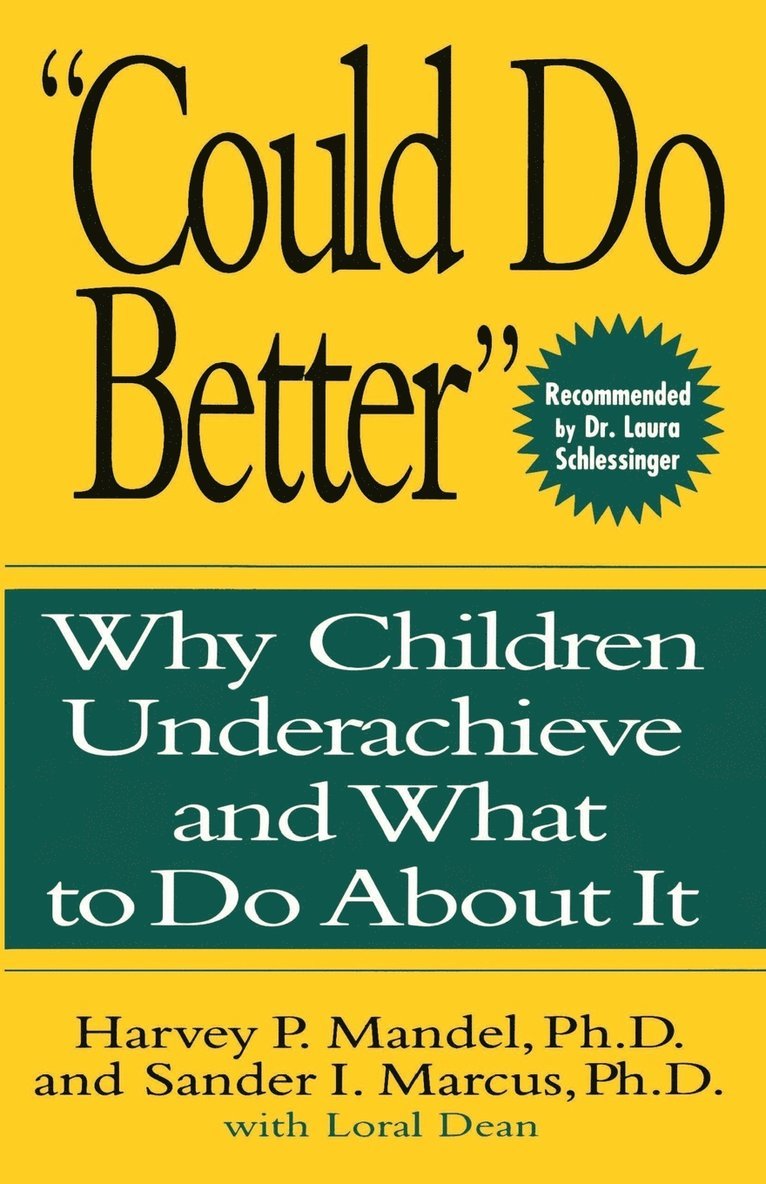
I know my son is bright. . . . why doesn't he care about school? Why is he so lazy and unmotivated? My daughter is . . . so unmotivated. How can I make her want to do better?In this lifesaving, groundbreaking book, Drs. Mandel and Marcus, clinical psychologists with more than 25 years' experience working with underachievers, show that these children are, in fact, highly motivated—in directions other than schoolwork. The key to helping underachievers reach their full potential lies in discovering their real motivation and redirecting it.But first, say the authors, you must abandon conventional wisdom; underachievers are not all alike. "Could Do Better" identifies six major underachieving personalities and includes step-by-step programs tailored to help each. Learn how to recognize which kind of underachiever your child is—the procrastinating Coaster, the distracted Identity-Searcher, the manipulative Wheeler-Dealer are just a few of the most recognizable personalities—and discover what's really going on inside his or her mind. The information is revealing, the expectations realistic. Useful parent checklists are included in each section, along with practical guidelines for when you can hope to see change, and illuminating profiles of the six personalities as adults should the underachieving continue unchecked. "Could Do Better" also addresses the specific underachievement problems of gifted and learning disabled children.A breakthrough approach to helping children realize their full potential, "Could Do Better" speaks urgently to the millions of parents deeply concerned about how to prepare their child for a competitive, achievement-oriented world, as well as to everyone who works with underachievers.IS ONE OF THESE UNDERACHIEVERS YOUR CHILD?COASTERS: the ultimate procrastinators, usually described as easy-going and unmotivated, the most common type of underachieverANXIOUS UNDERACHIEVERS: want to do better but are too tense and uptight to work effectivelyIDENTITY-SEARCHERS: so wrapped up in figuring out who they are that they become distracted from schoolworkWHEELER-DEALERS: impulsive and manipulative, so intent on instant gratification that they see no point in doing well in schoolSAD UNDERACHIEVERS: their depressed mood and low self-esteem rob them of the energy they need for schoolworkDEFIANT UNDERACHIEVERS: underachieve as an act of rebellionHelp redirect your child's motivation. "Could Do Better" offers a revolutionary new approach conceived by leading authorities in the field. Their step-by-step techniques show you how to put your child back on the achievement track.PRAISE FOR THE AUTHORS' PREVIOUS BOOK"Thought-provoking, practical information."—Marianne M. O'Hare, Drew University"Particularly excellent and detailed remediation procedures.... Mandel and Marcus are to be applauded." —Dr. Jane H. Hamacher — in The Ontario Psychologist
207 kr
Skickas inom 5-8 vardagar
I know my son is bright. . . . why doesn't he care about school? Why is he so lazy and unmotivated? My daughter is . . . so unmotivated. How can I make her want to do better?In this lifesaving, groundbreaking book, Drs. Mandel and Marcus, clinical psychologists with more than 25 years' experience working with underachievers, show that these children are, in fact, highly motivated—in directions other than schoolwork. The key to helping underachievers reach their full potential lies in discovering their real motivation and redirecting it.But first, say the authors, you must abandon conventional wisdom; underachievers are not all alike. "Could Do Better" identifies six major underachieving personalities and includes step-by-step programs tailored to help each. Learn how to recognize which kind of underachiever your child is—the procrastinating Coaster, the distracted Identity-Searcher, the manipulative Wheeler-Dealer are just a few of the most recognizable personalities—and discover what's really going on inside his or her mind. The information is revealing, the expectations realistic. Useful parent checklists are included in each section, along with practical guidelines for when you can hope to see change, and illuminating profiles of the six personalities as adults should the underachieving continue unchecked. "Could Do Better" also addresses the specific underachievement problems of gifted and learning disabled children.A breakthrough approach to helping children realize their full potential, "Could Do Better" speaks urgently to the millions of parents deeply concerned about how to prepare their child for a competitive, achievement-oriented world, as well as to everyone who works with underachievers.IS ONE OF THESE UNDERACHIEVERS YOUR CHILD?COASTERS: the ultimate procrastinators, usually described as easy-going and unmotivated, the most common type of underachieverANXIOUS UNDERACHIEVERS: want to do better but are too tense and uptight to work effectivelyIDENTITY-SEARCHERS: so wrapped up in figuring out who they are that they become distracted from schoolworkWHEELER-DEALERS: impulsive and manipulative, so intent on instant gratification that they see no point in doing well in schoolSAD UNDERACHIEVERS: their depressed mood and low self-esteem rob them of the energy they need for schoolworkDEFIANT UNDERACHIEVERS: underachieve as an act of rebellionHelp redirect your child's motivation. "Could Do Better" offers a revolutionary new approach conceived by leading authorities in the field. Their step-by-step techniques show you how to put your child back on the achievement track.PRAISE FOR THE AUTHORS' PREVIOUS BOOK"Thought-provoking, practical information."—Marianne M. O'Hare, Drew University"Particularly excellent and detailed remediation procedures.... Mandel and Marcus are to be applauded." —Dr. Jane H. Hamacher — in The Ontario Psychologist
Del 127 - Wiley Series on Personality Processes
Psychology of Underachievement
Differential Diagnosis and Differential Treatment
Inbunden, Engelska, 1988
3 044 kr
Skickas inom 7-10 vardagar
An integrated approach to the psychology of underachievement, unifying theory and practice. Examines different types of underachievers, explores the relationship between personality and underachievement, and provides useful guidelines for clinical practice. Provides an outline and summary of the voluminous (and often contradictory) literature, then presents theoretical models of the underachiever that are grounded in mainstream diagnostic and therapeutic theory. Offers examples of each personality type, so practitioners can easily recognize and treat them.
Short-Term Psychotherapy and Brief Treatment Techniques
An Annotated Bibliography 1920–1980
Häftad, Engelska, 2012
536 kr
Skickas inom 10-15 vardagar
The Scope of Brief Therapy Within the last two decades there has been a dramatic expansion in the uses of short-term treatment (Grayson, 1979, Small, 1979). Brief therapies have been and continue to be widely used with a number of different patient popu lations in a broad variety of service settings. They have been reported in use with children, adolescents, adults~ and the aged; in groups, families, and individual treatment; on college campuses, high schools, in community mental health centers, in child guidance clinics, in private psychiatric clinics, in hospitals as part of out-patient or in-patient therapy, in programs of preventive community mental health; with the rich, the middle class, and the poor (Barten, 1971, 1972; Caplan, 1961, 1964; Small, 1979; Wolberg, 1965). Further, short term methods of therapy range across all of the major and well-known theoretical orientations found in the broader field of psychotherapy. There are some unique theoretical contributions which can be found within this field as well.