He Bian - Böcker
Visar alla böcker från författaren He Bian. Handla med fri frakt och snabb leverans.
3 produkter
3 produkter
Del 143 - Harvard-Yenching Institute Monograph Series
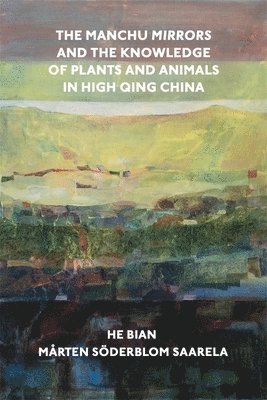
Manchu Mirrors and the Knowledge of Plants and Animals in High Qing China
Inbunden, Engelska, 2025
517 kr
Skickas inom 7-10 vardagar
As the territory of Qing China expanded, so evolved the ways in which birds, beasts, fish, trees, and flowers came to be known in the multilingual empire. The Manchu Mirrors and the Knowledge of Plants and Animals in High Qing China is the first systematic study of how the Qing court sought to codify Manchu and Chinese words for animals and plants throughout the eighteenth century, with a particular focus on Manchurian and other Inner Asian species. Calling for renewed attention to Manchu dictionaries as an important source for Qing intellectual and cultural history, Bian and Söderblom Saarela show how Qing lexicographical practices embodied major revisions to the Chinese encyclopedic tradition, realigned the relationship between words and things, and left a lasting impact on natural historical scholarship in the modern era. The updated form of Chinese learning, along with the malleable lexicon of the Manchu language, proved useful for the Manchu elite in displaying the reach and intellectual depth of Qing imperial power. Manchu was transformed from the language of a single people into the lexicographic façade for an imperial order of things.
437 kr
Skickas inom 7-10 vardagar
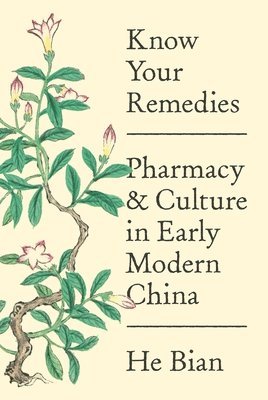
A cultural history of the concept of pharmacy, both the material nature of drugs and the trade in medicine, in early modern China Know Your Remedies presents a panoramic inquiry into China’s early modern cultural transformation through the lens of pharmacy. In the history of science and civilization in China, pharmacy—as a commercial enterprise and as a branch of classical medicine—resists easy characterization. While China’s long tradition of documenting the natural world through state-commissioned pharmacopeias, known as bencao, dwindled after the sixteenth century, the ubiquitous presence of Chinese pharmacy shops around the world today testifies to the vitality of Traditional Chinese Medicine. Rejecting narratives of intellectual stagnation or an unchanging folk culture, He Bian argues that pharmacy’s history in early modern China can best be understood as a dynamic interplay between elite and popular culture.Beginning with decentralizing trends in book culture and fiscal policy in the sixteenth century, Bian reveals pharmacy’s central role in late Ming public discourse. Fueled by factional politics in the early 1600s, amateur investigation into pharmacology reached peak popularity among the literati on the eve of the Qing conquest in the mid-seventeenth century. The eighteenth century witnessed a systematic reclassification of knowledge, as the Qing court turned away from pharmacopeia in favor of a demedicalized natural history. Throughout this time, growth in long-distance trade enabled the rise of urban pharmacy shops, generating new knowledge about the natural world.Bringing together a wealth of primary sources, Know Your Remedies makes an essential contribution to the study of Chinese history and the history of medicine.
283 kr
Skickas inom 7-10 vardagar
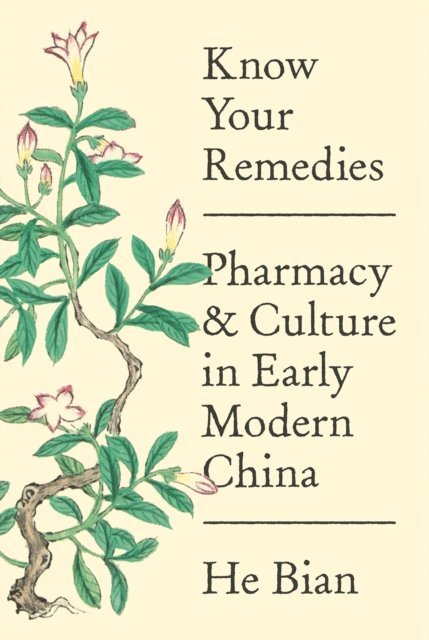
A cultural history of the concept of pharmacy, both the material nature of drugs and the trade in medicine, in early modern China Know Your Remedies presents a panoramic inquiry into China’s early modern cultural transformation through the lens of pharmacy. In the history of science and civilization in China, pharmacy—as a commercial enterprise and as a branch of classical medicine—resists easy characterization. While China’s long tradition of documenting the natural world through state-commissioned pharmacopeias, known as bencao, dwindled after the sixteenth century, the ubiquitous presence of Chinese pharmacy shops around the world today testifies to the vitality of Traditional Chinese Medicine. Rejecting narratives of intellectual stagnation or an unchanging folk culture, He Bian argues that pharmacy’s history in early modern China can best be understood as a dynamic interplay between elite and popular culture.Beginning with decentralizing trends in book culture and fiscal policy in the sixteenth century, Bian reveals pharmacy’s central role in late Ming public discourse. Fueled by factional politics in the early 1600s, amateur investigation into pharmacology reached peak popularity among the literati on the eve of the Qing conquest in the mid-seventeenth century. The eighteenth century witnessed a systematic reclassification of knowledge, as the Qing court turned away from pharmacopeia in favor of a demedicalized natural history. Throughout this time, growth in long-distance trade enabled the rise of urban pharmacy shops, generating new knowledge about the natural world.Bringing together a wealth of primary sources, Know Your Remedies makes an essential contribution to the study of Chinese history and the history of medicine.