Heather Moulaison-Sandy – författare
762 kr
Skickas inom 10-15 vardagar
405 kr
Läs direkt efter köp
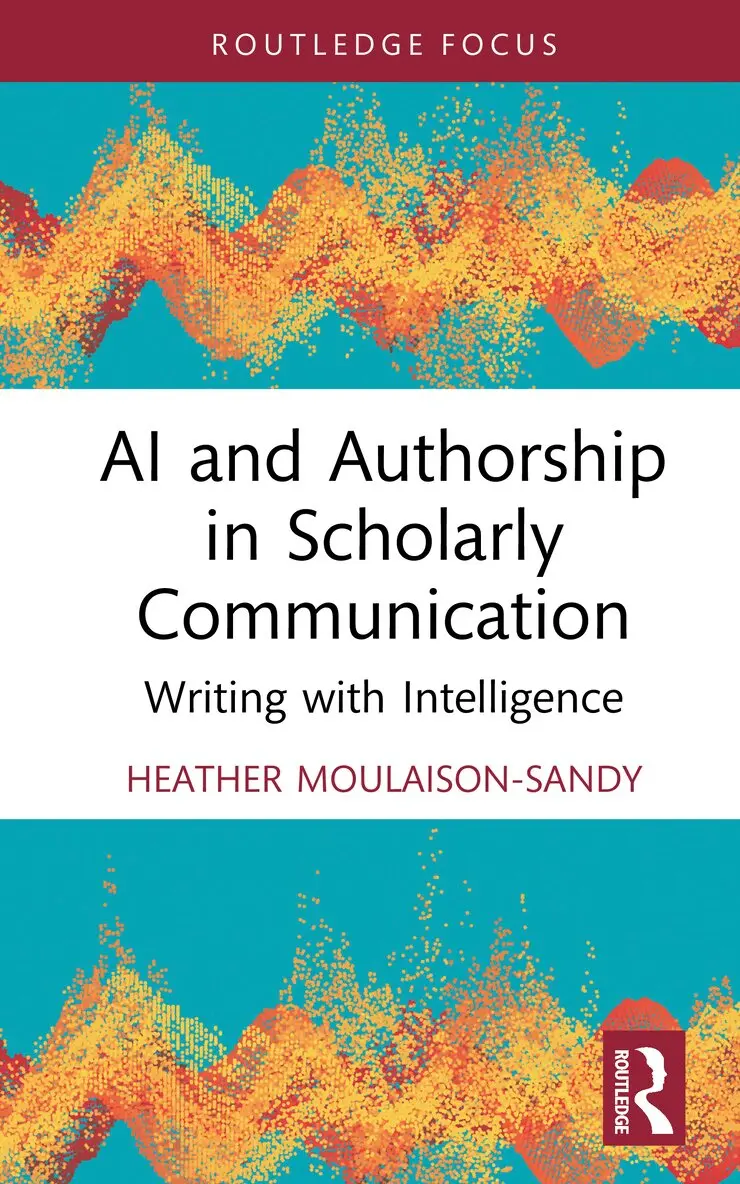
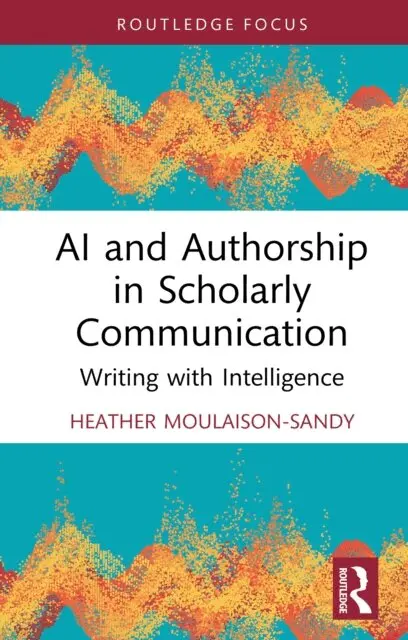
AI and Authorship in Scholarly Communication explores the role of artificial intelligence (AI) as it pertains to scholarly research and writing.
Explaining what AI is and how it can be used by scholars, the book also focuses on aspects with the potential to change the scholarly communication landscape. Bringing together research on AI and writing from the scholarly literature in LIS and beyond, the book weaves together information about essential topics relating to AI and authorship. In laying out the primary concerns surrounding AI in the field of scholarly communication, Moulaison-Sandy considers how those concerns map to norms and practices in research and writing. The book likewise explores the future landscape of scholarly communication, an environment in which AI will continue to play an important role.
AI and Authorship in Scholarly Communication will be of great interest to scholars, students, and practitioners and will be particularly useful to those studying AI or authorship from a library and information science (LIS) perspective. Researchers or practitioners working in higher education or with learning technologies will also find much to interest them within the pages of the book.
401 kr
Läs direkt efter köp
AI and Authorship in Scholarly Communication explores the role of artificial intelligence (AI) as it pertains to scholarly research and writing.
Explaining what AI is and how it can be used by scholars, the book also focuses on aspects with the potential to change the scholarly communication landscape. Bringing together research on AI and writing from the scholarly literature in LIS and beyond, the book weaves together information about essential topics relating to AI and authorship. In laying out the primary concerns surrounding AI in the field of scholarly communication, Moulaison-Sandy considers how those concerns map to norms and practices in research and writing. The book likewise explores the future landscape of scholarly communication, an environment in which AI will continue to play an important role.
AI and Authorship in Scholarly Communication will be of great interest to scholars, students, and practitioners and will be particularly useful to those studying AI or authorship from a library and information science (LIS) perspective. Researchers or practitioners working in higher education or with learning technologies will also find much to interest them within the pages of the book.
1 483 kr
Skickas inom 10-15 vardagar
946 kr
Skickas inom 10-15 vardagar
1 349 kr
Skickas inom 10-15 vardagar
430 kr
Skickas inom 5-8 vardagar
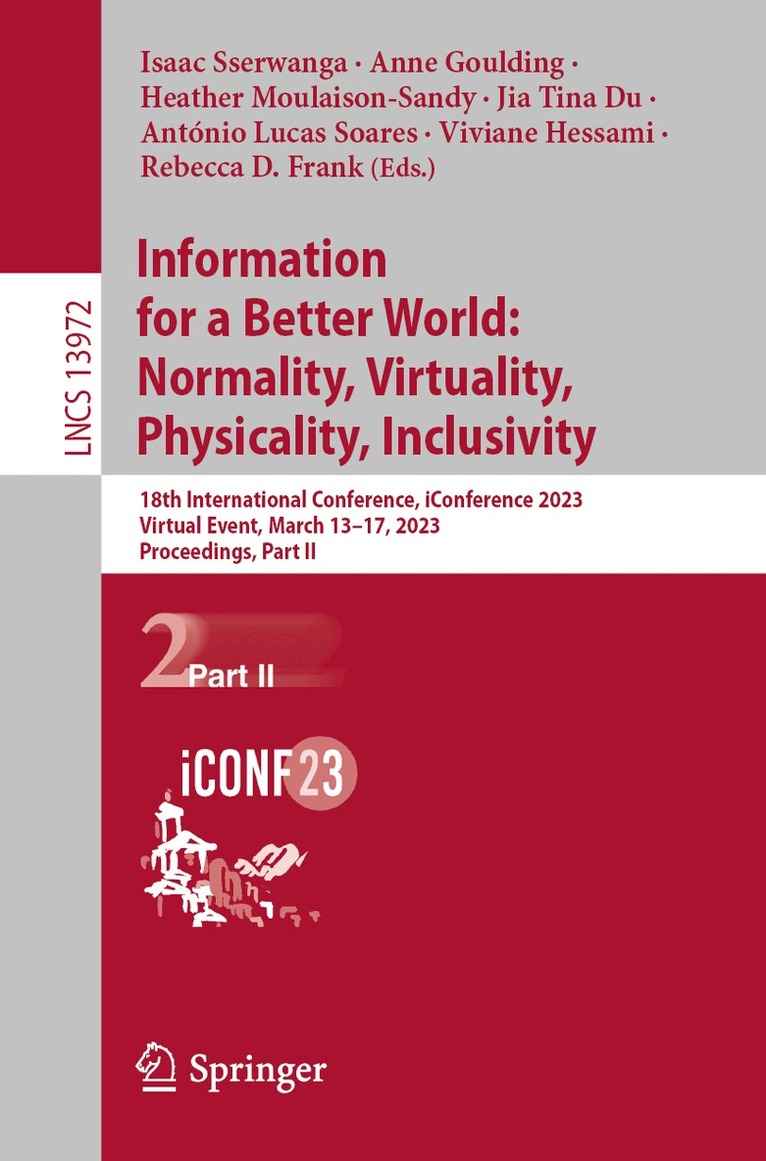
Information for a Better World: Normality, Virtuality, Physicality, Inclusivity
18th International Conference, iConference 2023, Virtual Event, March 13–17, 2023, Proceedings, Part II
1 114 kr
Skickas inom 10-15 vardagar
1 420 kr
Läs direkt efter köp
The 36 full papers and the 46 short papers presented in these proceedings were carefully reviewed and selected from 197 submissions. They cover topics such as: Archives and Records, Behavioral Research, Information Governance and Ethics, AI and Machine Learning, Data Science, Information and Digital literacy, Cultural Perspectives, Knowledge Management and Intellectual Capital, Social Media and Digital Networks, Libraries, Human-Computer Interaction and Technology, Information Retrieval, Community Informatics, and Digital Information Infrastructure.
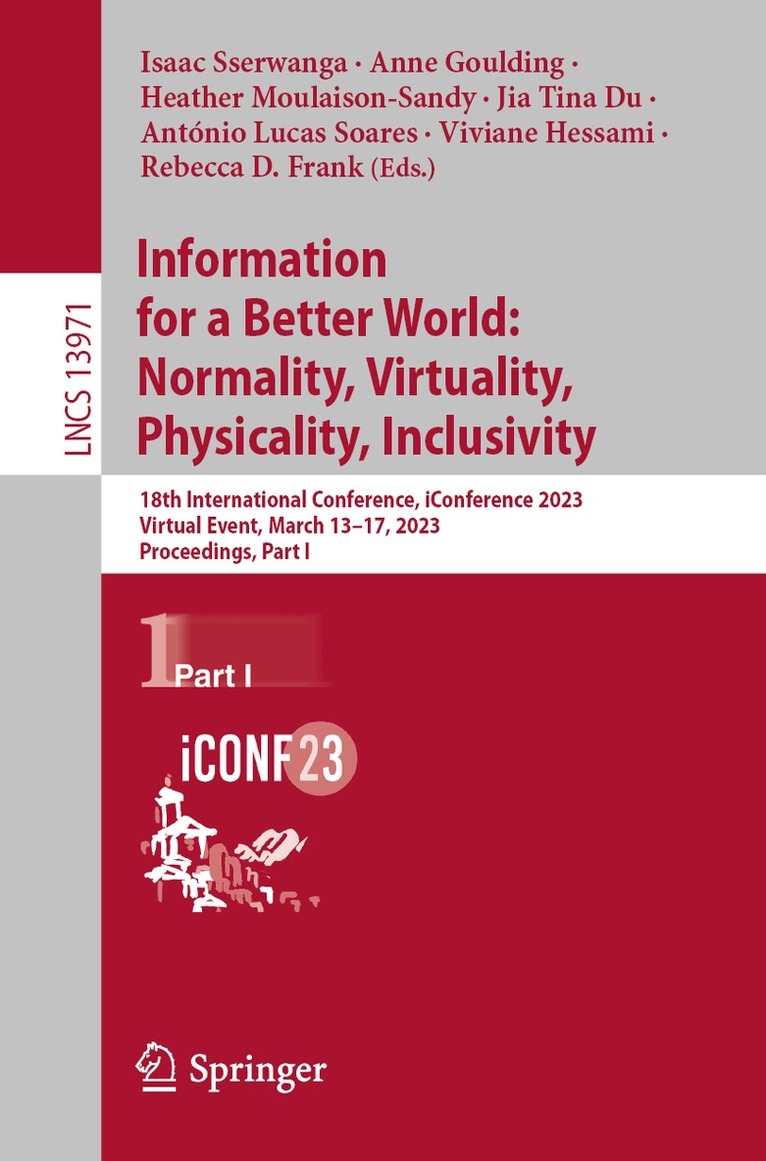
Information for a Better World: Normality, Virtuality, Physicality, Inclusivity
18th International Conference, iConference 2023, Virtual Event, March 13–17, 2023, Proceedings, Part I
974 kr
Skickas inom 10-15 vardagar
1 214 kr
Läs direkt efter köp
The 36 full papers and the 46 short papers presented in these proceedings were carefully reviewed and selected from 197 submissions. They cover topics such as: Archives and Records, Behavioral Research, Information Governance and Ethics, AI and Machine Learning, Data Science, Information and Digital literacy, Cultural Perspectives, Knowledge Management and Intellectual Capital, Social Media and Digital Networks, Libraries, Human-Computer Interaction and Technology, Information Retrieval, Community Informatics, and Digital Information Infrastructure.