Heide Imai - Böcker
Visar alla böcker från författaren Heide Imai. Handla med fri frakt och snabb leverans.
6 produkter
6 produkter
690 kr
Skickas inom 10-15 vardagar
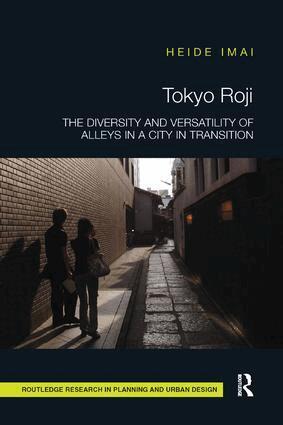
The Japanese urban alleyway, which was once part of people’s personal spatial sphere and everyday life has been transformed by diverse and competing interests. Marginalised through the emergence of new forms of housing and public spaces, re-appropriated by different fields, and re-invented by the contemporary urban design discourse, the social meaning attached to the roji is being re-interpreted by individuals, subcultures and new social movements. The book will introduce and discuss examples of urban practices which take place within the dynamic urban landscape of contemporary Tokyo to portray the life cycle of an urban form being rediscovered, commodified and lost as physical space.
629 kr
Skickas inom 10-15 vardagar
Asian Alleyways: An Urban Vernacular in Times of Globalization critically explores Global Asia and the metropolization process, specifically from its alleyways, which are understood as ordinary neighbourhood landscapes providing the setting for everyday urban life and place-based identities being shaped by varied everyday practices, collective experiences and forces. Beyond the mainstream, standardising vision of the metropolization process, Asian Alleyways offers a nuanced overview of urban production in Asia at a time of great changes, and will be welcomed by an array of scholars, students, and all those interested in the modern transformation of Asian cities and their urban cultures.
2 166 kr
Skickas inom 10-15 vardagar
The Japanese urban alleyway, which was once part of people’s personal spatial sphere and everyday life has been transformed by diverse and competing interests. Marginalised through the emergence of new forms of housing and public spaces, re-appropriated by different fields, and re-invented by the contemporary urban design discourse, the social meaning attached to the roji is being re-interpreted by individuals, subcultures and new social movements. The book will introduce and discuss examples of urban practices which take place within the dynamic urban landscape of contemporary Tokyo to portray the life cycle of an urban form being rediscovered, commodified and lost as physical space.
1 748 kr
Skickas inom 10-15 vardagar
This text critically explores Global Asia and the metropolization process, specifically from its alleyways, which are understood as ordinary neighbourhood landscapes providing the setting for everyday urban life and place-based identities being shaped by varied everyday practices, collective experiences and forces.
1 276 kr
Skickas inom 10-15 vardagar
This book focuses on overlooked contextual factors that constitute the urban creative climate or innovative urban milieu in contemporary cities. Filled with reflections based on interviews with a diverse range of creative actors in various local neighborhoods in Tokyo, it offers a rare glimpse into the complex set of elements that provide long-term, physical, and sociocultural support to urban creativity. Ursic and Imai highlight the interplay between physical and soft (social) factors in the process of place-making and explore how a city’s creativity is influenced by financial support and accessible infrastructure, as well as the sets of informal networks, services, and tacit, locally embedded knowledge that provide the basic layers of stimuli needed for creativity to fully develop. The authors show how the future development of creativity and the overall development of a city depend not only on the (top-down) planning strategies of formal authorities, but also on the appropriate (bottom-up) inclusion of heterogeneous elements that are provided and embedded within the small, hidden context of city spaces.
1 276 kr
Skickas inom 10-15 vardagar
This book focuses on overlooked contextual factors that constitute the urban creative climate or innovative urban milieu in contemporary cities. Filled with reflections based on interviews with a diverse range of creative actors in various local neighborhoods in Tokyo, it offers a rare glimpse into the complex set of elements that provide long-term, physical, and sociocultural support to urban creativity. Ursic and Imai highlight the interplay between physical and soft (social) factors in the process of place-making and explore how a city’s creativity is influenced by financial support and accessible infrastructure, as well as the sets of informal networks, services, and tacit, locally embedded knowledge that provide the basic layers of stimuli needed for creativity to fully develop. The authors show how the future development of creativity and the overall development of a city depend not only on the (top-down) planning strategies of formal authorities, but also on the appropriate (bottom-up) inclusion of heterogeneous elements that are provided and embedded within the small, hidden context of city spaces.