Heidi Byrnes – författare
Visar alla böcker från författaren Heidi Byrnes. Handla med fri frakt och snabb leverans.
11 produkter
Longitudinal Study of Advanced L2 Capacities
Av Lourdes Ortega, Heidi Byrnes
Häftad, 2010
955 kr
Lägg i varukorg
Researchers and educators routinely call for longitudinal research on language learning and teaching. The present volume explores the connection between longitudinal study and advanced language capacities, two under-researched areas, and proposes an agenda for future research. Five chapters probe …
Longitudinal Study of Advanced L2 Capacities
Av Lourdes Ortega, Heidi Byrnes
Inbunden, 2008
2594 kr
Lägg i varukorg
Researchers and educators routinely call for longitudinal research on language learning and teaching. The present volume explores the connection between longitudinal study and advanced language capacities, two under-researched areas, and proposes an agenda for future research. Five chapters probe …
Advanced Language Learning
The Contribution of Halliday and Vygotsky
Av Heidi Byrnes
Häftad, 2008
955 kr
Lägg i varukorg
This title examines the need for advanced levels of language learning from socio-cultural and linguistic perspectives.'The editor and authors in this volume make a convincing case for focusing on advanced foreign language instruction. Importantly, they invite consideration of this focus as an …
Advanced Language Learning
The Contribution of Halliday and Vygotsky
Inbunden, 2006
2189 kr
Lägg i varukorg
'The editor and authors in this volume make a convincing case for focusing on advanced foreign language instruction. Importantly, they invite consideration of this focus as an opportunity to re-examine conventional definitions of the target of instruction. In so doing, readers also learn more about …
Longitudinal Study of Advanced L2 Capacities
Av Heidi Byrnes, Lourdes Ortega
E-bok, 2009
1124 kr
Lägg i varukorg
Researchers and educators routinely call for longitudinal research on language learning and teaching. The present volume explores the connection between longitudinal study and advanced language capacities, two under-researched areas, and proposes an agenda for future research. Five chapters probe …
Longitudinal Study of Advanced L2 Capacities
Av Heidi Byrnes, Lourdes Ortega
E-bok, 2009
1099 kr
Lägg i varukorg
Researchers and educators routinely call for longitudinal research on language learning and teaching. The present volume explores the connection between longitudinal study and advanced language capacities, two under-researched areas, and proposes an agenda for future research. Five chapters probe …
Advanced Language Learning
The Contribution of Halliday and Vygotsky
Av Heidi Byrnes
E-bok, 2008
1043 kr
Lägg i varukorg
'The editor and authors in this volume make a convincing case for focusing on advanced foreign language instruction. Importantly, they invite consideration of this focus as an opportunity to re-examine conventional definitions of the target of instruction. In so doing, readers also learn more about …
Educating for Advanced Foreign Language Capacities
Constructs, Curriculum, Instruction, Assessment
Av Heidi Byrnes, Heather D. Weger m. fl.
Häftad, 2006
648 kr
Lägg i varukorg
Advanced language learning has only recently begun to capture the interest and attention of applied linguists and professionals in language education in the United States. In this breakthrough volume, experts in the field lay the groundwork for approaching the increasingly important role of …
Educating for Advanced Foreign Language Capacities
Constructs, Curriculum, Instruction, Assessment
Av Katherine A. Sprang, Heather D. Weger m. fl.
E-bok, 2006
657 kr
Lägg i varukorg
Advanced language learning has only recently begun to capture the interest and attention of applied linguists and professionals in language education in the United States. In this breakthrough volume, experts in the field lay the groundwork for approaching the increasingly important role of …
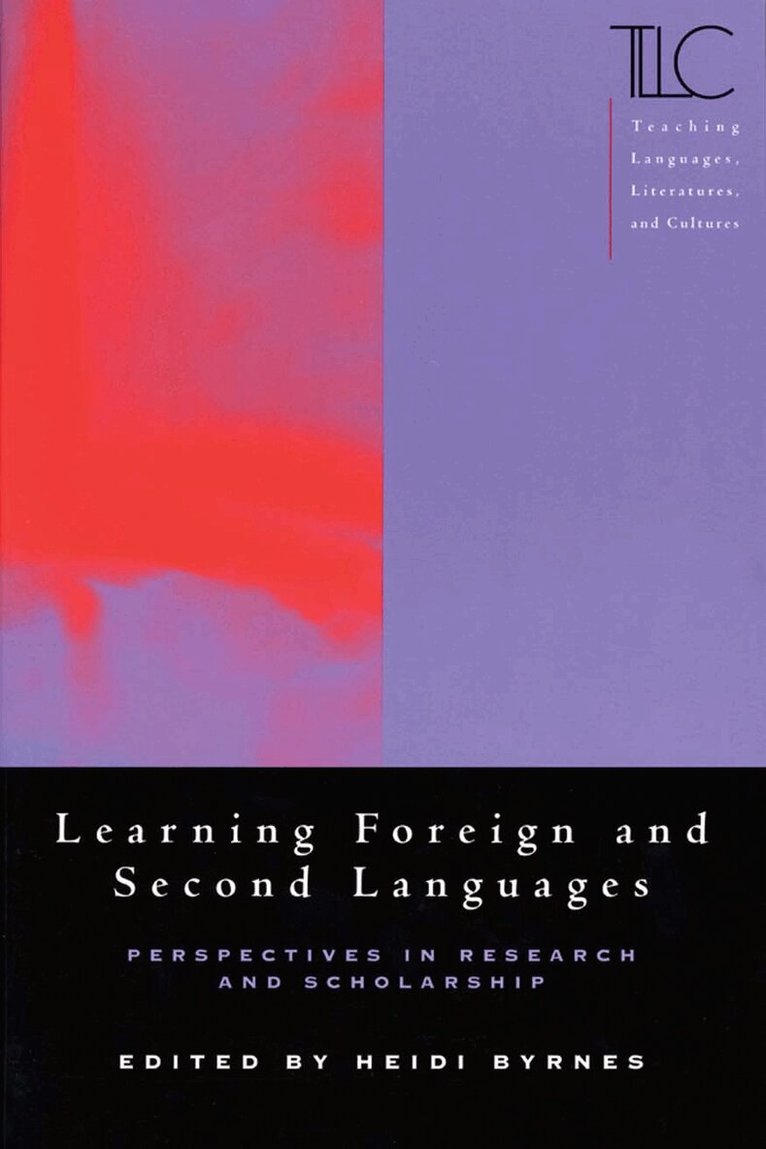
Learning Foreign and Second Languages
Av Heidi Byrnes
Inbunden, 1998
1337 kr
Tillfälligt slut
This inaugural volume in the MLA series Teaching Languages, Literatures, and Cultures provides an overview of second language acquisition research. Is language a system of linguistic forms to be acquired by the study of grammar, or is language a means of communication, where students learn not by …
Learning Foreign and Second Languages
Av Heidi Byrnes
Häftad, 1998
643 kr
Tillfälligt slut
This inaugural volume in the MLA series Teaching Languages, Literatures, and Cultures provides an overview of second language acquisition research. Is language a system of linguistic forms to be acquired by the study of grammar, or is language a means of communication, where students learn not by …