Heike Klüver - Böcker
Visar alla böcker från författaren Heike Klüver. Handla med fri frakt och snabb leverans.
4 produkter
4 produkter
Coalition Agreements as Control Devices
Coalition Governance in Western and Eastern Europe
Inbunden, Engelska, 2023
1 010 kr
Skickas inom 5-8 vardagar
Many coalition cabinets negotiate lengthy coalition contracts outlining the agenda for the time in office. Not only does negotiating these agreements take up time and resources, but compromises have to be made, which may result in cabinet conflicts and electoral costs. This book explores why political parties negotiate such agreements, and argues that coalition agreements are important control devices that allow coalition parties to keep their partners in line. The authors show that their use varies with the preference configuration in cabinet and the allocation of ministerial portfolios. First, they posit that parties will only negotiate policy issues in a coalition agreement when they disagree on these issues and when they are important to all partners. Second, since controlling a ministry provides parties with important information and policy-making advantages, parties use agreements to constrain their partners particularly when they control the ministry in charge of a policy area. Finally, they argue that coalition agreements only work as effective control devices if coalition parties settle controversial issues in these contracts. The COALITIONAGREE Dataset is used to evaluate the expectations set out in the book; the dataset maps the content of 229 coalition agreements that were negotiated by 189 parties between 1945 and 2015 in 24 Western and Eastern European countries. The results show that coalition parties systematically use agreements to control their partners when policy issues are divisive and salient and when they are confronted with a hostile minister. These agreements only effectively contain conflicts, however, when parties negotiate a compromise on precisely the issues that divide them.Comparative Politics is a series for researchers, teachers, and students of political science that deals with contemporary government and politics. Global in scope, books in the series are characterized by a stress on comparative analysis and strong methodological rigour. The series is published in association with the European Consortium for Political Research. For more information visit: www.ecprnet.eu.The series is edited by Nicole Bolleyer, Chair of Comparative Political Science, Geschwister Scholl Institut, LMU Munich and Jonathan Slapin, Professor of Political Institutions and European Politics, Department of Political Science, University of Zurich.
Lobbying in the European Union
Interest Groups, Lobbying Coalitions, and Policy Change
Inbunden, Engelska, 2013
2 106 kr
Skickas inom 5-8 vardagar
Why can some interest groups influence policy-making while others cannot? Even though this question is central to the study of politics, we know little about the factors explaining interest group influence. Understanding lobbying success should be of particular concern to scholars of European politics since the European Union constitutes a promising political opportunity structure for organized interests. This book sheds light on the impact of interest groups on European policy-making and makes a major contribution to the study of both European Union politics and interest groups more generally. Klüver develops a comprehensive theoretical model for understanding lobbying success and presents an extensive empirical analysis of interest group influence on policy-making in the EU. The book relies on a large, new, and innovative dataset that combines a wide variety of data sources including a quantitative text analysis of European Commission consultations, an online survey of interest groups, information gathered on interest group websites, and legislative data retrieved from EU databases. This book analyzes interest group influence across 56 policy issues and 2,696 interest groups and shows that lobbying is an exchange relationship in which the European institutions trade influence for information, citizen support and economic power. Importantly, this book demonstrates that it is not sufficient to solely focus on individual interest groups, but that it is crucial how interest groups come together in issue-specific lobbying coalitions. Lobbying is a collective enterprise in which information supply, citizen support, and economic power of entire lobbying coalitions are decisive for lobbying success.
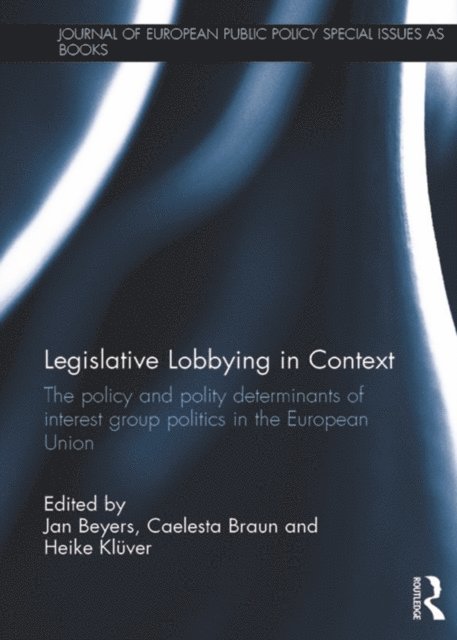
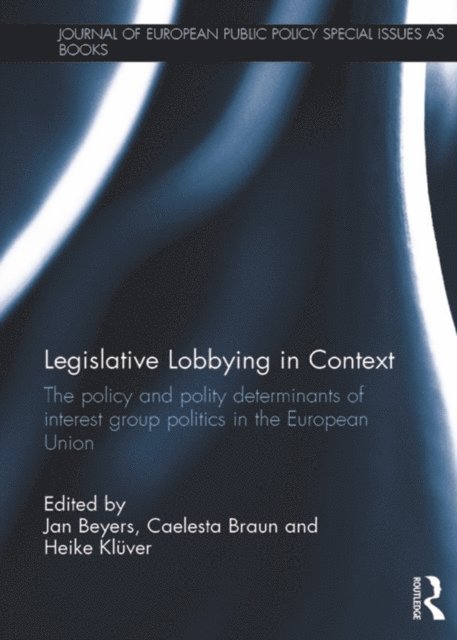
Legislative Lobbying in Context
The Policy and Polity Determinants of Interest Group Politics in the European Union
Häftad, Engelska, 2017
725 kr
Skickas inom 10-15 vardagar
The lack of previous research into political interest groups and taking into account policy-specific and institutional context characteristics is largely due to research designs that have been primarily focused on a small number of policy debates, with the result that contextual characteristics were largely held constant. This book brings together articles from different modules that are part of a larger European Collaborative Research Project, INTEREURO, carried out by research teams in nine different countries under the auspices of the European Science Foundation. The main goal of the book is to analyse strategies, framing and influence processes for a set of 125 legislative proposals submitted by the European Commission, in an effort to better understand the involvement of interest organizations in the decision-making process of the EU. Contributors draw on sophisticated and innovative policy-driven samples of interest group mobilization, allowing them to account systematically for how policy-specific and institutional context factors shape mobilization, lobbying strategies and influence of interest groups on public policy debates in the EU. In this way, the book makes an important contribution to the study of interest groups in the EU and represents the breadth of positions taken in the current literature.This book was originally published as a special issue of the Journal of European Public Policy.
Legislative Lobbying in Context
The Policy and Polity Determinants of Interest Group Politics in the European Union
Inbunden, Engelska, 2015
2 088 kr
Skickas inom 10-15 vardagar
The lack of previous research into political interest groups and taking into account policy-specific and institutional context characteristics is largely due to research designs that have been primarily focused on a small number of policy debates, with the result that contextual characteristics were largely held constant. This book brings together articles from different modules that are part of a larger European Collaborative Research Project, INTEREURO, carried out by research teams in nine different countries under the auspices of the European Science Foundation. The main goal of the book is to analyse strategies, framing and influence processes for a set of 125 legislative proposals submitted by the European Commission, in an effort to better understand the involvement of interest organizations in the decision-making process of the EU. Contributors draw on sophisticated and innovative policy-driven samples of interest group mobilization, allowing them to account systematically for how policy-specific and institutional context factors shape mobilization, lobbying strategies and influence of interest groups on public policy debates in the EU. In this way, the book makes an important contribution to the study of interest groups in the EU and represents the breadth of positions taken in the current literature.This book was originally published as a special issue of the Journal of European Public Policy.