Heikki Ikäheimo - Böcker
Visar alla böcker från författaren Heikki Ikäheimo. Handla med fri frakt och snabb leverans.
5 produkter
5 produkter
1 113 kr
Skickas inom 7-10 vardagar
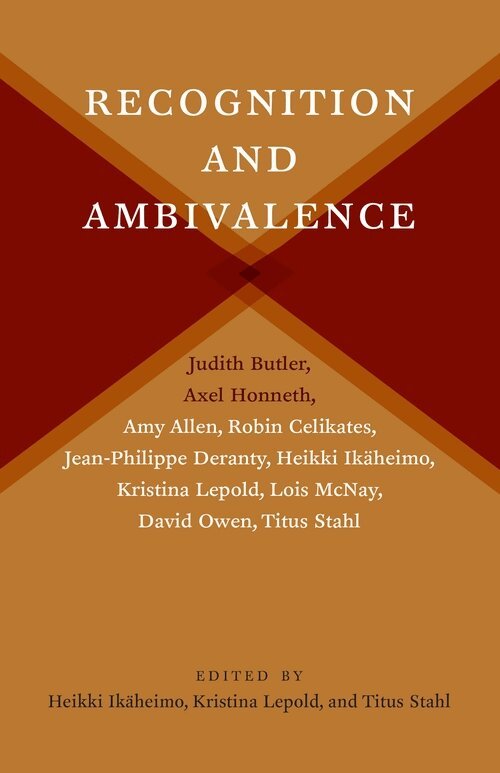
Recognition is one of the most debated concepts in contemporary social and political thought. Its proponents, such as Axel Honneth, hold that to be recognized by others is a basic human need that is central to forming an identity, and the denial of recognition deprives individuals and communities of something essential for their flourishing. Yet critics including Judith Butler have questioned whether recognition is implicated in structures of domination, arguing that the desire to be recognized can motivative individuals to accept their assigned place in the social order by conforming to oppressive norms or obeying repressive institutions. Is there a way to break this impasse?Recognition and Ambivalence brings together leading scholars in social and political philosophy to develop new perspectives on recognition and its role in social life. It begins with a debate between Honneth and Butler, the first sustained engagement between these two major thinkers on this subject. Contributions from both proponents and critics of theories of recognition further reflect upon and clarify the problems and challenges involved in theorizing the concept and its normative desirability. Together, they explore different routes toward a critical theory of recognition, departing from wholly positive or negative views to ask whether it is an essentially ambivalent phenomenon. Featuring original, systematic work in the philosophy of recognition, this book also provides a useful orientation to the key debates on this important topic.
373 kr
Skickas
Recognition is one of the most debated concepts in contemporary social and political thought. Its proponents, such as Axel Honneth, hold that to be recognized by others is a basic human need that is central to forming an identity, and the denial of recognition deprives individuals and communities of something essential for their flourishing. Yet critics including Judith Butler have questioned whether recognition is implicated in structures of domination, arguing that the desire to be recognized can motivative individuals to accept their assigned place in the social order by conforming to oppressive norms or obeying repressive institutions. Is there a way to break this impasse?Recognition and Ambivalence brings together leading scholars in social and political philosophy to develop new perspectives on recognition and its role in social life. It begins with a debate between Honneth and Butler, the first sustained engagement between these two major thinkers on this subject. Contributions from both proponents and critics of theories of recognition further reflect upon and clarify the problems and challenges involved in theorizing the concept and its normative desirability. Together, they explore different routes toward a critical theory of recognition, departing from wholly positive or negative views to ask whether it is an essentially ambivalent phenomenon. Featuring original, systematic work in the philosophy of recognition, this book also provides a useful orientation to the key debates on this important topic.
2 098 kr
Skickas inom 10-15 vardagar
What is recognition and why is it so important? This book develops a synoptic conception of the significance of recognition in its many forms for human persons by means of a rational reconstruction and internal critique of classical and contemporary accounts.The book begins with a clarification of several fundamental questions concerning recognition. It then reconstructs the core ideas of Fichte, Hegel, Taylor, Fraser, and Honneth and utilizes the insights and conceptual tools developed across these chapters for developing a case for the universal importance of recognition for humans. It argues in favour of a universalist anthropological position, unusual in the literature on recognition, that aims to construe a philosophically sound basis for a discourse of common humanity, or of a shared human life-form for which moral relations of recognition are essential. This synthetic conception of the importance of recognition provides tools for articulating deep intuitions shared across cultures about what makes human life and forms of human co-existence better or worse, and thus tools for mutual understanding about the deepest shared concerns of humanity, or of what makes us all human persons despite our differences.Recognition and the Human Life-Form will appeal to readers interested in philosophical anthropology, social and political philosophy, critical theory, and the history of philosophy. It also provides ideas and conceptual tools for fields such as anthropology, education, disability studies, international relations, law, politics, religious studies, sociology, and social research.Chapter 5 of this book is available for free in PDF format as Open Access from the individual product page at www.routledge.com. It has been made available under a Creative Commons Attribution-Non Commercial-No Derivatives 4.0 license.
579 kr
Skickas inom 10-15 vardagar
What is recognition and why is it so important? This book develops a synoptic conception of the significance of recognition in its many forms for human persons by means of a rational reconstruction and internal critique of classical and contemporary accounts.The book begins with a clarification of several fundamental questions concerning recognition. It then reconstructs the core ideas of Fichte, Hegel, Taylor, Fraser, and Honneth and utilizes the insights and conceptual tools developed across these chapters for developing a case for the universal importance of recognition for humans. It argues in favour of a universalist anthropological position, unusual in the literature on recognition, that aims to construe a philosophically sound basis for a discourse of common humanity, or of a shared human life-form for which moral relations of recognition are essential. This synthetic conception of the importance of recognition provides tools for articulating deep intuitions shared across cultures about what makes human life and forms of human co-existence better or worse, and thus tools for mutual understanding about the deepest shared concerns of humanity, or of what makes us all human persons despite our differences.Recognition and the Human Life-Form will appeal to readers interested in philosophical anthropology, social and political philosophy, critical theory, and the history of philosophy. It also provides ideas and conceptual tools for fields such as anthropology, education, disability studies, international relations, law, politics, religious studies, sociology, and social research.Chapter 5 of this book is available for free in PDF format as Open Access from the individual product page at www.routledge.com. It has been made available under a Creative Commons Attribution-Non Commercial-No Derivatives 4.0 license.
3 219 kr
Skickas inom 10-15 vardagar
Anerkennung ist ein grundlegender Begriff der politischen und der Sozialphilosophie. Zugleich wird ihre mittlerweile erreichte ideen- und problemgeschichtliche Vielfalt durch ihre wichtigsten Autoren anschaulich präsentiert.