Heiner Dribbusch – författare
Visar alla böcker från författaren Heiner Dribbusch. Handla med fri frakt och snabb leverans.
3 produkter
3 produkter
E-bok
PDF, Engelska, 2025656 kr
Läs direkt efter köp
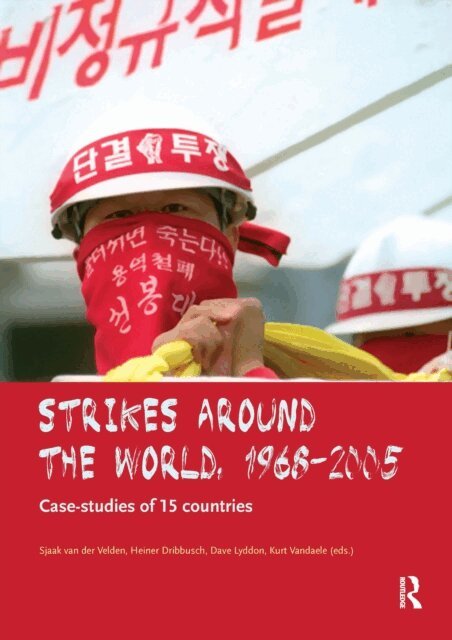
Are strikes going out of fashion or are they an inevitable feature of working life? This is a longstanding debate. The much-proclaimed 'withering away of the strike' in the 1950s was quickly overturned by the 'resurgence of class conflict' in the late 1960s and 1970s. The period since then has been characterized as one of 'labor quiescence'. Commentators again predict the strike's demise, at least in the former heartlands of capitalism.Patterns of employment are constantly changing and strike activity reflects this. The secular decline of manufacturing in mature industrialized economies is of major importance here (though the global relocation of manufacturing may lead to some 'relocation' of strikes). Simultaneously we see the growth of disputes in the service sector (the 'tertiarization' of strikes). This is evident particularly in public services, including health care, social care and education, and is accompanied by a 'feminization' of strikes, given the prevalence of women working there. This unique study draws on the experience of fifteen countries around the world - South Africa, Argentina, Canada, Mexico, United States, Korea, Australia, New Zealand, Belgium, Denmark, France, Germany, the Netherlands, Sweden and the United Kingdom. Covering the high and low points of strike activity over the period 1968-2005, the study shows continuing evidence of the durability, adaptability and necessity of the strike.
E-bok
Engelska, 2025656 kr
Läs direkt efter köp
Are strikes going out of fashion or are they an inevitable feature of working life? This is a longstanding debate. The much-proclaimed 'withering away of the strike' in the 1950s was quickly overturned by the 'resurgence of class conflict' in the late 1960s and 1970s. The period since then has been characterized as one of 'labor quiescence'. Commentators again predict the strike's demise, at least in the former heartlands of capitalism.Patterns of employment are constantly changing and strike activity reflects this. The secular decline of manufacturing in mature industrialized economies is of major importance here (though the global relocation of manufacturing may lead to some 'relocation' of strikes). Simultaneously we see the growth of disputes in the service sector (the 'tertiarization' of strikes). This is evident particularly in public services, including health care, social care and education, and is accompanied by a 'feminization' of strikes, given the prevalence of women working there. This unique study draws on the experience of fifteen countries around the world - South Africa, Argentina, Canada, Mexico, United States, Korea, Australia, New Zealand, Belgium, Denmark, France, Germany, the Netherlands, Sweden and the United Kingdom. Covering the high and low points of strike activity over the period 1968-2005, the study shows continuing evidence of the durability, adaptability and necessity of the strike.
E-bok
PDF, Tyska, 2019544 kr
Läs direkt efter köp
Der Sonderband der WSI-Mitteilungen fokussiert auf die institutionellen Arbeitsbeziehungen in Deutschland. Das System der deutschen industriellen Beziehungen stieß in der Folge des korporatistischen Krisenmanagements der Jahre 2009/2010 auf ein reges Interesse, da es als wesentliche Ursache für das "deutsche Jobwunder" betrachtet wurde. Heute ist jedoch festzustellen, dass, obwohl die beiden Kerninstitutionen – Betriebsräte und das System der Flächentarifverträge – noch intakt sind, die deutschen Arbeitsbeziehungen als Ganzes betrachtet erheblichen Veränderungen unterworfen sind.Ziel dieses Sonderbandes ist es, zum besseren Verständnis dieser Änderungen beizutragen und somit auch neue Blickwinkel für die Theorie und Praxis der industriellen Beziehungen in Deutschland zu ermöglichen.Mit Beiträgen vonNadine Absenger, Martin Behrens, Wolfram Brehmer, Heiner Dribbusch, Helge Emmler, Anke Hassel, Wolfgang Schroeder, Thorsten Schulten und Daniel Seikel.