Helasvuo Marja-Liisa Helasvuo – författare
Visar alla böcker från författaren Helasvuo Marja-Liisa Helasvuo. Handla med fri frakt och snabb leverans.
4 produkter
4 produkter
E-bok
PDF, Engelska, 20151 353 kr
Läs direkt efter köp
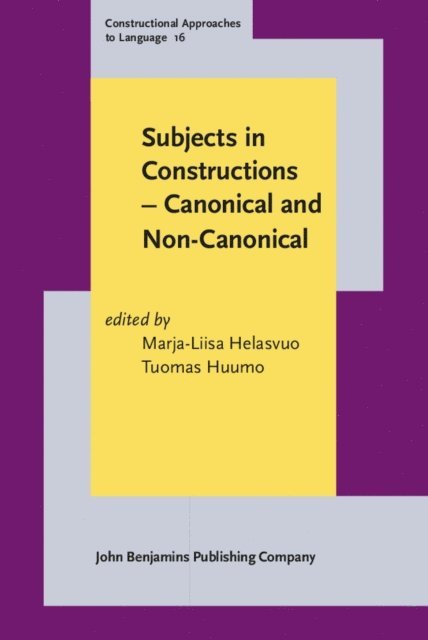
This volume analyzes constructions with non-canonical subjects in individual languages and cross-linguistically, drawing on insights from cognitive and discourse-functional linguistics. Prototypical subjects have often been characterized in terms of their semantic, syntactic and discourse features, such as animacy, agentivity, topicality, referentiality, definiteness and autonomy of existence of the subject referent. A non-canonical subject is one that lacks some of these features. This may be reflected in its meaning, grammatical coding, and/or discourse function. In discussing non-canonical subjects in individual languages and cross-linguistically, the chapters in the volume address the following more general topics: What kinds of grammatical, semantic and discourse criteria can be used to distinguish subjects from non-subjects? To what extent are subject criteria construction-specific? What kinds of constructions have non-canonical subjects? What are the semantic and discourse functions of constructions with non-canonical subjects? Are subjects which are grammatically non-canonical also atypical in terms of their discourse features?
E-bok
PDF, Engelska, 20101 304 kr
Läs direkt efter köp
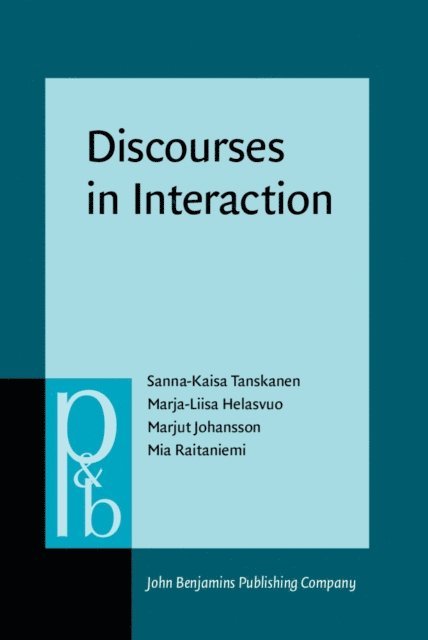
The fourteen contributions in this collection come from different approaches in pragmatics, interactional linguistics, conversation analysis, discourse analysis and dialogue analysis; the name given to what is studied ranges from spoken language and conversation to interaction, dialogue, discourse and communication. What the articles have in common is a similar starting point: they are informed by a form of linguistic understanding which has emerged within what could be called the interactional turn. The materials investigated come from several different languages, representing a variety of interactions: private and public, written and spoken, historical and present-day. While studies of such diverse materials naturally differ in their starting points, goals and aims, engaging them in a dialogue can help reveal where old beliefs may be challenged and new understandings may emerge. The interactional approaches to discourse presented in this volume show that there are several discourses on interaction: interconnected, parallel, but also varying and even divergent.
E-bok
PDF, Engelska, 20061 447 kr
Läs direkt efter köp
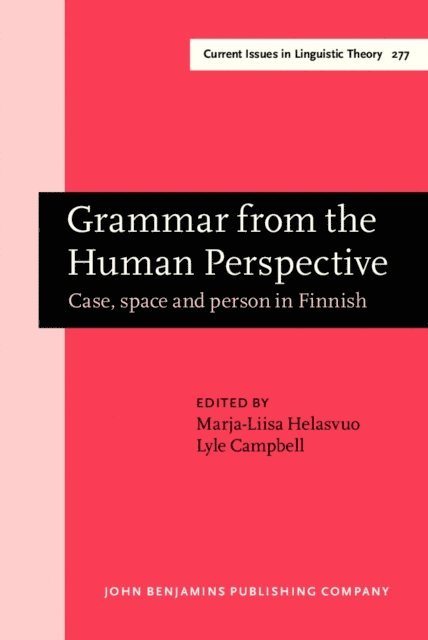
The papers of this volume investigate how grammar codes the subjective viewpoint of human language users, that is, how grammar reflects human conceptualization. Some of the articles deal with spatial relations and locations. They discuss how basic attributes of human conceptualization are encoded in the grammatical expression of spatial relations. Other articles concern embodiment in language, showing how conceptualization is mediated by one’s embodied experience of the world and ourselves. Finally, some of the articles discuss coding of person focusing on the subjectivity of conceptualization and how it is reflected in grammar. The articles show that conceptualization reflects the speaker’s construal of the situation, and furthermore, that it is intersubjective because it reflects the speaker’s understanding of the relations between the speech act participants. The papers deal with Finnish, utilizing the rich resources of Finnish grammar to contribute to issues in contemporary linguistics and in particular to Cognitive Grammar.
E-bok
PDF, Engelska, 20011 353 kr
Läs direkt efter köp
Research on the interplay between language structure and language use has shown that grammar is shaped, maintained, and modified by language use. In this view, then, grammar is not seen as existing apart from language use, but rather as a set of recurrent, grammaticized patterns of discourse. This book focuses on syntactic structuring in Finnish from the viewpoint of language use. The author sets out to study syntactic structures in their local contexts in order to discover the more global patterns and constraints on the use of these structures. The coding strategies point to the clause core as the locus of syntactic structuring: this is where syntactic relations emerge most clearly. It is shown that the key to understanding the coding of the core syntactic relations is the category of person. The clause core also shows strong intonational unity as it is most often presented in one intonation unit. Furthermore, analysis of spoken discourse shows the robustness of the category of noun phrase, both as a clausal constituent and as a free syntactic unit, the free NP.