Helen de Cruz – författare
763 kr
Skickas inom 3-6 vardagar
282 kr
Läs direkt efter köp
512 kr
Läs direkt efter köp
An examination of the cognitive foundations of intuitions about the existence and attributes of God.
Questions about the existence and attributes of God form the subject matter of natural theology, which seeks to gain knowledge of the divine by relying on reason and experience of the world. Arguments in natural theology rely largely on intuitions and inferences that seem natural to us, occurring spontaneously—at the sight of a beautiful landscape, perhaps, or in wonderment at the complexity of the cosmos—even to a nonphilosopher. In this book, Helen De Cruz and Johan De Smedt examine the cognitive origins of arguments in natural theology. They find that although natural theological arguments can be very sophisticated, they are rooted in everyday intuitions about purpose, causation, agency, and morality. Using evidence and theories from disciplines including the cognitive science of religion, evolutionary ethics, evolutionary aesthetics, and the cognitive science of testimony, they show that these intuitions emerge early in development and are a stable part of human cognition.
De Cruz and De Smedt analyze the cognitive underpinnings of five well-known arguments for the existence of God: the argument from design, the cosmological argument, the moral argument, the argument from beauty, and the argument from miracles. Finally, they consider whether the cognitive origins of these natural theological arguments should affect their rationality.
627 kr
Skickas inom 5-8 vardagar
193 kr
Skickas inom 5-8 vardagar
232 kr
Skickas inom 5-8 vardagar
160 kr
Skickas inom 5-8 vardagar
230 kr
Skickas inom 7-10 vardagar
275 kr
Läs direkt efter köp
275 kr
Läs direkt efter köp
275 kr
Läs direkt efter köp
275 kr
Läs direkt efter köp
230 kr
Skickas inom 7-10 vardagar
165 kr
262 kr
Läs direkt efter köp
Would our world be a better place if some of us were benders?
Can Katara repair the world through care?
Is Toph a disability pride icon?
What does it mean for Zuko to be bad at being good?
Can we tell whether uncle Iroh is a fool or a sage?
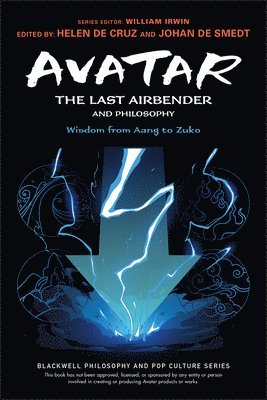
The world is out of sorts. The four nations, Water, Earth, Fire, and Air, are imbalanced because of the unrelenting conquest of the Fire Nation. The only one who can restore balance to the world is the Avatar. On the face of it, Avatar: The Last Airbender is a story about a lone superhero. However, saving the world is a team effort, embodied in Team Avatar, aka the Gaang. Aang needs help from his friends and tutors, even from non-human animals. Through the teachings of Guru Pathik and Huu he comes to realize that though the world and its nations seem separate, we are all one people. We all have the same roots and we are all branches of the same tree.
Avatar: The Last Airbender and Philosophy brings to the fore the Eastern, Western, and Indigenous philosophies that are implicit in the show. Following Uncle Iroh’s advice that it is important to draw wisdom from many traditions, this volume features contributions by experts on Buddhist, Daoist, Confucian, and Indigenous schools of thought, next to focusing on Western classical authors such as Plotinus, Kant, and Merleau-Ponty. The volume is also unique in drawing on less common traditions such as black abolitionism, anarchism, and the philosophy of martial arts.
Intertwining experience and reflection, ATLA and Philosophy helps readers to deeply engage with today’s burning questions, such as how to deal with ecological destruction, the aftermath of colonialism and genocide, and wealth inequality, using the tools from a wide range of philosophical traditions.
259 kr
Läs direkt efter köp
Would our world be a better place if some of us were benders?
Can Katara repair the world through care?
Is Toph a disability pride icon?
What does it mean for Zuko to be bad at being good?
Can we tell whether uncle Iroh is a fool or a sage?
The world is out of sorts. The four nations, Water, Earth, Fire, and Air, are imbalanced because of the unrelenting conquest of the Fire Nation. The only one who can restore balance to the world is the Avatar. On the face of it, Avatar: The Last Airbender is a story about a lone superhero. However, saving the world is a team effort, embodied in Team Avatar, aka the Gaang. Aang needs help from his friends and tutors, even from non-human animals. Through the teachings of Guru Pathik and Huu he comes to realize that though the world and its nations seem separate, we are all one people. We all have the same roots and we are all branches of the same tree.
Avatar: The Last Airbender and Philosophy brings to the fore the Eastern, Western, and Indigenous philosophies that are implicit in the show. Following Uncle Iroh’s advice that it is important to draw wisdom from many traditions, this volume features contributions by experts on Buddhist, Daoist, Confucian, and Indigenous schools of thought, next to focusing on Western classical authors such as Plotinus, Kant, and Merleau-Ponty. The volume is also unique in drawing on less common traditions such as black abolitionism, anarchism, and the philosophy of martial arts.
Intertwining experience and reflection, ATLA and Philosophy helps readers to deeply engage with today’s burning questions, such as how to deal with ecological destruction, the aftermath of colonialism and genocide, and wealth inequality, using the tools from a wide range of philosophical traditions.
539 kr
Skickas inom 10-15 vardagar
314 kr
Skickas
1 099 kr
Skickas inom 10-15 vardagar
386 kr
Läs direkt efter köp
386 kr
Läs direkt efter köp
570 kr
Läs direkt efter köp
570 kr
Läs direkt efter köp
1 913 kr
Skickas inom 10-15 vardagar
1 191 kr
Skickas inom 10-15 vardagar
1 519 kr
Läs direkt efter köp
A growing body of evidence from the sciences suggests that our moral beliefs have an evolutionary basis. To explain how human morality evolved, some philosophers have called for the study of morality to be naturalized, i.e., to explain it in terms of natural causes by looking at its historical and biological origins. The present literature has focused on the link between evolution and moral realism: if our moral beliefs enhance fitness, does this mean they track moral truths? In spite of the growing empirical evidence, these discussions tend to remain high-level: the mere fact that morality has evolved is often deemed enough to decide questions in normative and meta-ethics. This volume starts from the assumption that the details about the evolution of morality do make a difference, and asks how. It presents original essays by authors from various disciplines, including philosophy, anthropology, developmental psychology, and primatology, who write in conversation with neuroscience, sociology, and cognitive psychology.
1 191 kr
Skickas inom 10-15 vardagar
32 kr
Läs direkt efter köp