Helmut Lütkepohl - Böcker
Visar alla böcker från författaren Helmut Lütkepohl. Handla med fri frakt och snabb leverans.
4 produkter
4 produkter
565 kr
Skickas inom 7-10 vardagar
Time series econometrics is a rapidly evolving field. Particularly, the cointegration revolution has had a substantial impact on applied analysis. Hence, no textbook has managed to cover the full range of methods in current use and explain how to proceed in applied domains. This gap in the literature motivates the present volume. The methods are sketched out, reminding the reader of the ideas underlying them and giving sufficient background for empirical work. The treatment can also be used as a textbook for a course on applied time series econometrics. Topics include: unit root and cointegration analysis, structural vector autoregressions, conditional heteroskedasticity and nonlinear and nonparametric time series models. Crucial to empirical work is the software that is available for analysis. New methodology is typically only gradually incorporated into existing software packages. Therefore a flexible Java interface has been created, allowing readers to replicate the applications and conduct their own analyses.
1 553 kr
Skickas inom 7-10 vardagar
Time series econometrics is a rapidly evolving field. Particularly, the cointegration revolution has had a substantial impact on applied analysis. Hence, no textbook has managed to cover the full range of methods in current use and explain how to proceed in applied domains. This gap in the literature motivates the present volume. The methods are sketched out, reminding the reader of the ideas underlying them and giving sufficient background for empirical work. The treatment can also be used as a textbook for a course on applied time series econometrics. Topics include: unit root and cointegration analysis, structural vector autoregressions, conditional heteroskedasticity and nonlinear and nonparametric time series models. Crucial to empirical work is the software that is available for analysis. New methodology is typically only gradually incorporated into existing software packages. Therefore a flexible Java interface has been created, allowing readers to replicate the applications and conduct their own analyses.
2 163 kr
Skickas inom 7-10 vardagar
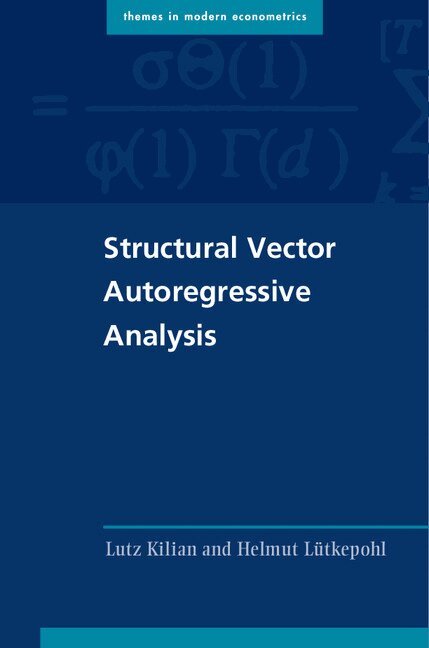
Structural vector autoregressive (VAR) models are important tools for empirical work in macroeconomics, finance, and related fields. This book not only reviews the many alternative structural VAR approaches discussed in the literature, but also highlights their pros and cons in practice. It provides guidance to empirical researchers as to the most appropriate modeling choices, methods of estimating, and evaluating structural VAR models. The book traces the evolution of the structural VAR methodology and contrasts it with other common methodologies, including dynamic stochastic general equilibrium (DSGE) models. It is intended as a bridge between the often quite technical econometric literature on structural VAR modeling and the needs of empirical researchers. The focus is not on providing the most rigorous theoretical arguments, but on enhancing the reader's understanding of the methods in question and their assumptions. Empirical examples are provided for illustration.
811 kr
Skickas inom 7-10 vardagar
Structural vector autoregressive (VAR) models are important tools for empirical work in macroeconomics, finance, and related fields. This book not only reviews the many alternative structural VAR approaches discussed in the literature, but also highlights their pros and cons in practice. It provides guidance to empirical researchers as to the most appropriate modeling choices, methods of estimating, and evaluating structural VAR models. The book traces the evolution of the structural VAR methodology and contrasts it with other common methodologies, including dynamic stochastic general equilibrium (DSGE) models. It is intended as a bridge between the often quite technical econometric literature on structural VAR modeling and the needs of empirical researchers. The focus is not on providing the most rigorous theoretical arguments, but on enhancing the reader's understanding of the methods in question and their assumptions. Empirical examples are provided for illustration.