Henner von Hesberg – författare
Visar alla böcker från författaren . Handla med fri frakt och snabb leverans.
4 produkter
4 produkter
Inbunden, Tyska, 2005
448 kr
Skickas inom 3-6 vardagar
E-bok
PDF, Tyska, 20254 455 kr
Läs direkt efter köp
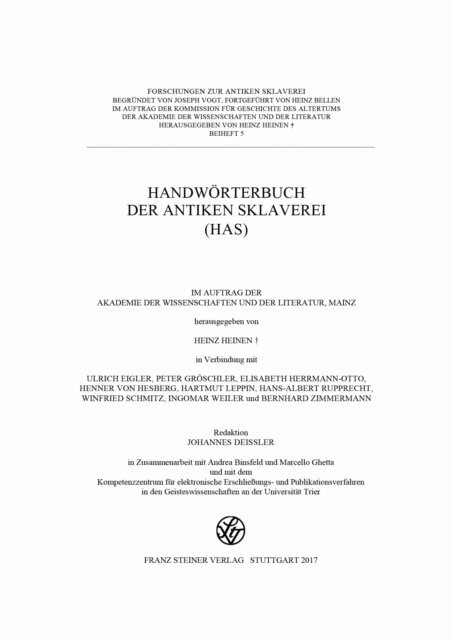
Das Handworterbuch der antiken Sklaverei (HAS) ist das Abschlussprojekt des Mainzer Akademievorhabens Forschungen zur antiken Sklaverei. Es erfasst die Ergebnisse der internationalen Sklavereiforschung und stellt der Fachwissenschaft ein Grundlagenwerk fur weitere Forschungen bereit.Als alphabetisch geordnetes Nachschlagewerk beinhaltet es auf 3.780 Spalten uber 1.400 Stichworter in unterschiedlicher Gewichtung. Beigegeben sind umfangreiche Register. Neben der Sklaverei in der griechisch-romischen Antike finden auch andere Arten der Unfreiheit, die ubrigen Kulturen des Mittelmeerraumes sowie Abhangigkeitszustande in auereuropaischen und nichtantiken Zivilisationen Berucksichtigung. Beitrage zur Rezeptions- und Wissenschaftsgeschichte runden das HAS ab. Die Beitrage werden erstmals - teilweise aktualisiert - in einer herkommlichen Buchversion veroffentlicht, vorausgegangen sind seit 2006 vier elektronische, kumulative Lieferungen auf CD bzw. DVD, die funfte und letzte Gesamtlieferung erscheint 2018. Publikationssprache ist Deutsch, Artikel in englischer, franzosischer, italienischer und spanischer Sprache sind ebenfalls vertreten.
Häftad, Engelska, 2026
260 kr
Kommande
This book demonstrates how architecture can be visually conveyed despite historical uncertainty. It is an architectural contribution to resolving the dilemma that historical representations, in order to be vivid, often consist of pure fantasy. The method presented here translates archaeological hypotheses from words into images. As a result, the outcome is scientifically sound, even if it frequently involves analogical reasoning. This ambiguity is conveyed through the abstraction of the model. Thus, it is not the built structure itself but its concept that is depicted—and so clearly that misunderstandings are minimized. This transforms our perception of lost architecture. Instead of a glorified, romanticized past, it is conveyed as a timeless message.
Del 92 - Jahreshefte des Österreichischen Archäologischen Institutes in Wien Series
Jahreshefte des Österreichischen Archäologischen Institutes in Wien
Band 92 / 2003
Inbunden, Engelska, 2024
1 569 kr
Skickas inom 11-20 vardagar
Research from the Austria Romana project is represented in the current volume with a numismatic contribution on the settlement and villa complex at Bruckneudorf, as well as on bird-shaped glass vessels from Virunum. Aspects of the urbanisation of Pompeii, in particular the connection between Regio VI and the so-called Old Town, are re-evaluated with the aid of recent geophysical and geodetic investigations and discussed on a broad historical and archaeological basis. Initial findings on the material culture of Abthugnos, situated in the hinterland of Carthage, were generated during a surface survey and are presented for the first time in this volume. The ÖAI’s research in Ephesus is represented by two contributions: on the one hand, a previously unpublished clay seal from the Byzantine period found in the Artemision is presented; with its depiction of a horseman saint, it is interpreted as evidence of everyday Christian piety. On the other hand, the series of new inscriptions from Ephesus is continued: Number 16 is devoted to the inscriptions incorporated into the Byzantine aqueduct bridge at Selçuk. The province of Asia also includes the theatre of Nicaea, which was equipped with caryatid galleries and for which a gender-segregated seating arrangement has been reconstructed. Richly illustrated are archaic roof terracotta tiles from Epidamnos (now Durrës) in present-day Albania, which, amongst other things, formed part of an unusual roof of the Corinthian order. Also dating from the late Archaic period is a red-figure amphora in the collection of the Institute of Classical Archaeology at the University of Vienna, which is attributed to Oltos and for which a new name inscription is being put forward for discussion. At first glance, a contribution on the medieval Vienna Imperial Crown may seem surprising. However, as part of a large-scale research project, three previously unknown ancient amethyst intaglios with extraordinary depictions, which are incorporated into the crown, have been identified. They are presented here for the first time and classified on the basis of possible parallels.