Henry Abarbanel – författare
Visar alla böcker från författaren Henry Abarbanel. Handla med fri frakt och snabb leverans.
8 produkter
8 produkter
Häftad, Engelska, 1997
758 kr
Skickas inom 10-15 vardagar
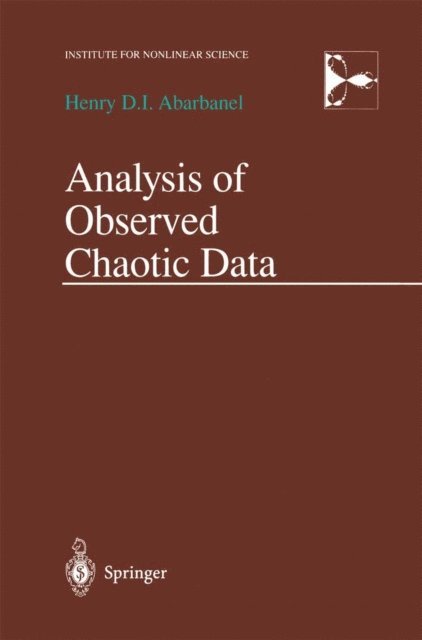
When I encountered the idea of chaotic behavior in deterministic dynami cal systems, it gave me both great pause and great relief. The origin of the great relief was work I had done earlier on renormalization group properties of homogeneous, isotropic fluid turbulence. At the time I worked on that, it was customary to ascribe the apparently stochastic nature of turbulent flows to some kind of stochastic driving of the fluid at large scales. It was simply not imagined that with purely deterministic driving the fluid could be turbulent from its own chaotic motion. I recall a colleague remarking that there was something fundamentally unsettling about requiring a fluid to be driven stochastically to have even the semblance of complex motion in the velocity and pressure fields. I certainly agreed with him, but neither of us were able to provide any other reasonable suggestion for the observed, apparently stochastic motions of the turbulent fluid. So it was with relief that chaos in nonlinear systems, namely, complex evolution, indistinguish able from stochastic motions using standard tools such as Fourier analysis, appeared in my bag of physics notions. It enabled me to have a physi cally reasonable conceptual framework in which to expect deterministic, yet stochastic looking, motions. The great pause came from not knowing what to make of chaos in non linear systems.
E-bok
PDF, Engelska, 2012916 kr
Läs direkt efter köp
When I encountered the idea of chaotic behavior in deterministic dynami cal systems, it gave me both great pause and great relief. The origin of the great relief was work I had done earlier on renormalization group properties of homogeneous, isotropic fluid turbulence. At the time I worked on that, it was customary to ascribe the apparently stochastic nature of turbulent flows to some kind of stochastic driving of the fluid at large scales. It was simply not imagined that with purely deterministic driving the fluid could be turbulent from its own chaotic motion. I recall a colleague remarking that there was something fundamentally unsettling about requiring a fluid to be driven stochastically to have even the semblance of complex motion in the velocity and pressure fields. I certainly agreed with him, but neither of us were able to provide any other reasonable suggestion for the observed, apparently stochastic motions of the turbulent fluid. So it was with relief that chaos in nonlinear systems, namely, complex evolution, indistinguish able from stochastic motions using standard tools such as Fourier analysis, appeared in my bag of physics notions. It enabled me to have a physi cally reasonable conceptual framework in which to expect deterministic, yet stochastic looking, motions. The great pause came from not knowing what to make of chaos in non linear systems.
E-bok
PDF, Engelska, 20121 416 kr
Läs direkt efter köp
The ocean has entranced mankind for as long as we have gazed upon it, traversed it, dived into it, and studied it. It remains ever changing and seemingly never changing. Each wave that progresses through the. imme diate surf zone on every coast is strikingly different, yet the waves come again and again, as if never to end. The seasons come with essential reg ularity, and· yet each is individual-whatever did happen to that year of the normal rainfall or tidal behavior? This fascination with the currents of the ocean has always had a most immediate practical aspect: shipping, transportation, commerce, and war have depended upon our knowledge, when we had it, and floundered on our surprising ignorance more often than we wish to reflect. These important practical issues have commanded attention from commercial, academic, and military research scientists and engineers from the earliest era of organized scientific investigation. The matter of direct and insistent investigation was from the outset the behavior of ocean currents with long time scales; namely, those varying on annual or at least seasonal cycles. Planning for all the named enterprises depended, as they still do, of course, on the ability to predict with some certainty this class of phenomena. That ability, as with most physical sci ence, is predicated on a firm basis of observational fact to establish what, amorig the myriad of mathematical possibilities, is chosen by Nature as her expression of fact.
Häftad, Engelska, 2011
1 080 kr
Skickas inom 10-15 vardagar
The ocean has entranced mankind for as long as we have gazed upon it, traversed it, dived into it, and studied it. It remains ever changing and seemingly never changing. Each wave that progresses through the. imme diate surf zone on every coast is strikingly different, yet the waves come again and again, as if never to end. The seasons come with essential reg ularity, and· yet each is individual-whatever did happen to that year of the normal rainfall or tidal behavior? This fascination with the currents of the ocean has always had a most immediate practical aspect: shipping, transportation, commerce, and war have depended upon our knowledge, when we had it, and floundered on our surprising ignorance more often than we wish to reflect. These important practical issues have commanded attention from commercial, academic, and military research scientists and engineers from the earliest era of organized scientific investigation. The matter of direct and insistent investigation was from the outset the behavior of ocean currents with long time scales; namely, those varying on annual or at least seasonal cycles. Planning for all the named enterprises depended, as they still do, of course, on the ability to predict with some certainty this class of phenomena. That ability, as with most physical sci ence, is predicated on a firm basis of observational fact to establish what, amorig the myriad of mathematical possibilities, is chosen by Nature as her expression of fact.
Inbunden, Engelska, 2013
1 080 kr
Skickas inom 10-15 vardagar
Through the development of an exact path integral for use in transferring information from observations to a model of the observed system, the author provides a general framework for the discussion of model building and evaluation across disciplines. Through many illustrative examples drawn from models in neuroscience, geosciences, and nonlinear electrical circuits, the concepts are exemplified in detail. Practical numerical methods for approximate evaluations of the path integral are explored, and their use in designing experiments and determining a model’s consistency with observations is explored.
E-bok
PDF, Engelska, 20131 416 kr
Läs direkt efter köp
Through the development of an exact path integral for use in transferring information from observations to a model of the observed system, the author provides a general framework for the discussion of model building and evaluation across disciplines. Through many illustrative examples drawn from models in neuroscience, geosciences, and nonlinear electrical circuits, the concepts are exemplified in detail. Practical numerical methods for approximate evaluations of the path integral are explored, and their use in designing experiments and determining a model’s consistency with observations is explored.
Häftad, Engelska, 2016
1 080 kr
Skickas inom 10-15 vardagar
Through the development of an exact path integral for use in transferring information from observations to a model of the observed system, the author provides a general framework for the discussion of model building and evaluation across disciplines. Through many illustrative examples drawn from models in neuroscience, geosciences, and nonlinear electrical circuits, the concepts are exemplified in detail. Practical numerical methods for approximate evaluations of the path integral are explored, and their use in designing experiments and determining a model’s consistency with observations is explored.
Häftad, Engelska, 2017
536 kr
Skickas inom 5-8 vardagar