Henry Scott Stokes - Böcker
Visar alla böcker från författaren Henry Scott Stokes. Handla med fri frakt och snabb leverans.
4 produkter
4 produkter
Fallacies in the Allied Nations' Historical Perception as Observed by a British Journalist
Häftad, Engelska, 2016
447 kr
Skickas inom 10-15 vardagar
In 1941, Imperial Japan rapidly brought an end to the British Empire in Asia. Because a non-white race dared to upset the white colonialists’ status quo in Asia, the British resented the Japanese long after the war. Mr. Henry Scott-Stokes states that he held such a view as well before arriving in Japan as a foreign correspondent. Mr. Scott-Stokes writes of his transformation, of uncritical acceptance of the western colonialist’s version of the Greater East Asian War, the so-called Pacific War, to realization of its absolute vacuousness. “[The Japanese],” he states, “were supposed to simply accept, without any criticism or opposition whatsoever, the noble wisdom of civilization [the verdicts of the Tokyo Trials].”Mindless parroting of historical fabrications by modern Japanese suggests a loss of national consciousness, of what it means to be Japanese, as Yukio Mishima expressed in his discussions with Mr. Scott-Stokes. Japan lost her independence to America and is merely a protectorate and not a nation with her own culture and history. Japanese people need to take it upon themselves to change this situation. Mr. Stokes’ mother-in-law, however, wryly commented that today’s Japanese are cowards, so it will take another 200 or 300 years.
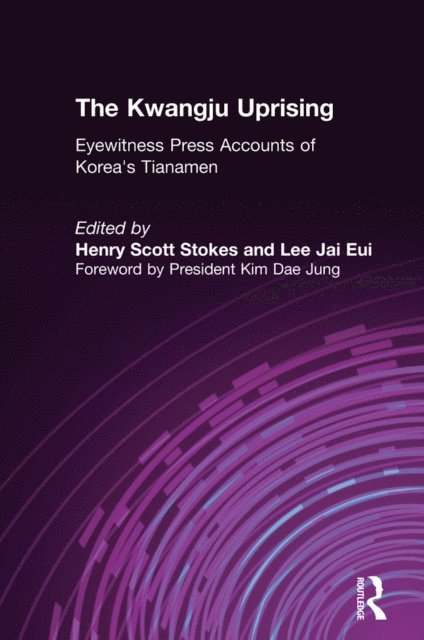
Kwangju Uprising: A Miracle of Asian Democracy as Seen by the Western and the Korean Press
A Miracle of Asian Democracy as Seen by the Western and the Korean Press
Inbunden, Engelska, 2000
2 159 kr
Skickas inom 10-15 vardagar
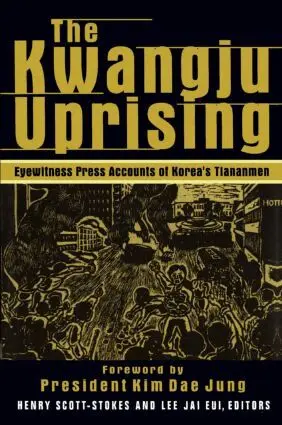
The Kwangju Uprising that occurred in May 1980 is burned into the minds of South Koreans in much the same way that Tiananmen is burned into the minds of contemporary Chinese. As the world watched in horror following the assassination of President Park Chung Hee, student protesters were brutally suppressed by the military and police led by strongman Chun Doo Hwan. Kim Dae Jung, the current president of South Korea, was imprisoned and sentenced to death during this period.This book recreates those earth-shaking events through eyewitness reports of leading Western correspondents on the scene as well as Korean participants and observers. Photographs, detailed street maps, and dramatic woodblock prints further illuminate the day-to-day drama to keep this atrocity alive in the conscience of the world.
Kwangju Uprising: A Miracle of Asian Democracy as Seen by the Western and the Korean Press
A Miracle of Asian Democracy as Seen by the Western and the Korean Press
Häftad, Engelska, 2000
771 kr
Skickas inom 10-15 vardagar
The Kwangju Uprising that occurred in May 1980 is burned into the minds of South Koreans in much the same way that Tiananmen is burned into the minds of contemporary Chinese. As the world watched in horror following the assassination of President Park Chung Hee, student protesters were brutally suppressed by the military and police led by strongman Chun Doo Hwan. Kim Dae Jung, the current president of South Korea, was imprisoned and sentenced to death during this period.This book recreates those earth-shaking events through eyewitness reports of leading Western correspondents on the scene as well as Korean participants and observers. Photographs, detailed street maps, and dramatic woodblock prints further illuminate the day-to-day drama to keep this atrocity alive in the conscience of the world.
212 kr
Skickas
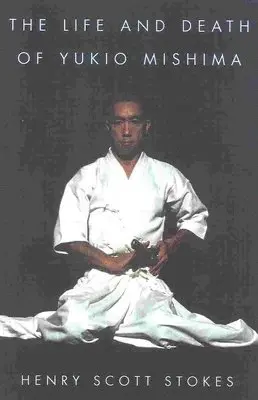
Novelist, playwright, film actor, martial artist, and political commentator, Yukio Mishima (1925-1970) was arguably the most famous person in Japan at the time of his death. Henry Scott Stokes, one of Mishima's closest friends, was the only non-Japanese allowed to attend the trial of the men involved in Mishima's spectacular suicide. In this insightful and empathetic look at the writer, Stokes guides the reader through the milestones of Mishima's meteoric and eclectic career and delves into the artist's major works and themes. This biography skillfully and compassionately illuminates the achievements and disquieting ideas of a brilliant and deeply troubled man, an artist of whom Nobel Laureate Yasunari Kawabata had said, "A writer of Mishima's caliber comes along only once every two or three hundred years."