Herbert A. Hauptman - Böcker
Visar alla böcker från författaren Herbert A. Hauptman. Handla med fri frakt och snabb leverans.
5 produkter
5 produkter
101+ Great Ideas for Introducing Key Concepts in Mathematics
A Resource for Secondary School Teachers
Inbunden, Engelska, 2006
1 243 kr
Skickas inom 3-6 vardagar
Multiply math mastery and interest with these inspired teaching tactics! Invigorate instruction and engage students with this treasure trove of "Great Ideas" compiled by two of the greatest minds in mathematics. From commonly taught topics in algebra, geometry, trigonometry, and statistics, to more advanced explorations into indirect proofs, binomial theorem, irrationality, relativity, and more, this guide outlines concepts and techniques that will inspire veteran and new educators alike. This updated second edition offers more proven practices for bringing math concepts to life in the classroom, including: 114 innovative strategies organized by subject area User-friendly content identifying "objective," "materials," and "procedure" for each technique A range of teaching models, including hands-on and computer-based methods Specific and straightforward examples with step-by-step lessonsWritten by two distinguished leaders in the field-mathematician, author, professor, university dean, and popular commentator Alfred S. Posamentier, along with mathematical pioneer and Nobel Prize recipient Herbert A. Hauptman-this guide brings a refreshing perspective to secondary math instruction to spark renewed interest and success among students and teachers.
101+ Great Ideas for Introducing Key Concepts in Mathematics
A Resource for Secondary School Teachers
Häftad, Engelska, 2006
640 kr
Skickas inom 3-6 vardagar
Multiply math mastery and interest with these inspired teaching tactics! Invigorate instruction and engage students with this treasure trove of "Great Ideas" compiled by two of the greatest minds in mathematics. From commonly taught topics in algebra, geometry, trigonometry, and statistics, to more advanced explorations into indirect proofs, binomial theorem, irrationality, relativity, and more, this guide outlines concepts and techniques that will inspire veteran and new educators alike. This updated second edition offers more proven practices for bringing math concepts to life in the classroom, including: 114 innovative strategies organized by subject area User-friendly content identifying "objective," "materials," and "procedure" for each technique A range of teaching models, including hands-on and computer-based methods Specific and straightforward examples with step-by-step lessonsWritten by two distinguished leaders in the field-mathematician, author, professor, university dean, and popular commentator Alfred S. Posamentier, along with mathematical pioneer and Nobel Prize recipient Herbert A. Hauptman-this guide brings a refreshing perspective to secondary math instruction to spark renewed interest and success among students and teachers.
On the Beauty of Science
A Nobel Laureate Reflects on the Universe, God, and the Nature of Discovery
Inbunden, Engelska, 2007
282 kr
Tillfälligt slut
In this memoir of a long, distinguished career devoted to scientific research, world-renowned mathematician Herbert A. Hauptman recounts both the joys and the disappointments of his lifelong quest to induce nature to "reveal her secrets."In 1985, Dr. Hauptman received the greatest honor that any scientist can receive, when the Royal Swedish Academy of Sciences awarded him and his colleague, Jerome Karle, the Nobel Prize in chemistry. Drs. Hauptman and Karle were recognized "for their outstanding achievements in the development of direct methods for the determination of crystal structures." This work has proved to be of the greatest importance because it relates molecular structure to biological activity, thus permitting a better understanding of life processes and making possible the development of many new disease-fighting drugs. Dr. Hauptman vividly describes the difficulties of the mathematical work that led up to his discovery as well as his joy when he finally hit upon a method of unraveling the structure of crystals. In addition, he provides a personal account of his background, family, his formative studies in high school and college, and the experiences that motivated him to pursue a life devoted to scientific research. A strong advocate of the naturalistic worldview and a critic of supernaturalism in any form, he reflects on the alleged compatibility of science and religion and emphasizes the importance of scientific understanding for contemporary civilization.Complete with an appendix containing the original monograph (coauthored with Jerome Karle), which became the basis for their Nobel Prize-winning work, this fascinating and moving memoir offers important insights into the nature of scientific research and the value of the scientific outlook on life.
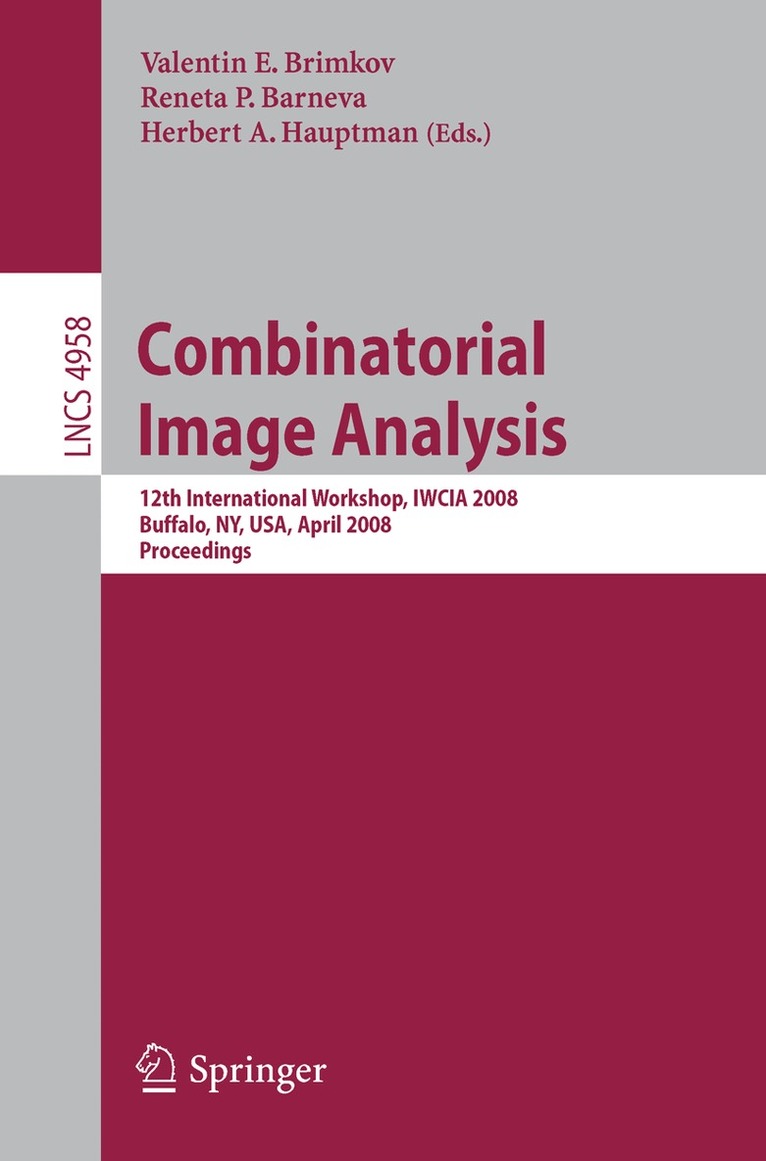
Combinatorial Image Analysis
12th International Workshop, IWCIA 2008, Buffalo, NY, USA, April 7-9, 2008, Proceedings
Häftad, Engelska, 2008
538 kr
Skickas inom 10-15 vardagar
It is indeed a great pleasure to welcome you to the proceedings of the 12th International Workshop on Combinatorial Image Analysis (IWCIA 2008) held in Bu?alo, NY, April 7-9, 2008. Image analysis is a scienti?c discipline providing theoretical foundations and methods for solving problems that appear in various areas of human practice, as diverseas medicine,robotics,defense,andsecurity.As a rule,the processeddata are discrete; thus, the "discrete," or "combinatorial"approachto image analysis appears to be a natural one and therefore its importance is increasing. In fact, combinatorial image analysis often provides various advantages (in terms of - ciency and accuracy) over the more traditional approaches based on continuous models requiring numeric computation. The IWCIA workshop series provides a forum for researchers throughout the world to present cutting-edge results in combinatorial image analysis, to discuss recent advances in this research ?eld, and to promote interaction with researchersfromothercountries.Infact,IWCIA2008retainedandevenenriched the international spirit of these workshops, that had successful prior meetings in Paris (France) 1991, Ube (Japan) 1992, Washington DC (USA) 1994, Lyon (France) 1995, Hiroshima (Japan) 1997, Madras (India) 1999, Caen (France) 2000, Philadelphia (USA) 2001, Palermo (Italy) 2003, Auckland (New Zealand) 2004, and Berlin (Germany) 2006.The IWCIA 2008 Program Committee was highly international as its members are renowned experts coming from 23 di?- entcountries,andsubmissionscamefrom24countriesfromAfrica,Asia,Europe, North and South America.
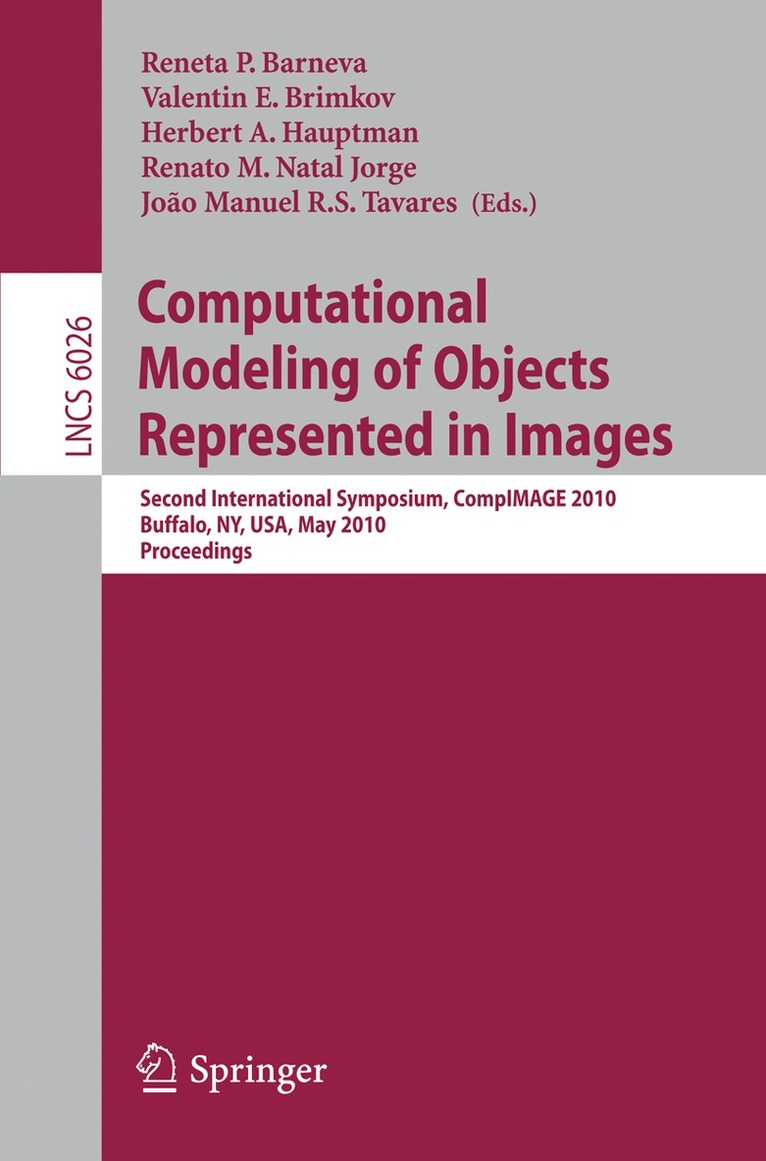
Computational Modeling of Objects Represented in Images
Second International Symposium, CompIMAGE 2010, Buffalo, NY, USA, May 5-7, 2010. Proceedings
Häftad, Engelska, 2010
554 kr
Skickas inom 10-15 vardagar
It is indeed a great pleasure to welcome you to the proceedings of the Inter- tional Symposium "Computational Modeling of Objects Represented in Images. Fundamentals,MethodsandApplications"(CompIMAGE2010)heldinBu?alo, NY, May 5-7, 2010. This was the second issue of CompIMAGE symposia, the ?rst one being held in Coimbra, Portugal. The purpose of CompIMAGE 2010 was to provide a common forum for - searchers, scientists, engineers, and practitioners around the world to present their latest research ?ndings, ideas, developments, and applications in the area of computational modeling of objects represented in images. In particular, the symposium aimed to attract scientists who use various approaches - such as ?nite element method, optimization methods, modal analysis, stochastic me- ods, principal components analysis, independent components analysis, distri- tion models, geometrical modeling, digital geometry, grammars,fuzzy logic, and others - to solve problems that appear in a wide range of areas as diverse as medicine, robotics, defense, security, astronomy,materialscience, and manuf- turing. CompIMAGE 2010 was highly international.Its Program Committee m- bersarerenownedexpertscomingfrom25di?erentcountries.Submissionstothe symposium came from 22 countries from Africa, Asia, Europe, North and South America. Overall, representatives of 32 countries contributed to the symposium in di?erent capacities.