Herbert Freeman – författare
Visar alla böcker från författaren Herbert Freeman. Handla med fri frakt och snabb leverans.
10 produkter
10 produkter
E-bok
PDF, Engelska, 2012672 kr
Läs direkt efter köp
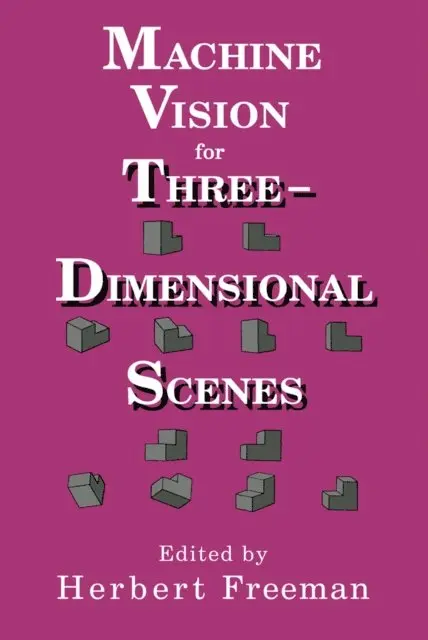
Machine Vision for Three-Dimensional Scenes contains the proceedings of the workshop "Machine Vision - Acquiring and Interpreting the 3D Scene" sponsored by the Center for Computer Aids for Industrial Productivity (CAIP) at Rutgers University and held in April 1989 in New Brunswick, New Jersey. The papers explore the applications of machine vision in image acquisition and 3D scene interpretation and cover topics such as segmentation of multi-sensor images; the placement of sensors to minimize occlusion; and the use of light striping to obtain range data.Comprised of 14 chapters, this book opens with a discussion on 3D object recognition and the problems that arise when dealing with large object databases, along with solutions to these problems. The reader is then introduced to the free-form surface matching problem and object recognition by constrained search. The following chapters address the problem of machine vision inspection, paying particular attention to the use of eye tracking to train a vision system; images of 3D scenes and the attendant problems of image understanding; the problem of object motion; and real-time range mapping. The final chapter assesses the relationship between the developing machine vision technology and the marketplace.This monograph will be of interest to practitioners in the fields of computer science and applied mathematics.
E-bok
PDF, Engelska, 2012696 kr
Läs direkt efter köp
Machine Vision for Inspection and Measurement contains the proceedings of the Second Annual Workshop on Machine Vision sponsored by the Center for Computer Aids for Industrial Productivity (CAIP) at Rutgers University and held on April 25-26, 1988 in New Brunswick, New Jersey. The papers explore the application of machine vision to inspection and measurement and cover topics such as the problem of object-pose estimation and depth recovery through inverse optics. The use of machine vision techniques in inspection of integrated circuits and semiconductor wafers is also discussed. Comprised of 11 chapters, this book opens with the problem of using fine-grained parallel machines for VLSI inspection. The discussion then turns to a variety of real-life applications of machine vision, including inspection of integrated circuits, semiconductor wafers, TV-tube glass, and mechanical parts. The use of machine vision to measure the curvature of the human cornea for vision correction and contact lens fitting purposes is also considered. The remaining chapters focus on motion estimation from stereo sequences using orthographic-view algorithms; photometric sampling for determining surface shape and reflectance; and efficient depth recovery by means of inverse optics. A chapter addresses the question of whether the industry is ready for machine vision and comes up with some optimistic predictions. This monograph will be of interest to practitioners in the fields of computer science and applied mathematics.
E-bok
PDF, Engelska, 2012696 kr
Läs direkt efter köp
Machine Vision: Algorithms, Architectures, and Systems contains the proceedings of the workshop ""Machine Vision: Where Are We and Where Are We Going?"" sponsored by the Center for Computer Aids for Industrial Productivity (CAIP) at Rutgers University and held in April 1987 in New Brunswick, New Jersey. The papers review the state of the art of machine vision and sets directions for future research. Topics covered include ""smart sensing"" in machine vision, computer architectures for machine vision, and range image segmentation. Comprised of 14 chapters, this book opens with an overview of ""smart sensing"" strategies in machine vision and illustrates how smart sensing may fit into a general purpose vision system by implementing a flexible, modular system called Pipeline Pyramid Machine. The discussion then turns to a hierarchy of local autonomy for processor arrays, focusing on the progression from pure SIMD to complete MIMD as well as the hardware penalties that arise when autonomy is increased. The following chapters explore schemes for integrating vision modules on fine-grained machines; computer architectures for real-time machine vision systems; the application of machine vision to industrial inspection; and characteristics of technologies and social processes that are inhibiting the development and/or evolution of machine vision. Machine vision research at General Motors is also considered. The final chapter assesses future prospects for machine vision and highlights directions for research. This monograph will be a useful resource for practitioners in the fields of computer science and applied mathematics.
Häftad, Engelska, 2009
251 kr
Skickas inom 5-8 vardagar
E-bok
Engelska, 2009137 kr
Läs direkt efter köp
An autobiographical story, Cobblestones describes the life story of the author from his early days in Germany, his emigration during the Nazi period, his separation from his family and his difficulties in obtaining a visa to come to the United States, resolved finally only through the intercession of Professor Albert Einstein. In his new country he had to learn English and adapt to the new countrys culture in Waterford, NY, a small central New York village, and later Cohoes, NY where he graduated as valedictorian of his high school class. After college and graduate school, he joined industry and within a decade rose to head a department with over 100 persons. This was followed by a move to academia - New York University, then Rensselaer Polytechnic Institute, and finally Rutgers University, from where he retired. In industry he designed one of the early computers (for which he received the IEEE Pioneer Award). He was active in some of the leading computer professional organizations, traveled widely in the US, Europe, Asia, and South America, and received many awards. Just prior to retirement he founded and successfully led a pioneering software company for eight years.
E-bok
Engelska, 2014783 kr
Läs direkt efter köp
Map Data Processing is a collection of papers from a NATO study on the same subject. This collection deals with the exchange of ideas and setting directions in research, particularly in pattern-recognition-, image-processing-, and computer-related issues. The papers discuss the usefulness of computer systems in geographical data processing, as well as the viability of scan digitization resulting from improvements in line thinning and vectorization. Automated spatial data integration can also be helpful in analyzing spatial data, data collection, capture methods, and data characteristics. Another paper addresses the application of the 8-point chain-encoded lineal map data to define more accurate algorithms found in many geographical and medical imagery. One paper considers how the same data used in monochromatic images can be realized for full colored, textured, realist terrain scenes. This book can be a valuable reference for workers involved in areas of geography, computer imaging, cartography, computer graphics, and remote sensing.
Häftad, Engelska, 1998
1 116 kr
Skickas inom 10-15 vardagar
This book constitutes the joint refereed proceedings of the two IAPR International Workshops on Structural and Syntactic Pattern Recognition and on Statistical Techniques in Pattern Recognition, SSPR'98 and SPR'98, held in Sydney, Australia, in August 1998.The book presents 107 revised full papers selected from 134 submissions. Also included are six invited presentations. The papers are organized in topical sections on structural matching and grammatical inference, recognition of 2D and 3D objects, document image analysis and recognition, handwritten character recognition, shape representation and image segmentation, learning methodologies, feature selection and extraction, statistical classification techniques, statistical pattern recognition, and rejection in pattern recognition.
E-bok
PDF, Engelska, 20131 459 kr
Läs direkt efter köp
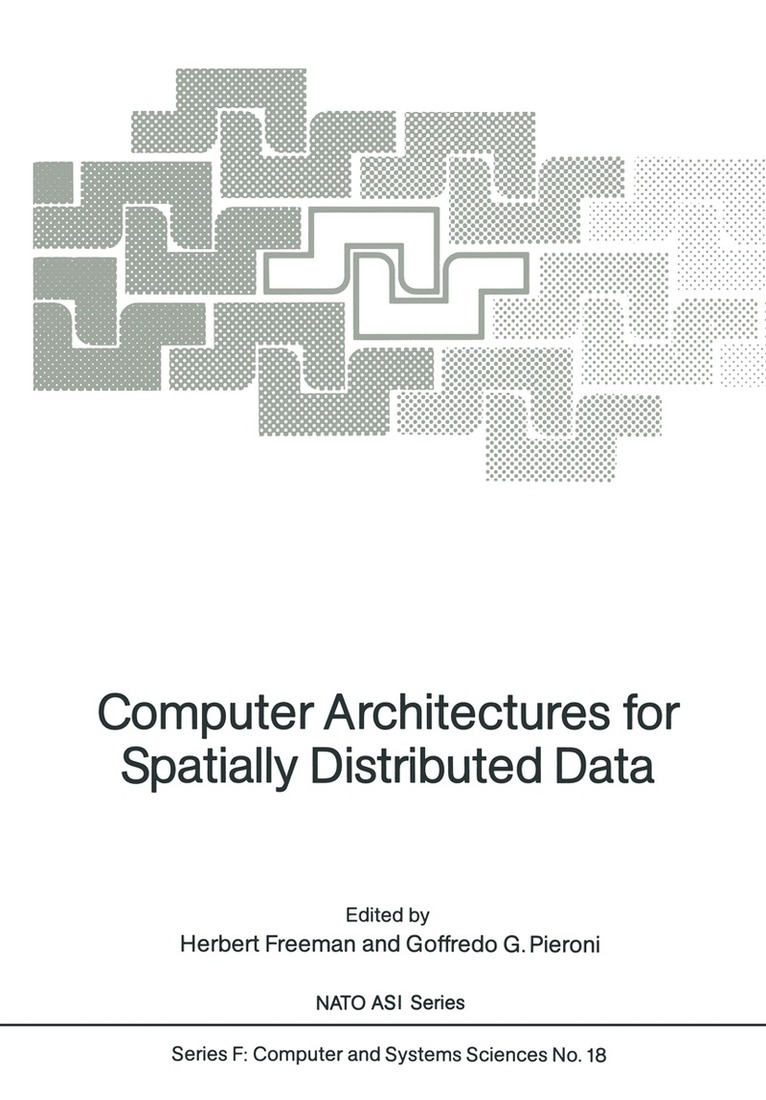
These are the proceedings of a NATO Advanced Study Institute (ASI) held in Cetraro, Italy during 6-17 June 1983. The title of the ASI was Computer Arehiteetures for SpatiaZZy vistributed Vata, and it brouqht together some 60 participants from Europe and America. Presented ~ere are 21 of the lectures that were delivered. The articles cover a wide spectrum of topics related to computer architecture s specially oriented toward the fast processing of spatial data, and represent an excellent review of the state-of-the-art of this topic. For more than 20 years now researchers in pattern recognition, image processing, meteorology, remote sensing, and computer engineering have been looking toward new forms of computer architectures to speed the processing of data from two- and three-dimensional processes. The work can be said to have commenced with the landmark article by Steve Unger in 1958, and it received a strong forward push with the development of the ILIAC III and IV computers at the University of Illinois during the 1960''s. One clear obstacle faced by the computer designers in those days was the limitation of the state-of-the-art of hardware, when the only switching devices available to them were discrete transistors. As aresult parallel processing was generally considered to be imprae tieal, and relatively little progress was made.
Häftad, Engelska, 2011
1 116 kr
Skickas inom 10-15 vardagar
These are the proceedings of a NATO Advanced Study Institute (ASI) held in Cetraro, Italy during 6-17 June 1983. The title of the ASI was Computer Arehiteetures for SpatiaZZy vistributed Vata, and it brouqht together some 60 participants from Europe and America. Presented ~ere are 21 of the lectures that were delivered. The articles cover a wide spectrum of topics related to computer architecture s specially oriented toward the fast processing of spatial data, and represent an excellent review of the state-of-the-art of this topic. For more than 20 years now researchers in pattern recognition, image processing, meteorology, remote sensing, and computer engineering have been looking toward new forms of computer architectures to speed the processing of data from two- and three-dimensional processes. The work can be said to have commenced with the landmark article by Steve Unger in 1958, and it received a strong forward push with the development of the ILIAC III and IV computers at the University of Illinois during the 1960's. One clear obstacle faced by the computer designers in those days was the limitation of the state-of-the-art of hardware, when the only switching devices available to them were discrete transistors. As aresult parallel processing was generally considered to be imprae tieal, and relatively little progress was made.
Del 25 - Series In Machine Perception And Artificial Intelligence
Studies In Pattern Recognition: A Memorial To The Late Professor King-sun Fu
Inbunden, Engelska, 1997
1 665 kr
Tillfälligt slut
More than ten years have passed since the untimely death of King-Sun Fu, one of the great pioneers in the field of pattern recognition. It was he, more than any other single individual, who nurtured the field during its formative years, and set the tone and tempo for others to follow. This book is dedicated to his memory.This book contains 11 chapters by authors who knew King-Sun Fu and in varying degrees interacted with him. The articles span the field of pattern recognition in its current state, and cover such diverse topics as neural nets, covariance propagation, genetic selection, shape description, characteristic views for 3D modeling, face recognition, speech recognition, and machine translation. In tone they vary from the highly theoretical to the applied. Their presentation here is a testimonial, by his former colleagues and friends, to the pioneer who did so much to bring pattern recognition to its position as a recognized discipline world-wide.