Herbert Spiegelberg – författare
Visar alla böcker från författaren . Handla med fri frakt och snabb leverans.
7 produkter
7 produkter
Häftad, Engelska, 1972
394 kr
Skickas inom 11-20 vardagar
Del 5 - Phaenomenologica
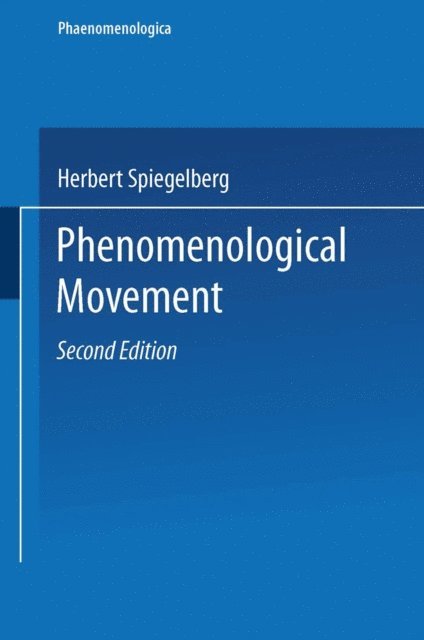
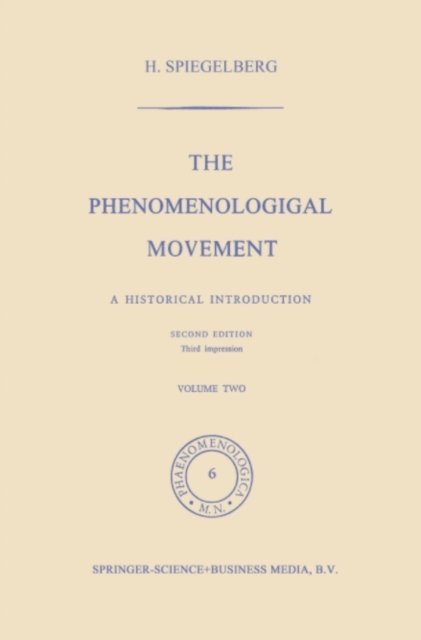
Phenomenological Movement
A Historical Introduction
Häftad, Engelska, 1971
973 kr
Skickas inom 10-15 vardagar
The present attempt to introduce the general philosophical reader to the Phenomenological Movement by way of its history has itself a history which is pertinent to its objective. It may suitably be opened by the following excerpts from a review which Herbert W. Schneider of Columbia University, the Head of the Division for Internc. . tional Cultural Cooperation, Department of Cultural Activities of Unesco from 1953 to 56, wrote in 1950 from France: The influence of Husser! has revolutionized continental philosophies, not because his philosophy has become dominant, but because any philosophy now seeks to accommodate itself to, and express itself in, phenomenological method. It is the sine qua non of critical respectability. In America, on the contrary, phenomenology is in its infancy. The aver age American student of philosophy, when he picks up a recent volume of philosophy published on the continent of Europe, must first learn the "tricks" of the phenomenological trade and then translate as best he can the real import of what is said into the kind of analysis with which he is familiar. . . . . . . No doubt, American education will gradually take account of the spread of phenomenological method and terminology, but until it does, American readers of European philosophy have a severe handicap; and this applies not only to existentialism but to almost all current philosophicalliterature.
Häftad, Engelska, 1976
866 kr
Skickas inom 10-15 vardagar
E-bok
PDF, Engelska, 20131 140 kr
Läs direkt efter köp
The present attempt to introduce the general philosophical reader to the Phenomenological Movement by way of its history has itself a history which is pertinent to its objective. It may suitably be opened by the following excerpts from a review which Herbert W. Schneider of Columbia University, the Head of the Division for International Cultural Cooperation, Department of Cultural Activities of Unesco from 1953 to 56, wrote in 1950 from France: The influence of Husserl has revolutionized continental philosophies, not because his philosophy has become dominant, but because any philosophy now seeks to accommodate itself to, and express itself in, phenomenological method. It is the sine qua non of critical respectability. In America, on the contrary, phenomenology is in its infancy. The aver age American student of philosophy, when he picks up a recent volume of philosophy published on the continent of Europe, must first learn the "tricks" of the phenomenological trade and then translate as best he can the real import of what is said into the kind of analysis with which he is familiar. . . . . . . No doubt, American education will gradually take account of the spread of phenomenological method and terminology, but until it does, American readers of European philosophy have a severe handicap; and this applies not only to existentialism but to almost all current philosophicalliterature.
E-bok
PDF, Engelska, 20131 258 kr
Läs direkt efter köp
The present attempt to introduce the general philosophical reader to the Phenomenological Movement by way of its history has itself a history which is pertinent to its objective. It may suitably be opened by the following excerpts from a review which Herbert W. Schneider of Columbia University, the Head of the Division for Internc. . tional Cultural Cooperation, Department of Cultural Activities of Unesco from 1953 to 56, wrote in 1950 from France: The influence of Husser! has revolutionized continental philosophies, not because his philosophy has become dominant, but because any philosophy now seeks to accommodate itself to, and express itself in, phenomenological method. It is the sine qua non of critical respectability. In America, on the contrary, phenomenology is in its infancy. The aver age American student of philosophy, when he picks up a recent volume of philosophy published on the continent of Europe, must first learn the "tricks" of the phenomenological trade and then translate as best he can the real import of what is said into the kind of analysis with which he is familiar. . . . . . . No doubt, American education will gradually take account of the spread of phenomenological method and terminology, but until it does, American readers of European philosophy have a severe handicap; and this applies not only to existentialism but to almost all current philosophicalliterature.
E-bok
PDF, Engelska, 20131 140 kr
Läs direkt efter köp
E-bok
PDF, Engelska, 20131 116 kr
Läs direkt efter köp