Heritage John Heritage – författare
Visar alla böcker från författaren Heritage John Heritage. Handla med fri frakt och snabb leverans.
2 produkter
2 produkter
E-bok
Engelska, 20181 305 kr
Läs direkt efter köp
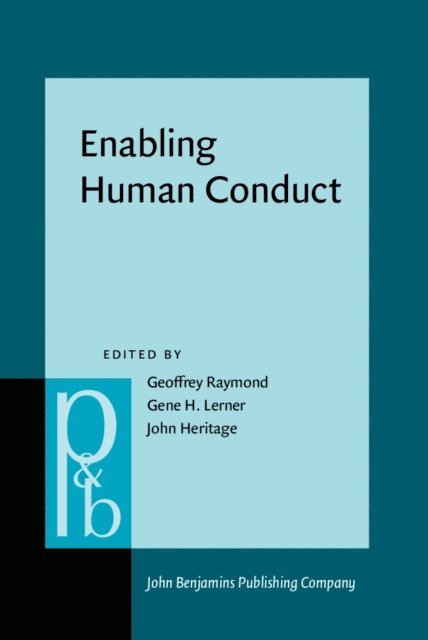
The last two decades have witnessed a remarkable growth of interest in what are variously termed discourse markers or discourse particles. The greatest area of growth has centered on particles that occur in sentence-initial or turn-initial position, and this interest intersects with a long-standing focus in Conversation Analysis on turn-taking and turn-construction. This volume brings together conversation analytic studies of turn-initial particles in interactions in fourteen languages geographically widely distributed (Europe, America, Asia and Australia). The contributions show the significance of turn-initial particles in three key areas of turn and sequence organization: (i) the management of departures from expected next actions, (ii) the projection of the speaker's epistemic stance, and (iii) the management of overall activities implemented across sequences. Taken together the papers demonstrate the crucial importance of the positioning of particles within turns and sequences for the projection and management of social actions, and for relationships between speakers.
E-bok
Engelska, 20171 258 kr
Läs direkt efter köp
This collection offers a multifaceted view of the life, research and impact of Emanuel A. Schegloff, the co-originator, with Harvey Sacks and Gail Jefferson, of Conversation Analysis (or CA), and its leading contemporary authority. The first section introduces Schegloff's life and work, and, using a series of interviews with him, provides a concise, comprehensive and accessible introduction to the field's major aims and achievements. Next many of the world's leading researchers from various disciplines - including Communication, Linguistics, Psycholinguistics, Linguistic Anthropology, and Sociology - build on Schegloff's foundational research, analyzing encounters from everyday and institutional settings (conducted in English, German, Korean, Mandarin, and Russian) to explicate how conversation and other conduct in interaction are organized. The final section of the book includes reflections on Schegloff's contributions by some of his major interlocutors and Schegloff's response to them.