Herman G. van de Werfhorst – författare
Visar alla böcker från författaren . Handla med fri frakt och snabb leverans.
4 produkter
4 produkter
E-bok
PDF, Engelska, 2014694 kr
Läs direkt efter köp
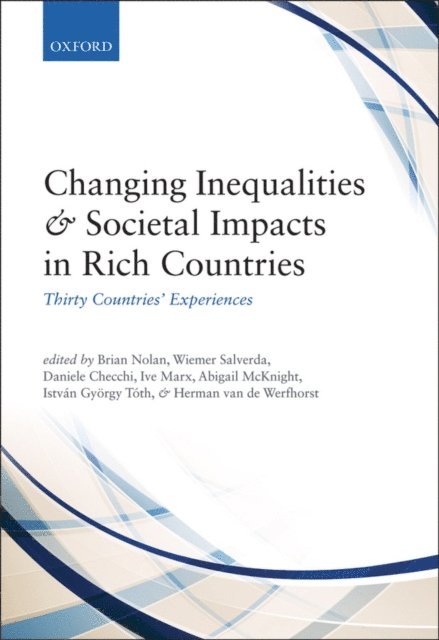
There has been a remarkable upsurge of debate about increasing inequalities and their societal implications, reinforced by the economic crisis but bubbling to the surface before it. This has been seen in popular discourse, media coverage, political debate, and research in the social sciences. The central questions addressed by this book, and the major research project GINI on which it is based, are:- Have inequalities in income, wealth and education increased over the past 30 years or so across the rich countries, and if so why?- What are the social, cultural and political impacts of increasing inequalities in income, wealth and education?- What are the implications for policy and for the future development of welfare states?In seeking to answer these questions, this book adopts an interdisciplinary approach that draws on economics, sociology, and political science, and applies a common analytical framework to the experience of 30 advanced countries, namely all the EU member states except Cyprus and Malta, together with the USA, Japan, Canada, Australia and South Korea. It presents a description and analysis of the experience of each of these countries over the past three decades, together with an introduction, anoverview of inequality trends, and a concluding chapter highlighting key findings and implications. These case-studies bring out the variety of country experiences and the importance of framing inequality trends in the institutional and policy context of each country if one is to adequately captureand understand the evolution of inequality and its impacts.
Inbunden, Engelska, 2027
2 153 kr
Kommande
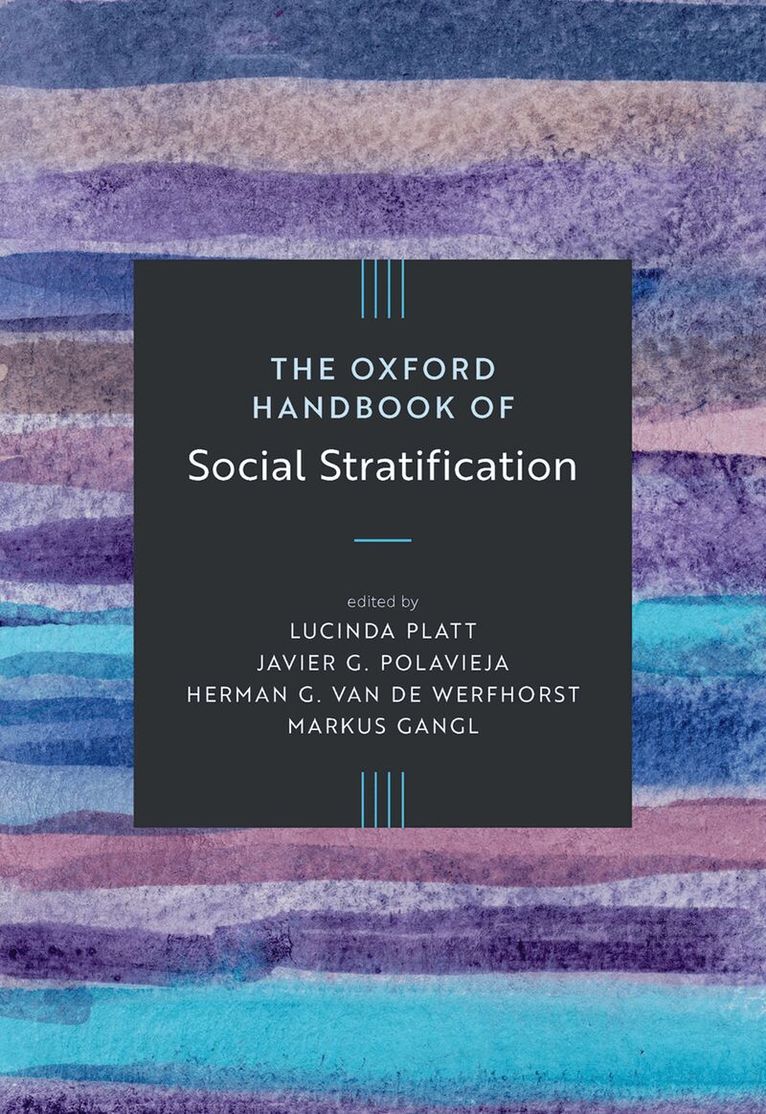
The Oxford Handbook of Social Stratification brings together leading experts to demonstrate the value of stratification research for sociology's past and future as a population science. In an era of profound transformation, characterized by growing inequalities, political unrest, technological disruption, demographic changes, and global crises, the need for rigorous scholarship on social stratification is crucial. This Handbook provides a forward-looking overview, illustrating how the field remains grounded in its scholarly roots while expanding to address contemporary social inequality dynamics.With historical insights, analytical precision, and methodological rigor, the Handbook serves as both a comprehensive field assessment and a roadmap for future research. Part I covers core concepts such as social class, gender, race, education, and life course analysis. Part II offers state-of-the-art research insights on social mobility, family dynamics, education and labor markets, migration, discrimination, and policy, connecting these to classical sociological questions. Part III explores future research directions, incorporating innovations from behavioral and cognitive sciences, sociogenomics, cultural analysis, and responses to global crises. Broad, cohesive, and accessible, the volume is an indispensable resource for scholars, students, and anyone interested in understanding the construction, maintenance, and challenge of social hierarchies and their impact on shaping 21st-century societies.
Häftad, Engelska, 2016
987 kr
Skickas inom 7-10 vardagar
There has been a remarkable upsurge of debate about increasing inequalities and their societal implications, reinforced by the economic crisis but bubbling to the surface before it. This has been seen in popular discourse, media coverage, political debate, and research in the social sciences. The central questions addressed by this book, and the major research project GINI on which it is based, are: - Have inequalities in income, wealth and education increased over the past 30 years or so across the rich countries, and if so why?- What are the social, cultural and political impacts of increasing inequalities in income, wealth and education?- What are the implications for policy and for the future development of welfare states? In seeking to answer these questions, this book adopts an interdisciplinary approach that draws on economics, sociology, and political science, and applies a common analytical framework to the experience of 30 advanced countries, namely all the EU member states except Cyprus and Malta, together with the USA, Japan, Canada, Australia and South Korea. It presents a description and analysis of the experience of each of these countries over the past three decades, together with an introduction, an overview of inequality trends, and a concluding chapter highlighting key findings and implications. These case-studies bring out the variety of country experiences and the importance of framing inequality trends in the institutional and policy context of each country if one is to adequately capture and understand the evolution of inequality and its impacts.
Inbunden, Engelska, 2014
2 320 kr
Skickas inom 7-10 vardagar
There has been a remarkable upsurge of debate about increasing inequalities and their societal implications, reinforced by the economic crisis but bubbling to the surface before it. This has been seen in popular discourse, media coverage, political debate, and research in the social sciences. The central questions addressed by this book, and the major research project GINI on which it is based, are:- Have inequalities in income, wealth and education increased over the past 30 years or so across the rich countries, and if so why?- What are the social, cultural and political impacts of increasing inequalities in income, wealth and education?- What are the implications for policy and for the future development of welfare states?In seeking to answer these questions, this book adopts an interdisciplinary approach that draws on economics, sociology, and political science, and applies a common analytical framework to the experience of 30 advanced countries, namely all the EU member states except Cyprus and Malta, together with the USA, Japan, Canada, Australia and South Korea. It presents a description and analysis of the experience of each of these countries over the past three decades, together with an introduction, an overview of inequality trends, and a concluding chapter highlighting key findings and implications. These case-studies bring out the variety of country experiences and the importance of framing inequality trends in the institutional and policy context of each country if one is to adequately capture and understand the evolution of inequality and its impacts.