Hermann König – författare
Visar alla böcker från författaren Hermann König. Handla med fri frakt och snabb leverans.
5 produkter
5 produkter
Inbunden, Engelska, 2018
546 kr
Skickas inom 10-15 vardagar
This monograph develops an operator viewpoint for functional equations in classical function spaces of analysis, thus filling a void in the mathematical literature. Major constructions or operations in analysis are often characterized by some elementary properties, relations or equations which they satisfy. The authors present recent results on the problem to what extent the derivative is characterized by equations such as the Leibniz rule or the Chain rule operator equation in Ck-spaces. By localization, these operator equations turn into specific functional equations which the authors then solve. The second derivative, Sturm-Liouville operators and the Laplacian motivate the study of certain "second-order" operator equations. Additionally, the authors determine the general solution of these operator equations under weak assumptions of non-degeneration. In their approach, operators are not required to be linear, and the authors also try to avoid continuity conditions. TheLeibniz rule, the Chain rule and its extensions turn out to be stable under perturbations and relaxations of assumptions on the form of the operators. The results yield an algebraic understanding of first- and second-order differential operators. Because the authors have chosen to characterize the derivative by algebraic relations, the rich operator-type structure behind the fundamental notion of the derivative and its relatives in analysis is discovered and explored.The book does not require any specific knowledge of functional equations. All needed results are presented and proven and the book is addressed to a general mathematical audience.
Häftad, Engelska, 2019
546 kr
Skickas inom 10-15 vardagar
This monograph develops an operator viewpoint for functional equations in classical function spaces of analysis, thus filling a void in the mathematical literature. Major constructions or operations in analysis are often characterized by some elementary properties, relations or equations which they satisfy. The authors present recent results on the problem to what extent the derivative is characterized by equations such as the Leibniz rule or the Chain rule operator equation in Ck-spaces. By localization, these operator equations turn into specific functional equations which the authors then solve. The second derivative, Sturm-Liouville operators and the Laplacian motivate the study of certain "second-order" operator equations. Additionally, the authors determine the general solution of these operator equations under weak assumptions of non-degeneration. In their approach, operators are not required to be linear, and the authors also try to avoid continuity conditions. TheLeibniz rule, the Chain rule and its extensions turn out to be stable under perturbations and relaxations of assumptions on the form of the operators. The results yield an algebraic understanding of first- and second-order differential operators. Because the authors have chosen to characterize the derivative by algebraic relations, the rich operator-type structure behind the fundamental notion of the derivative and its relatives in analysis is discovered and explored.The book does not require any specific knowledge of functional equations. All needed results are presented and proven and the book is addressed to a general mathematical audience.
Del 354 - Sammlung Göschen
Vektoren und Matrizen
Inbunden, Tyska, 1960
1 597 kr
Skickas inom 5-8 vardagar
Häftad, Tyska, 2012
1 147 kr
Skickas inom 10-15 vardagar
Häftad, Engelska, 2012
1 116 kr
Skickas inom 10-15 vardagar
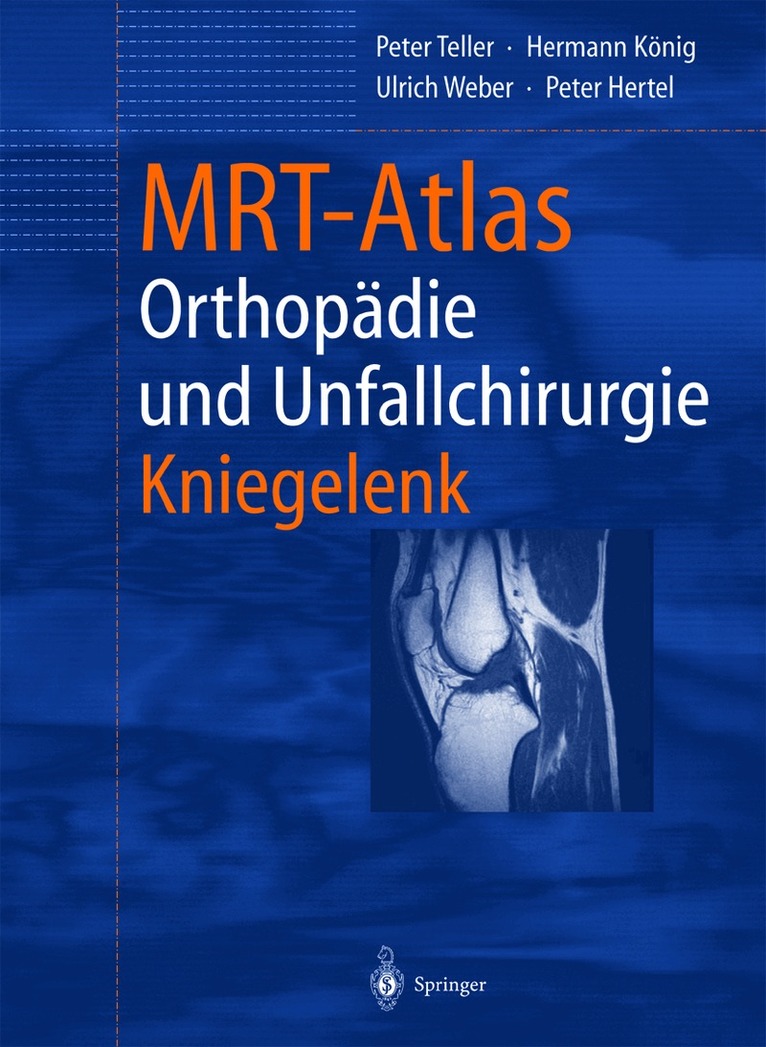
This MRI atlas of the knee joint is the fruit of interdisciplinary cooperation among radiologists, orthopedists and traumatologists. All important diseases and injuries of the knee are covered. Every part of the joint is comprehensively depicted in a series of MR images ranging all the way from the normal status to frank disease. Clinical evaluation of the findings is followed in each case by detailed information on diagnostic pitfalls, staging of disease and consequences for treatment.