Hermine Vloemans – författare
Visar alla böcker från författaren Hermine Vloemans. Handla med fri frakt och snabb leverans.
5 produkter
5 produkter
Inbunden, Engelska, 2002
1 091 kr
Skickas inom 10-15 vardagar
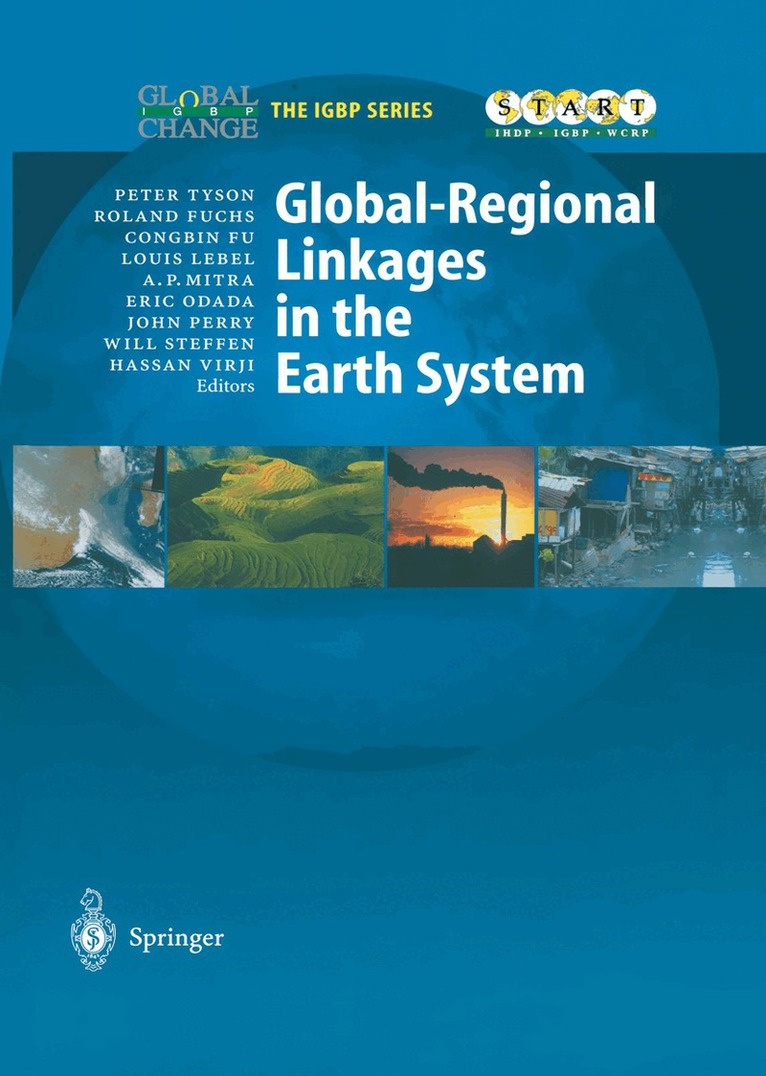
Global environmental change occupies a central niche in the pantheon of modern sciences. There is an urgent need to know and understand the way in which global biogeochemical cycles have changed over different time scales in the past and are likely to do so in the future. Equally important, it is necessary to determine the extent to which natural variability and that induce by anthropogenic activities are bringing about change. A number of international co-operative scientific programmes ad dress these issues. Chief among them are the International Geosphere-Biosphere Programme (IGBP), the World Climate Research Programme (WCRP) and the Inter national Human Dimensions Programme (IHDP) for global change. This book is one of a series of IGBP syntheses drawing together findings in global environmental change over the past decade or so. One focus of IGBP activities is the System for Analysis, Research and Training (START). Co-sponsored by the WCRP and IHDP, START establishes regional research networks for global change science in developing countries, stimulates and carries out global change research in developing regions of the world, and builds capacity to undertake such research at personal, institutional and regional levels. Several regional global change networks have been established, and much regional research has been accomplished in the last five years or so. In this book, work relating to four of the older START regions, Southern Africa, South Asia, Southeast Asia and East Asia, will be used as case studies to illustrate regional-global linkages in Earth System Science.
E-bok
PDF, Engelska, 20121 367 kr
Läs direkt efter köp
Global environmental change occupies a central niche in the pantheon of modern sciences. There is an urgent need to know and understand the way in which global biogeochemical cycles have changed over different time scales in the past and are likely to do so in the future. Equally important, it is necessary to determine the extent to which natural variability and that induce by anthropogenic activities are bringing about change. A number of international co-operative scientific programmes ad dress these issues. Chief among them are the International Geosphere-Biosphere Programme (IGBP), the World Climate Research Programme (WCRP) and the Inter national Human Dimensions Programme (IHDP) for global change. This book is one of a series of IGBP syntheses drawing together findings in global environmental change over the past decade or so. One focus of IGBP activities is the System for Analysis, Research and Training (START). Co-sponsored by the WCRP and IHDP, START establishes regional research networks for global change science in developing countries, stimulates and carries out global change research in developing regions of the world, and builds capacity to undertake such research at personal, institutional and regional levels. Several regional global change networks have been established, and much regional research has been accomplished in the last five years or so. In this book, work relating to four of the older START regions, Southern Africa, South Asia, Southeast Asia and East Asia, will be used as case studies to illustrate regional-global linkages in Earth System Science.
Häftad, Engelska, 2012
1 092 kr
Skickas inom 10-15 vardagar
Global environmental change occupies a central niche in the pantheon of modern sciences. There is an urgent need to know and understand the way in which global biogeochemical cycles have changed over different time scales in the past and are likely to do so in the future. Equally important, it is necessary to determine the extent to which natural variability and that induce by anthropogenic activities are bringing about change. A number of international co-operative scientific programmes ad dress these issues. Chief among them are the International Geosphere-Biosphere Programme (IGBP), the World Climate Research Programme (WCRP) and the Inter national Human Dimensions Programme (IHDP) for global change. This book is one of a series of IGBP syntheses drawing together findings in global environmental change over the past decade or so. One focus of IGBP activities is the System for Analysis, Research and Training (START). Co-sponsored by the WCRP and IHDP, START establishes regional research networks for global change science in developing countries, stimulates and carries out global change research in developing regions of the world, and builds capacity to undertake such research at personal, institutional and regional levels. Several regional global change networks have been established, and much regional research has been accomplished in the last five years or so. In this book, work relating to four of the older START regions, Southern Africa, South Asia, Southeast Asia and East Asia, will be used as case studies to illustrate regional-global linkages in Earth System Science.
E-bok
PDF, Engelska, 2012712 kr
Läs direkt efter köp
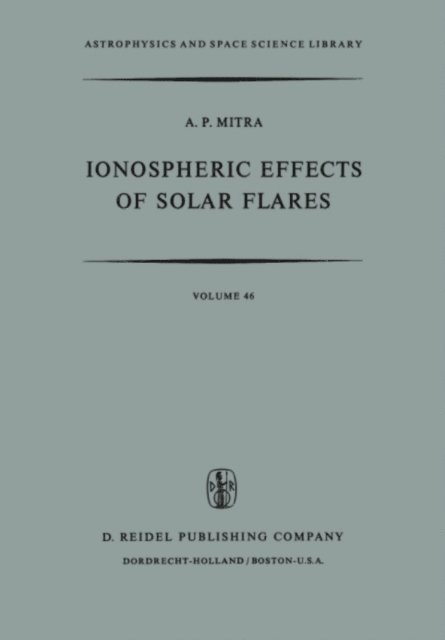
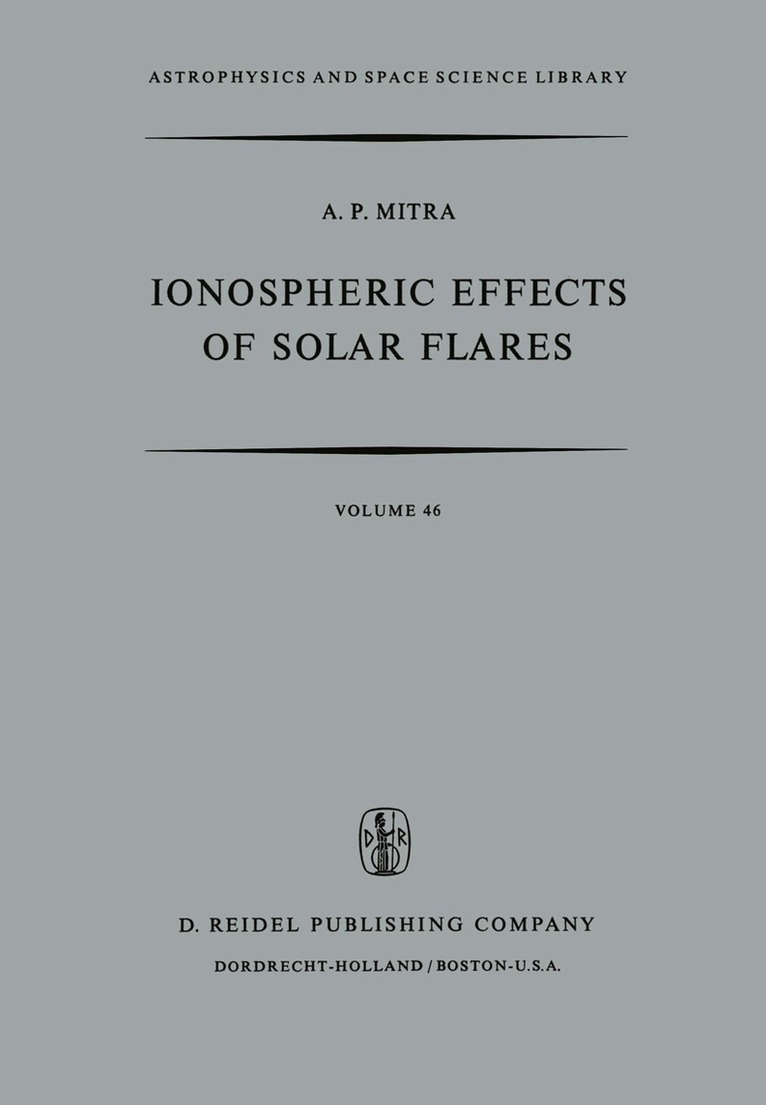
Sudden Ionospheric Disturbances resulting from an interaction of the Solar Flare radiation with the constituents of the upper atmosphere constitute one of the three major aspects of ground level monitoring of solar flares -the other two being optical observations of flares, and the observations of solar bursts in radio wavelengths. SIDs, therefore, form a major part of flare monitoring programme in many observatories. Unlike the other two, however, the ionospheric effects of flares provide one major additional source of interest - the reaction of the ionospheric plasma to an impulsive ionization. The high atmosphere provides a low pressure laboratory without walls in which a host of reactions occur between electrons, ions and neutral particles. The resulting products and their distributions may bear no resemblance to those of the primary neutral constituents or their direct ionization products. The variations with the time of the day, with season and with solar activity that form the bulk of the ionospheric measurements are too slow to allow any insight into the nature of these ionospheric reactions whose lifetimes are often very short. The relaxation time of the ionospheric ionization is only a few minutes or fraction of a minute in the lower ionosphere and in the E-region and is about 30 min to an hour at 300 km. The flares provide a sudden short impulse comparable to these time scales.
Del 46 - Astrophysics and Space Science Library
Ionospheric Effects of Solar Flares
Häftad, Engelska, 2012
549 kr
Skickas inom 10-15 vardagar
Sudden Ionospheric Disturbances resulting from an interaction of the Solar Flare radiation with the constituents of the upper atmosphere constitute one of the three major aspects of ground level monitoring of solar flares -the other two being optical observations of flares, and the observations of solar bursts in radio wavelengths. SIDs, therefore, form a major part of flare monitoring programme in many observatories. Unlike the other two, however, the ionospheric effects of flares provide one major additional source of interest - the reaction of the ionospheric plasma to an impulsive ionization. The high atmosphere provides a low pressure laboratory without walls in which a host of reactions occur between electrons, ions and neutral particles. The resulting products and their distributions may bear no resemblance to those of the primary neutral constituents or their direct ionization products. The variations with the time of the day, with season and with solar activity that form the bulk of the ionospheric measurements are too slow to allow any insight into the nature of these ionospheric reactions whose lifetimes are often very short. The relaxation time of the ionospheric ionization is only a few minutes or fraction of a minute in the lower ionosphere and in the E-region and is about 30 min to an hour at 300 km. The flares provide a sudden short impulse comparable to these time scales.