Hevina S. Dashwood – författare
Visar alla böcker från författaren Hevina S. Dashwood. Handla med fri frakt och snabb leverans.
3 produkter
3 produkter
Inbunden, Engelska, 2012
799 kr
Skickas inom 7-10 vardagar
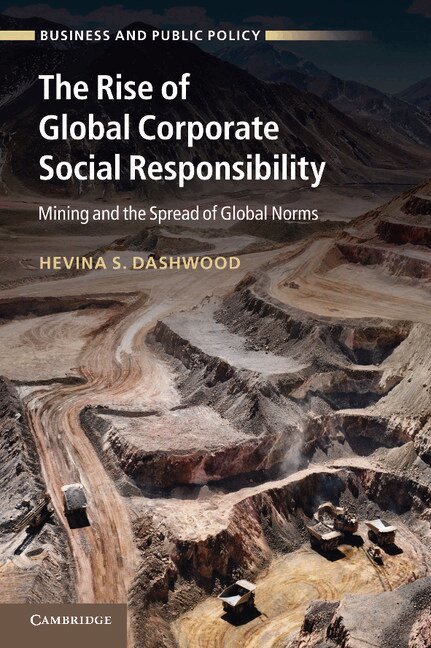
Combining insights from international relations theory with institutional approaches from organization theory and public policy, this book provides a complete explanation for the adoption of corporate social responsibility (CSR), showing how global norms influenced CSR adoption in the mining industry. Global normative developments have clearly had an important influence on major mining companies: by the mid-2000s, the majority had adopted sustainable development as a normative frame for their CSR policies and practices. However, there is significant variation between firms in terms of the timing, degree of commitment, and the willingness to assume a leadership role in promoting global standards for the mining industry. The author finds that attributes internal to the firm, including the critical role of leadership, and the way in which management responds to the institutional context and operational challenges faced in different countries are important influences on CSR adoption and important factors explaining variation.
Häftad, Engelska, 2014
462 kr
Skickas inom 7-10 vardagar
Combining insights from international relations theory with institutional approaches from organization theory and public policy, this book provides a complete explanation for the adoption of corporate social responsibility (CSR), showing how global norms influenced CSR adoption in the mining industry. Global normative developments have clearly had an important influence on major mining companies: by the mid-2000s, the majority had adopted sustainable development as a normative frame for their CSR policies and practices. However, there is significant variation between firms in terms of the timing, degree of commitment, and the willingness to assume a leadership role in promoting global standards for the mining industry. The author finds that attributes internal to the firm, including the critical role of leadership, and the way in which management responds to the institutional context and operational challenges faced in different countries are important influences on CSR adoption and important factors explaining variation.
E-bok
PDF, Engelska, 20001 145 kr
Läs direkt efter köp
Since Zimbabwe's transition to black-majority rule in 1980, the political changes in that country have been the subject of much study and debate. In this cogent analysis, Hevina Dashwood traces the evolution of Zimbabwe's development strategy from independence to 1997.During this period, there was a fundamental shift away from the social-welfarist orientation of the original development strategy, a change that coincided with the introduction of the Structural Adjustment Programme in 1991. Dashwood traces the reconfiguration of the class structure in Zimbabwe, which led to the formation of a state-based bourgeoisie, whose interests are more closely aligned with those of the agrarian and entrepreneurial elites, rather than with the poor. Greater reliance was placed on market considerations and it became clear that the government was moving away from its earlier strong commitment to meeting the welfare needs of the poor. Dashwood argues that it was the class interests of the ruling elite, rather than pressure from the international financial institutions, that explains the failure of the government to devise a coherent, socially sensitive development strategy in conjunction with market-based reforms. This account of Zimbabwe's transformation sheds light on recent events in Zimbabwe as well as current debates on economic development throughout Africa.