Hezi Brosh - Böcker
Visar alla böcker från författaren Hezi Brosh. Handla med fri frakt och snabb leverans.
4 produkter
4 produkter
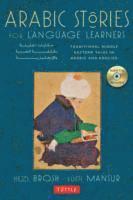
Arabic Stories for Language Learners
Traditional Middle Eastern Tales In Arabic and English (Online Included)
Häftad, Engelska, 2013
194 kr
Skickas
Arabic Stories for Language Learners—a language learning experience for beginner to intermediate students of the Arabic language.The traditional stories of a country are invaluable at providing insight into understanding the culture, history and language of a people. A great way to learn Arabic, the sixty-six stories found in Arabic Stories for Language Learners present the vocabulary and grammar used every day in Arabic-speaking countriesPulled from a wide variety of sources that have been edited and simplified for learning purposes, these stories are presented in parallel Arabic and English, facilitating language learning in the classroom and via self-study. Each story is followed by a series of questions in Arabic and English to test comprehension and encourage discussion. Online companion audio helps students of Arabic improve their pronunciation and inflection, and immerses non-students into the uniquely Arabic storytelling style.All audio content is alternatively accessible on the Tuttle Publishing website
Salamaat! Learning Arabic with Ease
Learn the Building Blocks of Modern Standard Arabic (Includes Free Online Audio)
Häftad, Engelska, 2018
276 kr
Skickas
Salamaat! Learning Arabic with Ease is a new language learning book designed to open your world to the beautiful Arabic language. "Salamaat!" means "Greetings, I hope you are well!" and is usually the first word used in every situation in the Arabic-spreaking world.The first step is to become comfortable with the Arabic alphabet and the sounds of the language. Author Dr. Hezi Brosh has developed a highly successful, simplified teaching method that has helped thousands of English speakers to speak, read, and write Arabic within a short period. His method teaches many basic building blocks that are proven to work well in promoting fluency. The most crucial goal of learning a language is to communicate effectively—learning the basic sentence structures and vocabulary that you need and will use on a daily basis. Salamaat! Learning Arabic with Ease guides you in acquiring the critical grammar and phrases, so you can begin to use Arabic to carry out fundamental tasks from greetings to daily routines. Here are some of the book's key features:You learn Modern Standard Arabic, understood in all parts of the Arabic-speaking world today.You learn to read and write the Arabic script efficiently thanks to a method designed specifically for native English speakers.Particular attention is given to understanding Arabic culture and placing the language within its cultural context.A fundamental communicative approach presents each new grammar feature with an emphasis on how it can help you communicate with others.Exercises build listening and comprehension skills to help you absorb the primary sounds, meanings and sentence patterns of the language.Free online audio with numerous recordings helps to build listening comprehension.
859 kr
Skickas inom 7-10 vardagar
This book offers a compelling case study on Arabic Teaching and Learning (ATL) as a foreign language within Israel's Jewish educational system. It delves into the intricate interplay among politics, pedagogy, and linguistics. The author argues that ATL has not met expectations, despite investments and pedagogical reforms. The sociopolitical context, particularly the Arab–Israeli conflict, has far-reaching consequences for various aspects of Arabic education, affecting the status and dissemination of the language within Jewish-Israeli society. These aspects encompass language policies, attitudes and motivation, curriculum development, recognizing Arabic as a critical security concern, and the roles of native and non-native teachers. By examining the distinct circumstances, constraints, and challenges encountered in ATL in Israel, this book provides valuable insights into the role of language education in conflict-ridden environments.Hezi Brosh sheds light on language teaching methodologies, policy, and planning, providing a fresh perspective on the intricate relationship between language and politics. Understanding these dynamics can pave the way for exploring strategies to leverage language as a unifying force rather than a divisive one. The Israeli experience holds valuable lessons and hypotheses that can be applied to other conflict-affected regions worldwide, such as Cyprus, South Africa, Northern Ireland, Bosnia, Serbia, Croatia, Myanmar, and Kosovo. These regions, where specific languages and cultures may bear negative stigmas, can benefit from comprehending how language policies shaped by conflict contribute to discrimination against minority groups. Given the significance of investigating language learning in conflict contexts, there is a need for extensive research to enhance our understanding. Critically evaluating the implications of conflicts on language policies and their impact on minority groups would yield valuable lessons to inform language education practices in conflict-affected regions.
291 kr
Skickas inom 7-10 vardagar
This book offers a compelling case study on Arabic Teaching and Learning (ATL) as a foreign language within Israel's Jewish educational system. It delves into the intricate interplay among politics, pedagogy, and linguistics. The author argues that ATL has not met expectations, despite investments and pedagogical reforms. The sociopolitical context, particularly the Arab–Israeli conflict, has far-reaching consequences for various aspects of Arabic education, affecting the status and dissemination of the language within Jewish-Israeli society. These aspects encompass language policies, attitudes and motivation, curriculum development, recognizing Arabic as a critical security concern, and the roles of native and non-native teachers. By examining the distinct circumstances, constraints, and challenges encountered in ATL in Israel, this book provides valuable insights into the role of language education in conflict-ridden environments.Hezi Brosh sheds light on language teaching methodologies, policy, and planning, providing a fresh perspective on the intricate relationship between language and politics. Understanding these dynamics can pave the way for exploring strategies to leverage language as a unifying force rather than a divisive one. The Israeli experience holds valuable lessons and hypotheses that can be applied to other conflict-affected regions worldwide, such as Cyprus, South Africa, Northern Ireland, Bosnia, Serbia, Croatia, Myanmar, and Kosovo. These regions, where specific languages and cultures may bear negative stigmas, can benefit from comprehending how language policies shaped by conflict contribute to discrimination against minority groups. Given the significance of investigating language learning in conflict contexts, there is a need for extensive research to enhance our understanding. Critically evaluating the implications of conflicts on language policies and their impact on minority groups would yield valuable lessons to inform language education practices in conflict-affected regions.