Hildegard Meyer-Ortmanns - Böcker
Visar alla böcker från författaren Hildegard Meyer-Ortmanns. Handla med fri frakt och snabb leverans.
5 produkter
5 produkter
535 kr
Skickas inom 10-15 vardagar
The book is written for advanced graduate students. The topics have been selected to present methods and models that have applications in both particle physics and polymer physics. The lectures may serve as a guide through more recent research activities and illustrate the applicability of joint methods in different contexts. The book deals with analytic tools (e.g. random walk models, polymer expansion), numerical tools (e.g. Langevin dynamics), and common models (the three-dimensional Gross-Neveu-Model).
535 kr
Skickas inom 10-15 vardagar
The book is written for advanced graduate students. The topics have been selected to present methods and models that have applications in both particle physics and polymer physics. The lectures may serve as a guide through more recent research activities and illustrate the applicability of joint methods in different contexts. The book deals with analytic tools (e.g. random walk models, polymer expansion), numerical tools (e.g. Langevin dynamics), and common models (the three-dimensional Gross-Neveu-Model).

694 kr
Skickas inom 10-15 vardagar
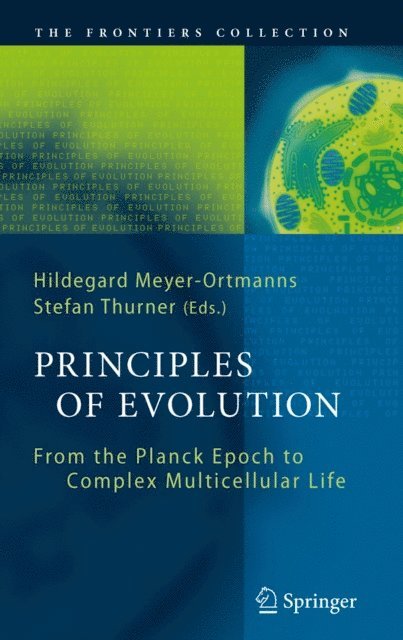
With contributions from a team of leading experts, this volume provides a comprehensive survey of recent achievements in our scientific understanding of evolution. The questions it asks concern the beginnings of the universe, the origin of life and the chances of its arising at all, the role of contingency, and the search for universal features in the plethora of evolutionary phenomena. Rather than oversimplified or premature answers, the chapters provide a clear picture of how these essential problems are being tackled, enabling the reader to understand current thinking and open questions. The tools employed stem from a range of disciplines including mathematics, physics, biochemistry and cell biology. Self-organization as an overarching concept is demonstrated in the most diverse areas: from galaxy formation in the universe to spindle and aster formation in the cell. Chemical master equations, population dynamics, and evolutionary game theory are presented as suitable frameworks for understanding the universal mechanisms and organizational principles observed in a wide range of living units, ranging from cells to societies. This book will provide engaging reading and food for thought for all those seeking a deeper understanding of the science of evolution.
694 kr
Skickas inom 10-15 vardagar
With contributions from a team of leading experts, this volume provides a comprehensive survey of recent achievements in our scientific understanding of evolution. The questions it asks concern the beginnings of the universe, the origin of life and the chances of its arising at all, the role of contingency, and the search for universal features in the plethora of evolutionary phenomena. Rather than oversimplified or premature answers, the chapters provide a clear picture of how these essential problems are being tackled, enabling the reader to understand current thinking and open questions. The tools employed stem from a range of disciplines including mathematics, physics, biochemistry and cell biology. Self-organization as an overarching concept is demonstrated in the most diverse areas: from galaxy formation in the universe to spindle and aster formation in the cell. Chemical master equations, population dynamics, and evolutionary game theory are presented as suitable frameworks for understanding the universal mechanisms and organizational principles observed in a wide range of living units, ranging from cells to societies. This book will provide engaging reading and food for thought for all those seeking a deeper understanding of the science of evolution.
Del 77 - World Scientific Lecture Notes In Physics
Principles Of Phase Structures In Particle Physics
Inbunden, Engelska, 2006
2 886 kr
Tillfälligt slut
The phase structure of particle physics shows up in matter at extremely high densities and/or temperatures as they were reached in the early universe, shortly after the big bang, or in heavy-ion collisions, as they are performed nowadays in laboratory experiments. In contrast to phase transitions of condensed matter physics, the underlying fundamental theories are better known than their macroscopic manifestations in phase transitions. These theories are quantum chromodynamics for the strong interaction part and the electroweak part of the Standard Model for the electroweak interaction. It is their non-Abelian gauge structure that makes it a big challenge to predict the type of phase conversion between phases of different symmetries and different particle contents. The book is about a variety of analytical and numerical tools that are needed to study the phase structure of particle physics. To these belong convergent and asymptotic expansions in strong and weak couplings, dimensional reduction, renormalization group studies, gap equations, Monte Carlo simulations with and without fermions, finite-size and finite-mass scaling analyses, and the approach of effective actions as supplement to first-principle calculations.