Howie Choset - Böcker
Visar alla böcker från författaren Howie Choset. Handla med fri frakt och snabb leverans.
5 produkter
5 produkter
983 kr
Skickas
1 064 kr
Skickas inom 10-15 vardagar
Distributed manipulation effects motion on objects through a large number of points of contact. The primary benefit of distributed manipulators is that many small inexpensive mechanisms can move and transport large heavy objects. In fact, each individual component is simple, but their combined effect is quite powerful. Furthermore, distributed manipulators are fault-tolerant because if one component breaks, the other components can compensate for the failure and the whole system can still perform its task. Finally, distributed manipulators can perform a variety of tasks in parallel. Distributed manipulation can be performed by many types of mechanisms at different scales. Due to the recent advances of MEMS (micro-electro-mechanical system) technology, it has become feasible to quickly manufacture distributed micro-manipulators at low cost. One such system is an actuator array where hundreds of micro-scaled actuators transport and manipulate small objects that rest on them. Macroscopic versions of the actuator array have also been developed and analyzed.Another form of distributed manipulation is derived from a vibrating plate, and teams of mobile robots have been used to herd large objects into desired locations. Since a distributed manipulator has many actuators, distributed control strategies must be considered to effectively manipulate objects. A basic understanding of contact analysis between the actuators and object must also be considered. When each actuator in the array has a sensor, distributed sensing presents some basic research challenges. Distributed computation and communication are key issues to enable the successful deployment of distributed manipulators into use.
1 064 kr
Skickas inom 10-15 vardagar
Distributed manipulation effects motion on objects through a large number of points of contact. The primary benefit of distributed manipulators is that many small inexpensive mechanisms can move and transport large heavy objects. In fact, each individual component is simple, but their combined effect is quite powerful. Furthermore, distributed manipulators are fault-tolerant because if one component breaks, the other components can compensate for the failure and the whole system can still perform its task. Finally, distributed manipulators can perform a variety of tasks in parallel. Distributed manipulation can be performed by many types of mechanisms at different scales. Due to the recent advances of MEMS (micro-electro-mechanical system) technology, it has become feasible to quickly manufacture distributed micro-manipulators at low cost. One such system is an actuator array where hundreds of micro-scaled actuators transport and manipulate small objects that rest on them. Macroscopic versions of the actuator array have also been developed and analyzed. Another form of distributed manipulation is derived from a vibrating plate, and teams of mobile robots have been used to herd large objects into desired locations. There are many fundamental issues involved in distributed manipulation. Since a distributed manipulator has many actuators, distributed control strategies must be considered to effectively manipulate objects. A basic understanding of contact analysis between the actuators and object must also be considered. When each actuator in the array has a sensor, distributed sensing presents some basic research challenges. Distributed computation and communication are key issues to enable the successful deployment of distributed manipulators into use. Finally, the trade-off in centralized and de-centralized approaches in all of these algorithms must be investigated.
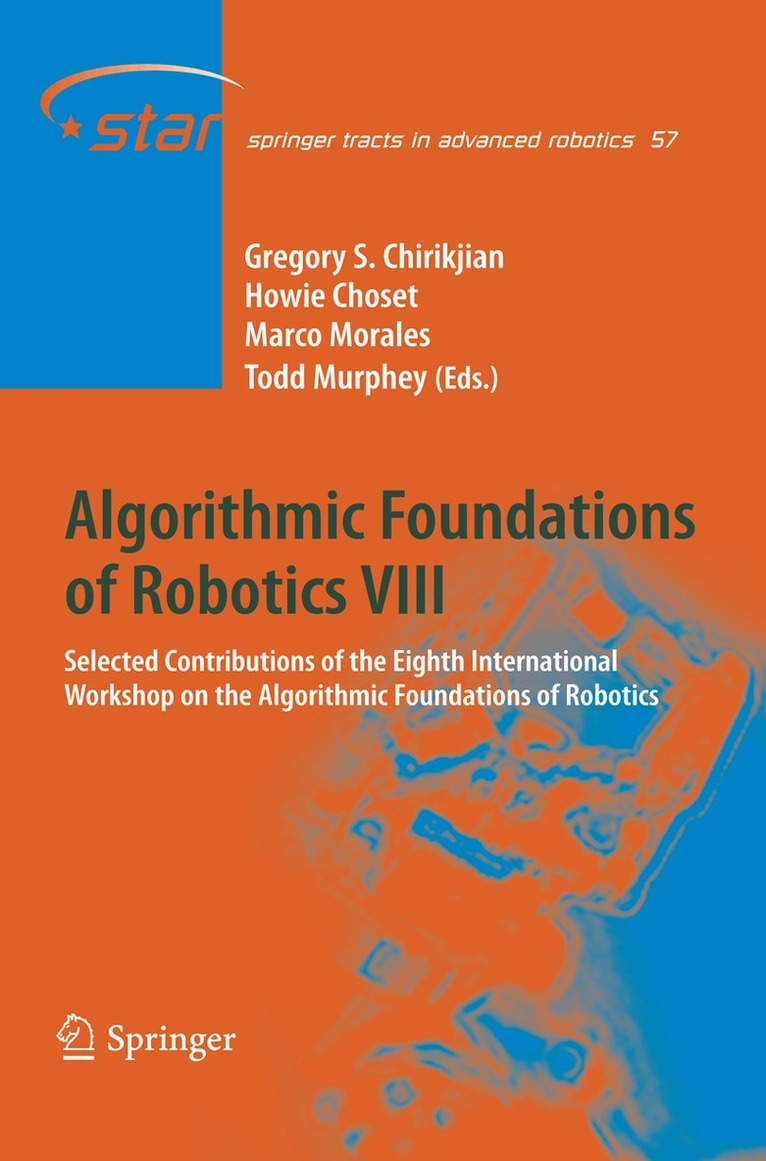
Algorithmic Foundations of Robotics VIII
Selected Contributions of the Eighth International Workshop on the Algorithmic Foundations of Robotics
Inbunden, Engelska, 2010
2 100 kr
Skickas inom 10-15 vardagar
By the dawn of the new millennium,robotics has undergonea major transformation in scope and dimensions. This expansion has been broughtabout by the maturity of the ?eld and the advances in its related technologies. From a largely dominant - dustrial focus, roboticshas been rapidly expandinginto the challengesof the human world.The new generationofrobotsis expectedto safely anddependablyco-habitat withhumansinhomes,workplaces,andcommunities,providingsupportinservices, entertainment, education, healthcare, manufacturing, and assistance. Beyond its impact on physical robots, the body of knowledge robotics has p- duced is revealing a much wider range of applications reaching across diverse research areas and scienti?c disciplines, such as: biomechanics, haptics, neu- sciences, virtual simulation, animation, surgery, and sensor networks among others. In return, the challenges of the new emerging areas are proving an abundant source of stimulation and insights for the ?eld of robotics. It is indeed at the intersection of disciplines that the most striking advances happen.The goal of the series of Springer Tracts in Advanced Robotics (STAR) is to bring, in a timely fashion, the latest advances and developments in robotics on the basis of their signi?cance and quality. It is our hope that the wider dissemination of research developmentswill stimulate more exchangesand collaborationsamongthe research community and contribute to further advancement of this rapidly growing ?eld. This volume is the outcome of the eight edition of the biennial Workshop Al- rithmic Foundations of Robotics (WAFR). Edited by G. Chirikjian, H. Choset, M.
Algorithmic Foundations of Robotics VIII
Selected Contributions of the Eighth International Workshop on the Algorithmic Foundations of Robotics
Häftad, Engelska, 2012
2 100 kr
Skickas inom 10-15 vardagar
By the dawn of the new millennium,robotics has undergonea major transformation in scope and dimensions. This expansion has been broughtabout by the maturity of the ?eld and the advances in its related technologies. From a largely dominant - dustrial focus, roboticshas been rapidly expandinginto the challengesof the human world.The new generationofrobotsis expectedto safely anddependablyco-habitat withhumansinhomes,workplaces,andcommunities,providingsupportinservices, entertainment, education, healthcare, manufacturing, and assistance. Beyond its impact on physical robots, the body of knowledge robotics has p- duced is revealing a much wider range of applications reaching across diverse research areas and scienti?c disciplines, such as: biomechanics, haptics, neu- sciences, virtual simulation, animation, surgery, and sensor networks among others. In return, the challenges of the new emerging areas are proving an abundant source of stimulation and insights for the ?eld of robotics. It is indeed at the intersection of disciplines that the most striking advances happen.The goal of the series of Springer Tracts in Advanced Robotics (STAR) is to bring, in a timely fashion, the latest advances and developments in robotics on the basis of their signi?cance and quality. It is our hope that the wider dissemination of research developmentswill stimulate more exchangesand collaborationsamongthe research community and contribute to further advancement of this rapidly growing ?eld. This volume is the outcome of the eight edition of the biennial Workshop Al- rithmic Foundations of Robotics (WAFR). Edited by G. Chirikjian, H. Choset, M.