H.R. Pruppacher - Böcker
Visar alla böcker från författaren H.R. Pruppacher. Handla med fri frakt och snabb leverans.
3 produkter
3 produkter
Del 18 - Atmospheric and Oceanographic Sciences Library
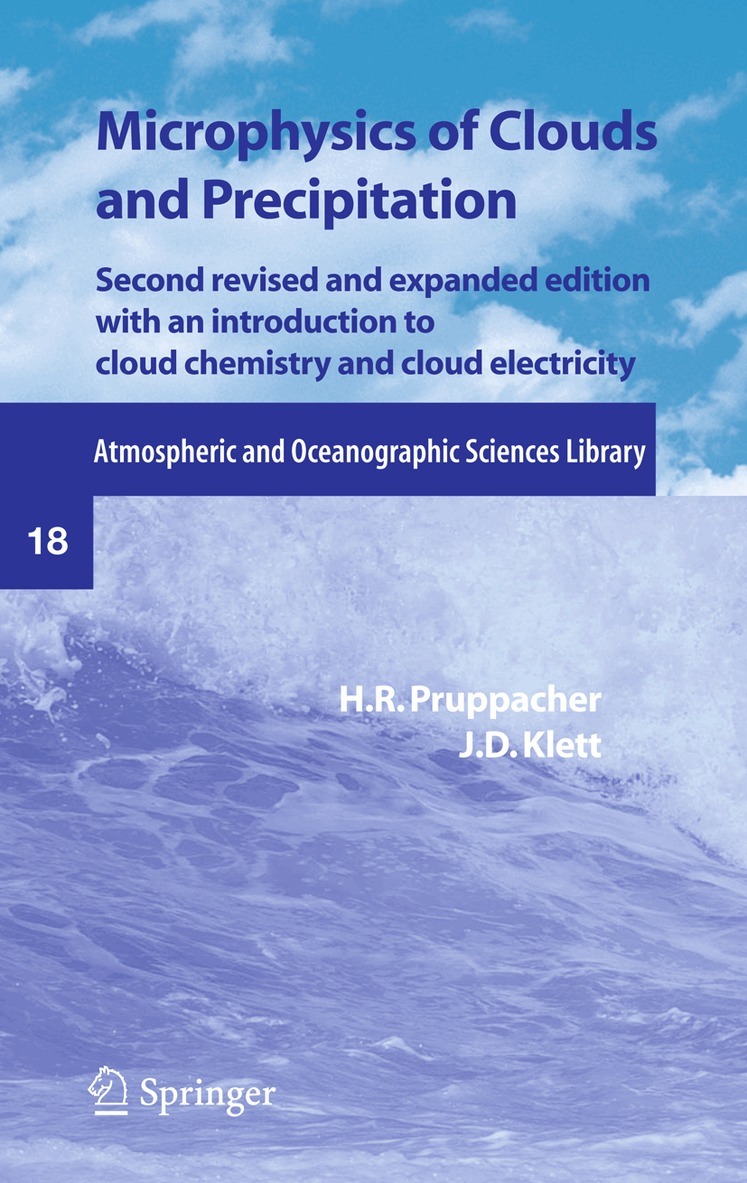
Microphysics of Clouds and Precipitation
Inbunden, Engelska, 1996
2 625 kr
Skickas inom 10-15 vardagar
This examination of the microphysical processes which lead to cloud and precipitation formation emphasizes a quantitative description of the various mechanisms (e.g. nucleation, diffusional growth and evaporation, collisional growth and breakup) which lead to the formation of cloud and precipitation particles, individually and in populations. This edition has been updated to incorporate new research reported in a large number of articles and dozens of books and conference proceedings published since the first edition. Some highlights include: a new chapter on cloud chemistry; improved statistical mechanics models for homogeneous and heterogeneous ice nucleation; better data on aerosol size distribution and on fundamental properties of water; new data and models for asymmetric flow past particles of various shapes and for drop oscillation and breakup; extended treatment of drop coalescence and particle collision cross-sections, including some new effects of turbulence; more complete simulations of stochastic growth; expanded treatment of growth modes of graupel, rime and hailstones; new field data and modelling concerning effects of electric fields and charges on cloud microphysics.
2 625 kr
Skickas inom 10-15 vardagar
This examination of the microphysical processes which lead to cloud and precipitation formation emphasizes a quantitative description of the various mechanisms (e.g. nucleation, diffusional growth and evaporation, collisional growth and breakup) which lead to the formation of cloud and precipitation particles, individually and in populations. This edition has been updated to incorporate new research reported in a large number of articles and dozens of books and conference proceedings published since the first edition. Some highlights include: a new chapter on cloud chemistry; improved statistical mechanics models for homogeneous and heterogeneous ice nucleation; better data on aerosol size distribution and on fundamental properties of water; new data and models for asymmetric flow past particles of various shapes and for drop oscillation and breakup; extended treatment of drop coalescence and particle collision cross-sections, including some new effects of turbulence; more complete simulations of stochastic growth; expanded treatment of growth modes of graupel, rime and hailstones; new field data and modelling concerning effects of electric fields and charges on cloud microphysics.
1 578 kr
Skickas inom 10-15 vardagar
Cloud physics has achieved such a voluminous literature over the past few decades that a significant quantitative study of the entire field would prove unwieldy. This book concentrates on one major aspect: cloud microphysics, which involves the processes that lead to the formation of individual cloud and precipitation particles. Common practice has shown that one may distinguish among the following additional major aspects: cloud dynamics, which is concerned with the physics responsible for the macroscopic features of clouds; cloud electricity, which deals with the electrical structure of clouds and the electrification processes of cloud and precipitation particles; and cloud optics and radar meteorology, which describe the effects of electromagnetic waves interacting with clouds and precipitation. Another field intimately related to cloud physics is atmospheric chemistry, which involves the chemical composition of the atmosphere and the life cycle and characteristics of its gaseous and particulate constituents. In view of the natural interdependence of the various aspects of cloud physics, the subject of microphysics cannot be discussed very meaningfully out of context. Therefore, we have found it necessary to touch briefly upon a few simple and basic concepts of cloud dynamics and thermodynamics, and to provide an account of the major characteristics of atmospheric aerosol particles. We have also included a separate chapter on some of the effects of electric fields and charges on the precipitation-forming processes.