Hugh D. Griffiths - Böcker
Visar alla böcker från författaren Hugh D. Griffiths. Handla med fri frakt och snabb leverans.
3 produkter
3 produkter
1 422 kr
Skickas
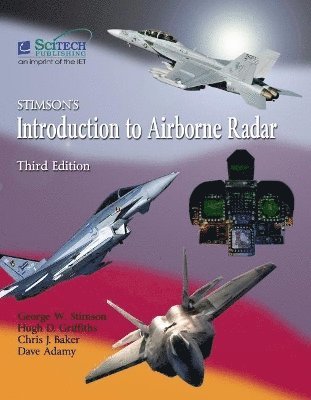
Completely modernized, greatly expanded, but retaining all the magic of the 2nd edition, Introduction to Airborne Radar has been brought into the 21st century without losing the hallmarks that made George Stimson's previous editions unique. Every chapter has been updated to reflect the constant transformations in radar technology and end-of-chapter exercises have also been added, improving its employment as a textbook.Over 100 radar and EW experts from around the world were involved in reviewing, writing, and editing this book, each one a longtime user of the previous editions. Each one of them was tasked with making sure this third edition lives up to its legacy of 'Introduction.'Stimson's is written specifically as an overview without going overboard on the math. Virtually anyone with a knowledge of high school algebra, trigonometry, and physics will be able to read and absorb the vast majority of the material. The first 17 chapters provide fundamentals that can be used by air, ground, and sea-based personnel. Every chapter provides extensive fundamental materials and practical applications, using visual system exemplars to aid explanations. The unique full color layout is enhanced with an immense number of illustrations, figures, tables, and color photographs.Key features: Modernized to reflect changes in the past 20 years including electronic scanning antennas and high resolution imaging.Completely covers the wide range of techniques employed in modern airborne and space borne radars.Fundamentals are applicable to ground and sea-based radar.Clear, understandable writing supplemented by extensive graphic illustration of concepts and offset boxes taking those concepts to the next level.Community reviewed by over 100 radar experts from organizations worldwide.
1 873 kr
Skickas inom 5-8 vardagar
Developed by recognized experts in the field, this first-of-its-kind resource provides an overview of the basic principles of passive radar technology, real passive radar systems and new developments in the industry. It explains in-depth how passive radar works and how it differs from the active type, while demonstrating the benefits and drawbacks of the technology. The book also explores properties of ambiguity functions, digital vs. analog, digitally-coded waveforms, vertical-plane coverage, and satellite-borne and radar illuminators. The book functions as a practical guide on direct signal suppression, passive radar performance prediction and detection and tracking. It contains concrete examples of systems and results, including analog TV, FM radio, cell phone base stations, DVB–T and DAB, HF skywave transmissions, indoor WiFi and low-cost scientific remote sensing.
1 895 kr
Skickas
Advances in Bistatic Radar updates and extends bistatic and multistatic radar developments since the publication of Willis' Bistatic Radar in 1991. New and recently declassified military applications are documented, civil applications are detailed including commercial and scientific systems and leading radar engineers provide expertise to each of these applications. Advances in Bistatic Radar consists of two major sections: Bistatic/Multistatic Radar Systems and Bistatic Clutter and Signal Processing. Starting with a history update, the first section documents the early and now declassified military AN/FPS-23 Fluttar DEW-Line Gap-filler, and high frequency (HF) bistatic radars developed for missile attack warning. It then documents the recently developed passive bistatic and multistatic radars exploiting commercial broadcast transmitters for military and civilian air surveillance. Next, the section documents scientific bistatic radar systems for planetary exploration, which have exploited data link transmitters over the last forty years; ionospheric measurements, again exploiting commercial broadcast transmitters; and 3-D wind field measurements using a bistatic receiver hitchhiking off doppler weather radars. This last application has been commercialized. The second section starts by documenting the full, unclassified bistatic clutter scattering coefficient data base, along with the theory and analysis supporting its development. The section then details two major clutter-related developments, spotlight bistatic synthetic aperture radar (SAR), which can now generate high resolution images using bistatic autofocus and related techniques; and adaptive moving target indication (MTI), which allows cancellation of nonstationary clutter generated by moving (i.e. airborne) platforms through the use of bistatic space-time adaptive processing (STAP).