This is a review volume containing articles written by experts on current theoretical topics in the subject of Quark-Gluon Plasma created in heavy-ion collisions at high energy. It is the fourth volume in the series with the same title sequenced numerically. The articles are written in a pedagogical style so that they can be helpful to a wide range of researchers from graduate students to mature physicists who have not worked previously on the subject. A reader should be able to learn from the reviews without having extensive knowledge of the background literature.
This is a review monograph on quark-gluon plasma (QGP). Different theoretical and experimental aspects of the program to produce QGP in relativistic heavy-ion collisions are covered by experts in the field. This is the third volume in a series on the subject, and the first such monograph to focus on the implications of the experimental results from RHIC, the relativistic heavy-ion collider at the National Brookhaven Laboratory. The review articles will be useful to experienced researchers as well as to graduate students entering the field.
This is a sequel to the review volume Quark-Gluon Plasma. There are 13 articles contributed by leading investigators in the field, covering a wide range of topics about the theoretical approach to the subject. These contributions are timely reviews of nearly all the actively pursued problems, written in a pedagogical style suitable for beginners as well as experienced researchers.
This volume presents the experimental and theoretical methods of studying soft interaction physics in high energy collisions. The topics include: dynamical and Bose-Einstein correlations, multiplicity fluctuation, soft photons, disoriented chiral condensate, self-similarity and self-affine behaviors, wavelet analysis, intermittency, chaos, and phase transition.
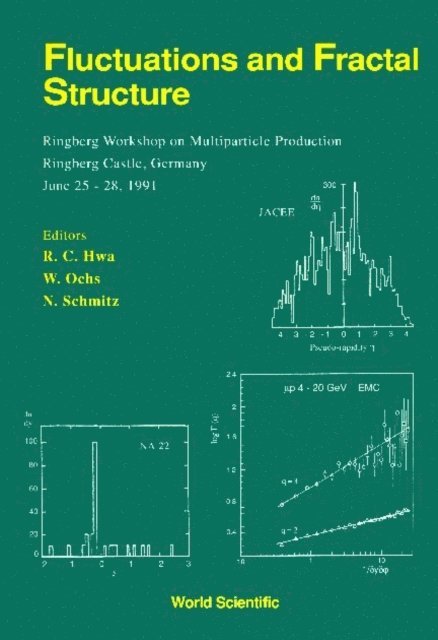
The fractal structure of multiplicity fluctuations (''intermittency'') in high energy multiparticle production is discussed with experimental results from fixed target and collider experiments on e+e-, p, hadronic and nuclear collisions. Theoretical investigations concern the selfsimilar dynamics of particle cascades and quark-gluon-plasma as well as the structure of particle correlations
This volume contains 14 review articles on the theory and phenomenology of the creation and diagnosis of quark-gluon plasma. They are written by active investigators of in the various research topics, which range from the QCD foundation through transport theory and thermalization models to the examination of possible signatures. The monograph should be useful not only to the experienced researchers in the subject but also to newcomers.