Hyung-Ki Kim - Böcker
Visar alla böcker från författaren Hyung-Ki Kim. Handla med fri frakt och snabb leverans.
3 produkter
3 produkter
1 451 kr
Skickas inom 5-8 vardagar
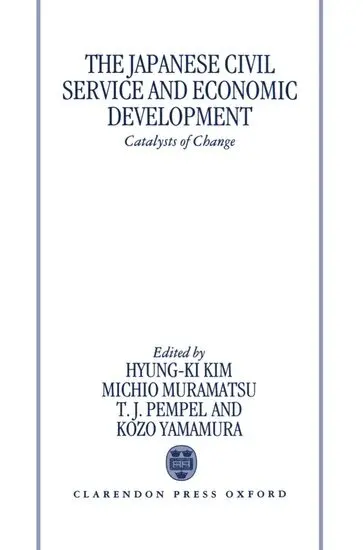
This volume analyses the way in which the Japanese civil service has contributed to Japan's phenomenally successful economic growth and the lessons that experience may offer for other developing countries. It provides much new information about the structures, functioning, and policymaking activities of the Japanese civil service. In its analysis, emphasises the degree of competitiveness within the Japanese bureaucracy, the extent to which political authority is wielded rather than formal power, and the way in which government policy has encouraged rather that inhibited market forces.
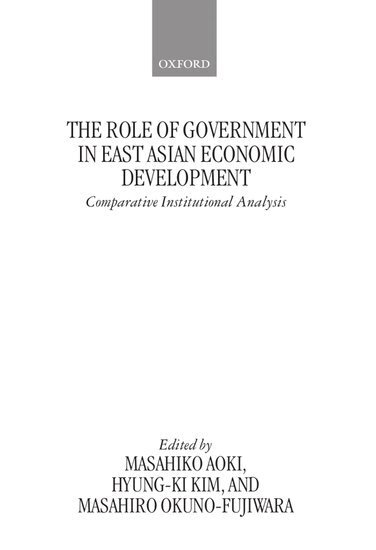
The Role of Government in East Asian Economic Development
Comparative Institutional Analysis
Inbunden, Engelska, 1997
2 890 kr
Skickas inom 5-8 vardagar
The role of government in East Asian economic development has been a continuous issue. Two competing views have shaped enquiries into the source of the rapid growth high-performing Asian economies and attempts to derive a general lesson for other developing economies: the market-friendly view, according to which government intervenes little in the market, and the developmental state view, in which it governs the market. What these views share in common is a conception of market and government as alternative mechanisms for resource allocation. They are distinct only in their judgement of the extent to which market failures have been, and ought to be, remedied by direct government intervention. This collection of essays suggests a breakthrough, third view: the market-enhancing view. Instead of viewing government and the market as mutually exclusive substitutes, it examines the capacity of government policy to facilitate or complement private sector co-ordination. The book starts from the premise that private sector institutions have important comparative advantages over government, in particular in their ability to process information available on site. At the same time, it recognizes that the capabilities of the private sector are more limited in developing economies. The market-enhancing view thus stresses the mechanisms whereby government policy is directed at improving the ability of the private sector to solve co-ordination problems and overcome other market imperfections.In presenting the market-enhancing view, the book recognizes the wide diversity of the roles of government across various East Asian economies-including Japan, Korea, Hong Kong, Malaysia, and China-and its path-dependant and developmental stage nature.
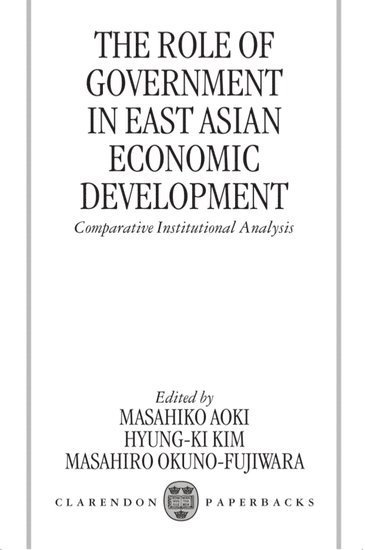
The Role of Government in East Asian Economic Development
Comparative Institutional Analysis
Häftad, Engelska, 1998
1 113 kr
Skickas inom 5-8 vardagar
The role of government in East Asian economic development has been a contentious issue. Two competing views have shaped enquiries into the source of the rapid growth of the high-performing Asian economies and attempts to derive a general lesson for other developing economies: the market-friendly view, according to which government intervenes little in the market, and the developmental state view, in which it governs the market. What these views share in common is a conception of market and government as alternative mechanisms for resource allocation. They are distinct only in their judgement of the extent to which market failures have been, and ought to be, remedied by direct government intervention. This collection of essays suggests a breakthrough, third view: the market-enhancing view. Instead of viewing government and the market as mutually exclusive substitutes, it examines the capacity of government policy to facilitate or complement private sector co-ordination. The book starts from the premiss that private sector institutions have important comparative advantages over government, in particular in their ability to process information available on site. At the same time, it recognizes that the capabilities of the private sector are more limited in developing economies. The market-enhancing view thus stresses the mechanisms whereby government policy is directed at improving the ability of the private sector to solve co-ordination problems and overcome other market imperfections. In presenting the market-enhancing view, the book recognizes the wide diversity of the roles of government across various East Asian economiesincluding Japan, Korea, Hong Kong, Malaysia, and China and its path-dependent and developmental stage nature.