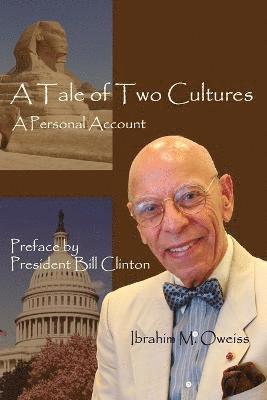
"Professor Oweiss' book recounts in clear prose the story of an active and productive life lived largely in two different cultures- Egyptian (and Middle Eastern) and American. The reader will meet many interesting personages- well known and not well known-across seven decades of important changes in the world. Ibrahim Oweiss has lived quite a life."-Carol Lancaster, Dean of the School of Foreign Service and Professor of Politics, Georgetown University. Ibrahim M. Oweiss is an educator and an international economic advisor. Born in Egypt, he earned his Masters and Ph.D. degrees in the U.S. As a Professor of Economics, he taught at Georgetown University for forty two years, and was a visiting professor at Harvard University and Johns Hopkins University. While on leave from academia, he was appointed First Under-Secretary for Economic Affairs in the Egyptian Cabinet. He also served as the Chief of the Egyptian Economic Mission to the U.S. with the rank of Ambassador. He authored over sixty scholarly publications, among them: Petrodollar Surpluses, Arab Civilization, The Political Economy of Contemporary Egypt, and The Arab Gulf Economies. He coined the terms "Petrodollar" and "Hostage Capital" in 1974. The "Oweiss Demand Curve" was first presented at Oxford University in 1982. He holds Egypt's Order of Merit, First Class, among other decorations.
This book discusses Arab history, law, philosophy, politics, and literature, analyzing the challenges and responses aroused by the interaction between Western culture and the ancient and modern Arab cultures. It offers a wealth of information on the forces that have shaped Arab civilization and on several of the major figures who have contributed to its development. Some of the outstanding contributions include a comprehensive study of Dr. Zurayk as the advocate of rationalism in modern Arab thought by Hani A. Faris; a sober but challenging look at the use of Islamic history in our time by Muhsin Mahdi; an analysis of the expression of historicity in the Koran by Jacques Berque; an explanation of the concept of equity in Islamic law by Majid Khadduri; and the revelation of a Mamluk Magna Carta by Aziz Sourial Atiya.