Ichiro Nishizaki - Böcker
Visar alla böcker från författaren Ichiro Nishizaki. Handla med fri frakt och snabb leverans.
9 produkter
9 produkter
1 105 kr
Skickas inom 10-15 vardagar
To derive rational and convincible solutions to practical decision making problems in complex and hierarchical human organizations, the decision making problems are formulated as relevant mathematical programming problems which are solved by developing optimization techniques so as to exploit characteristics or structural features of the formulated problems. In particular, for resolving con?ict in decision making in hierarchical managerial or public organizations, the multi level formula tion of the mathematical programming problems has been often employed together with the solution concept of Stackelberg equilibrium. However,weconceivethatapairoftheconventionalformulationandthesolution concept is not always suf?cient to cope with a large variety of decision making situations in actual hierarchical organizations. The following issues should be taken into consideration in expression and formulation of decision making problems. Informulationofmathematicalprogrammingproblems,itistacitlysupposedthat decisions are made by a single person while game theory deals with economic be havior of multiple decision makers with fully rational judgment. Because two level mathematical programming problems are interpreted as static Stackelberg games, multi level mathematical programming is relevant to noncooperative game theory; in conventional multi level mathematical programming models employing the so lution concept of Stackelberg equilibrium, it is assumed that there is no communi cation among decision makers, or they do not make any binding agreement even if there exists such communication. However, for decision making problems in such as decentralized large ?rms with divisional independence, it is quite natural to sup pose that there exists communication and some cooperativerelationship among the decision makers.
Del 159 - International Series in Operations Research & Management Science
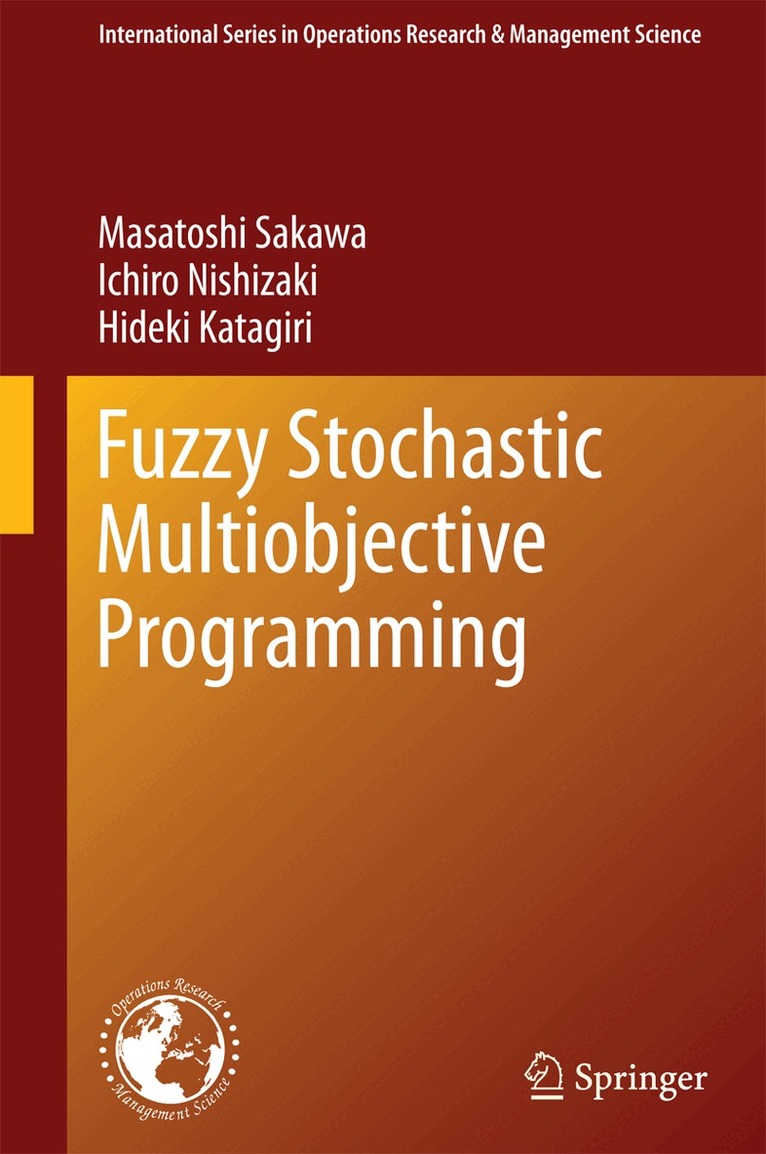
Fuzzy Stochastic Multiobjective Programming
Inbunden, Engelska, 2011
1 073 kr
Skickas inom 10-15 vardagar
Although studies on multiobjective mathematical programming under uncertainty have been accumulated and several books on multiobjective mathematical programming under uncertainty have been published (e.g., Stancu-Minasian (1984); Slowinski and Teghem (1990); Sakawa (1993); Lai and Hwang (1994); Sakawa (2000)), there seems to be no book which concerns both randomness of events related to environments and fuzziness of human judgments simultaneously in multiobjective decision making problems. In this book, the authors are concerned with introducing the latest advances in the field of multiobjective optimization under both fuzziness and randomness on the basis of the authors’ continuing research works. Special stress is placed on interactive decision making aspects of fuzzy stochastic multiobjective programming for human-centered systems under uncertainty in most realistic situations when dealing with both fuzziness and randomness. Organization of each chapter is briefly summarized as follows:Chapter 2 is devoted to mathematical preliminaries, which will be used throughout the remainderof the book. Starting with basic notions and methods of multiobjective programming, interactivefuzzy multiobjective programming as well as fuzzy multiobjective programming is outlined.In Chapter 3, by considering the imprecision of decision maker’s (DM’s) judgment for stochasticobjective functions and/or constraints in multiobjective problems, fuzzy multiobjective stochasticprogramming is developed. In Chapter 4, through the consideration of not only the randomness of parameters involved inobjective functions and/or constraints but also the experts’ ambiguous understanding of the realized values of the random parameters, multiobjective programming problems with fuzzy random variables are formulated.In Chapter 5, for resolving conflict of decision making problems in hierarchical managerial orpublic organizations where there exist two DMs who have different priorities in making decisions, two-level programming problems are discussed. Finally, Chapter 6 outlines some future research directions.
Del 48 - Operations Research/Computer Science Interfaces Series
Cooperative and Noncooperative Multi-Level Programming
Häftad, Engelska, 2011
1 099 kr
Skickas inom 10-15 vardagar
To derive rational and convincible solutions to practical decision making problems in complex and hierarchical human organizations, the decision making problems are formulated as relevant mathematical programming problems which are solved by developing optimization techniques so as to exploit characteristics or structural features of the formulated problems. In particular, for resolving con?ict in decision making in hierarchical managerial or public organizations, the multi level formula tion of the mathematical programming problems has been often employed together with the solution concept of Stackelberg equilibrium. However,weconceivethatapairoftheconventionalformulationandthesolution concept is not always suf?cient to cope with a large variety of decision making situations in actual hierarchical organizations. The following issues should be taken into consideration in expression and formulation of decision making problems. Informulationofmathematicalprogrammingproblems,itistacitlysupposedthat decisions are made by a single person while game theory deals with economic be havior of multiple decision makers with fully rational judgment. Because two level mathematical programming problems are interpreted as static Stackelberg games, multi level mathematical programming is relevant to noncooperative game theory; in conventional multi level mathematical programming models employing the so lution concept of Stackelberg equilibrium, it is assumed that there is no communi cation among decision makers, or they do not make any binding agreement even if there exists such communication. However, for decision making problems in such as decentralized large ?rms with divisional independence, it is quite natural to sup pose that there exists communication and some cooperativerelationship among the decision makers.
Del 159 - International Series in Operations Research & Management Science
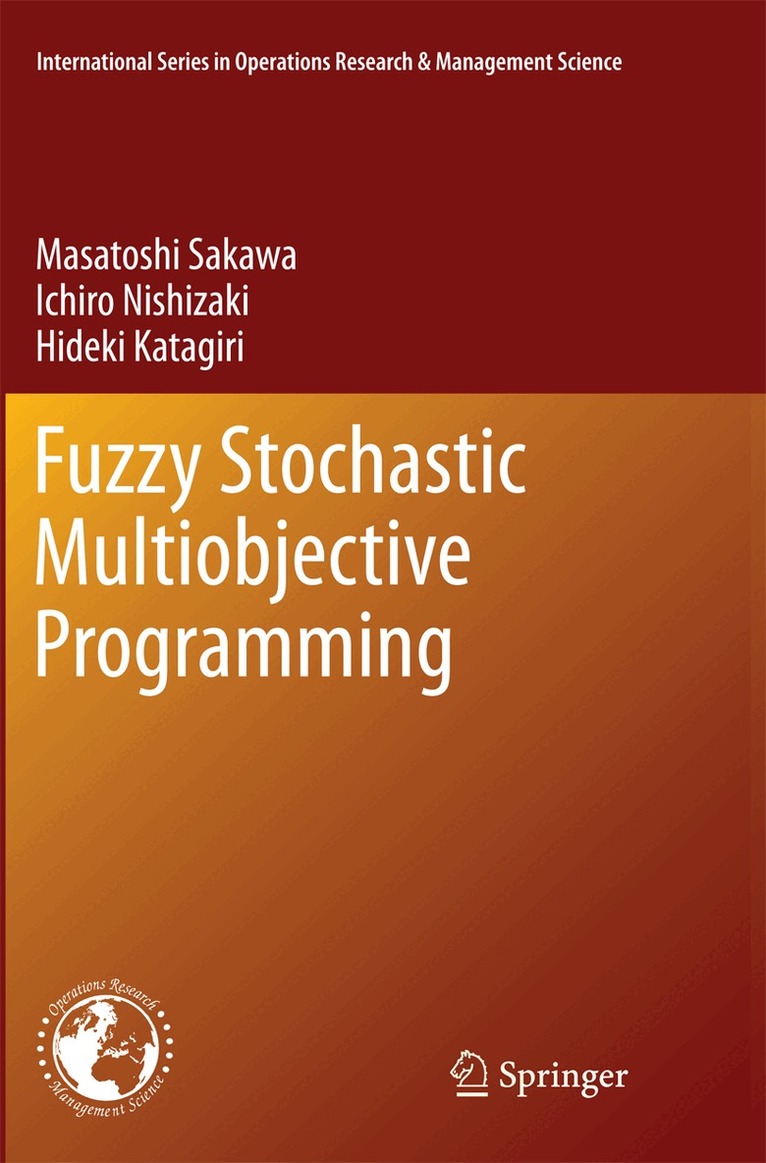
Fuzzy Stochastic Multiobjective Programming
Häftad, Engelska, 2013
1 067 kr
Skickas inom 10-15 vardagar
Although studies on multiobjective mathematical programming under uncertainty have been accumulated and several books on multiobjective mathematical programming under uncertainty have been published (e.g., Stancu-Minasian (1984); Slowinski and Teghem (1990); Sakawa (1993); Lai and Hwang (1994); Sakawa (2000)), there seems to be no book which concerns both randomness of events related to environments and fuzziness of human judgments simultaneously in multiobjective decision making problems. In this book, the authors are concerned with introducing the latest advances in the field of multiobjective optimization under both fuzziness and randomness on the basis of the authors’ continuing research works. Special stress is placed on interactive decision making aspects of fuzzy stochastic multiobjective programming for human-centered systems under uncertainty in most realistic situations when dealing with both fuzziness and randomness. Organization of each chapter is briefly summarized as follows:Chapter 2 is devoted to mathematical preliminaries, which will be used throughout the remainderof the book. Starting with basic notions and methods of multiobjective programming, interactivefuzzy multiobjective programming as well as fuzzy multiobjective programming is outlined.In Chapter 3, by considering the imprecision of decision maker’s (DM’s) judgment for stochasticobjective functions and/or constraints in multiobjective problems, fuzzy multiobjective stochasticprogramming is developed. In Chapter 4, through the consideration of not only the randomness of parameters involved inobjective functions and/or constraints but also the experts’ ambiguous understanding of the realized values of the random parameters, multiobjective programming problems with fuzzy random variables are formulated.In Chapter 5, for resolving conflict of decision making problems in hierarchical managerial orpublic organizations where there exist two DMs who have different priorities in making decisions, two-level programming problems are discussed. Finally, Chapter 6 outlines some future research directions.
Del 203 - International Series in Operations Research & Management Science
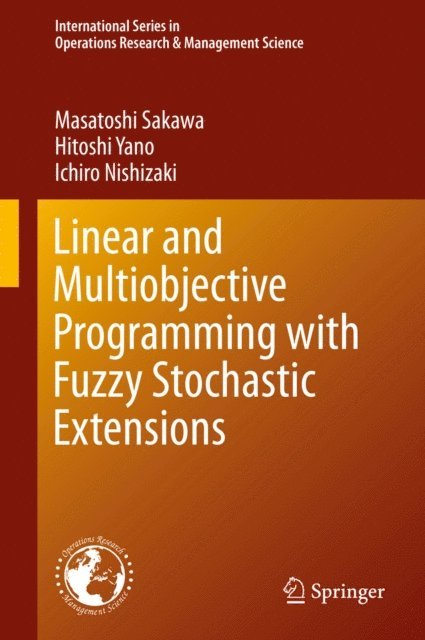
Linear and Multiobjective Programming with Fuzzy Stochastic Extensions
Inbunden, Engelska, 2013
537 kr
Skickas inom 10-15 vardagar
Although several books or monographs on multiobjective optimization under uncertainty have been published, there seems to be no book which starts with an introductory chapter of linear programming and is designed to incorporate both fuzziness and randomness into multiobjective programming in a unified way. In this book, five major topics, linear programming, multiobjective programming, fuzzy programming, stochastic programming, and fuzzy stochastic programming, are presented in a comprehensive manner. Especially, the last four topics together comprise the main characteristics of this book, and special stress is placed on interactive decision making aspects of multiobjective programming for human-centered systems in most realistic situations under fuzziness and/or randomness.Organization of each chapter is briefly summarized as follows: Chapter 2 is a concise and condensed description of the theory of linear programming and its algorithms. Chapter 3 discusses fundamental notions and methods of multiobjective linear programming and concludes with interactive multiobjective linear programming. In Chapter 4, starting with clear explanations of fuzzy linear programming and fuzzy multiobjective linear programming, interactive fuzzy multiobjective linear programming is presented. Chapter 5 gives detailed explanations of fundamental notions and methods of stochastic programming including two-stage programming and chance constrained programming. Chapter 6 develops several interactive fuzzy programming approaches to multiobjective stochastic programming problems. Applications to purchase and transportation planning for food retailing are considered in Chapter 7.The book is self-contained because of the three appendices and answers to problems. Appendix A contains a brief summary of the topics from linear algebra. Pertinent results from nonlinear programming are summarized in Appendix B. Appendix C is a clear explanation of the Excel Solver, one of the easiest ways to solve optimization problems, through the use of simple examples of linear and nonlinear programming.
Del 203 - International Series in Operations Research & Management Science
Linear and Multiobjective Programming with Fuzzy Stochastic Extensions
Häftad, Engelska, 2016
537 kr
Skickas inom 10-15 vardagar
Although several books or monographs on multiobjective optimization under uncertainty have been published, there seems to be no book which starts with an introductory chapter of linear programming and is designed to incorporate both fuzziness and randomness into multiobjective programming in a unified way. In this book, five major topics, linear programming, multiobjective programming, fuzzy programming, stochastic programming, and fuzzy stochastic programming, are presented in a comprehensive manner. Especially, the last four topics together comprise the main characteristics of this book, and special stress is placed on interactive decision making aspects of multiobjective programming for human-centered systems in most realistic situations under fuzziness and/or randomness.Organization of each chapter is briefly summarized as follows: Chapter 2 is a concise and condensed description of the theory of linear programming and its algorithms. Chapter 3 discusses fundamental notions and methods of multiobjective linear programming and concludes with interactive multiobjective linear programming. In Chapter 4, starting with clear explanations of fuzzy linear programming and fuzzy multiobjective linear programming, interactive fuzzy multiobjective linear programming is presented. Chapter 5 gives detailed explanations of fundamental notions and methods of stochastic programming including two-stage programming and chance constrained programming. Chapter 6 develops several interactive fuzzy programming approaches to multiobjective stochastic programming problems. Applications to purchase and transportation planning for food retailing are considered in Chapter 7.The book is self-contained because of the three appendices and answers to problems. Appendix A contains a brief summary of the topics from linear algebra. Pertinent results from nonlinear programming are summarized in Appendix B. Appendix C is a clear explanation of the Excel Solver, one of the easiest ways to solve optimization problems, through the use of simple examples of linear and nonlinear programming.
634 kr
Skickas inom 5-8 vardagar
Del 64 - Studies in Fuzziness and Soft Computing
Fuzzy and Multiobjective Games for Conflict Resolution
Inbunden, Engelska, 2001
1 073 kr
Skickas inom 10-15 vardagar
This book presents some of the most important concepts in noncooperative games and cooperative games and introduces as well the latest advances in the new field of game theory in fuzzy and multiobjective environments. Several game representations and solution concepts are introduced which take the amgiguity and the multiplicity of objectives into consideration. The book also demonstrates the computational methods applied for obtaining the solutions. The reader can learn much about fuzzy and multiobjective games for conflict resolution in most realistic settings without prior mathematical sophistication.
1 073 kr
Skickas inom 10-15 vardagar
This book presents some of the most important concepts in noncooperative games and cooperative games and introduces as well the latest advances in the new field of game theory in fuzzy and multiobjective environments. Several game representations and solution concepts are introduced which take the amgiguity and the multiplicity of objectives into consideration. The book also demonstrates the computational methods applied for obtaining the solutions. The reader can learn much about fuzzy and multiobjective games for conflict resolution in most realistic settings without prior mathematical sophistication.