• Fri frakt över 249 kr
  • •
  • Snabba leveranser
  • •
  • Billiga böcker
Kundservice

Du är på sajten för privatpersoner.

Företag, bibliotek eller offentlig verksamhet?

Du handlar på classic.bokus.com, där alla dina funktioner finns intakta.
Till classic.bokus.com
Bokus logotyp. Gå till startsidan.
  • Erbjudanden
  • Nyheter
  • Student
  • Topplistor
  • Barn & ungdom
  • Bokus Play
  • E-böcker
  • Pocketböcker
  • Spel & pussel

10% rabatt på allt med kod NYSTART10 →

Sidfot

Mina sidor

    Hjälp

    • Kundservice
    • Vanliga frågor och svar
    • Frakt och leverans
    • Retur vid ångerrätt
    • Reklamera vara
    • Betalning
    • Köpvillkor
    • Allmänna villkor
    • Information om webbplatsens tillgänglighet

    Om Bokus

    • Om oss
    • Pressrum
    • För studenter
    • För företag
    • För bibliotek och offentlig verksamhet
    • För leverantörer
    • Hållbarhet

    Populärt

    • Aktuella erbjudanden
    • Presentkort
    • Studentlitteratur
    • Nya böcker
    • Topplistor
    • Signerade böcker
    • Engelska böcker

    Inspiration

    • Boktips
    • BookTok
    • Populära bokserier
    • Barnbokskaraktärer
    • Populära författare
    Logotyp för Bokus
    Följ oss på Facebook (extern länk)Följ oss på Instagram (extern länk)Följ oss på YouTube (extern länk)Följ oss på TikTok (extern länk)
    bokus @ CookiesAnpassa cookiesIntegritetspolicyKöpvillkor
    Till Citymail hemsida (extern länk)Till Budbee hemsida (extern länk)Till Postnord hemsida (extern länk)Till Schenker hemsida (extern länk)Till Early Bird hemsida (extern länk)Till Walleys hemsida (extern länk)
    1. Naturvetenskap och teknik
    2. Matematik och naturvetenskap
    3. Matematik
    4. Optimering

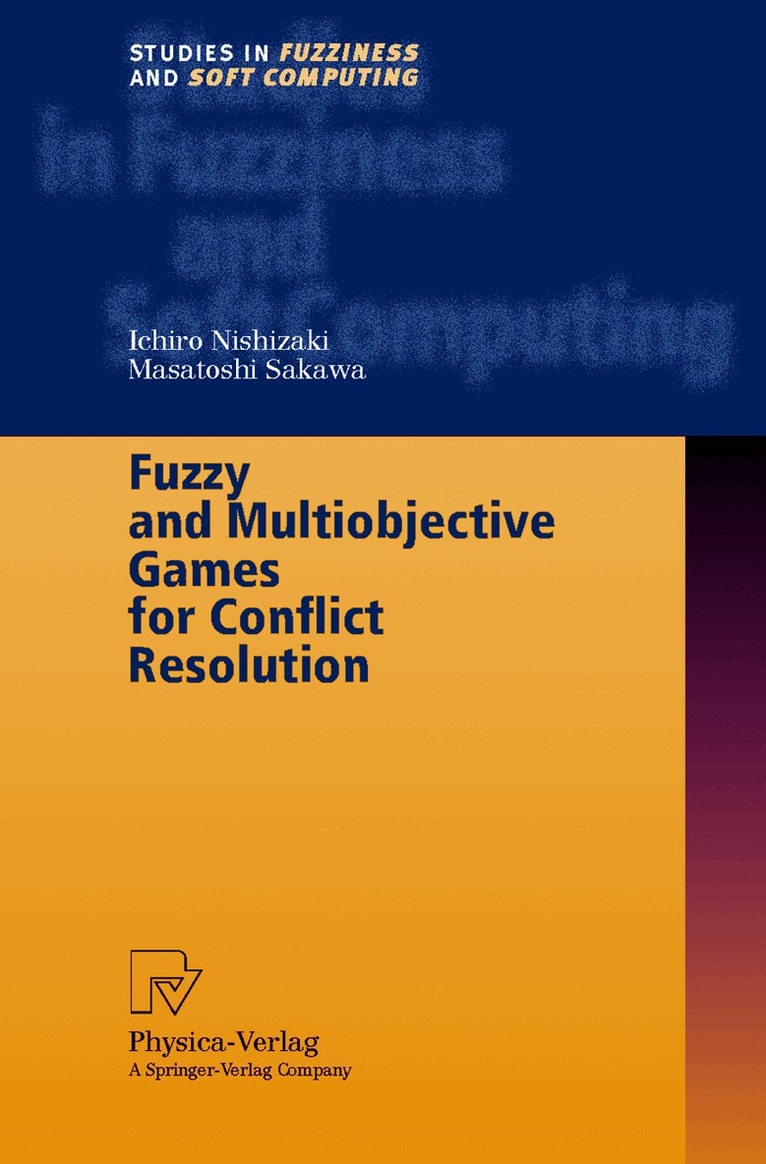
    Fuzzy and Multiobjective Games for Conflict Resolution

    AvIchiro Nishizaki,Masatoshi Sakawa

    Inbunden, Engelska, 2001

    Del 64 i serien Studies in Fuzziness and Soft Computing

    1 085 kr

    Beställningsvara. Skickas inom 10-15 vardagar. Fri frakt över 249 kr.

    Fler format och utgåvor

    Övrigt

    648 kr

    Häftad

    1 085 kr

    Beskrivning

    Decision makers in managerial and public organizations often encounter de­ cision problems under conflict or competition, because they select strategies independently or by mutual agreement and therefore their payoffs are then affected by the strategies of the other decision makers. Their interests do not always coincide and are at times even completely opposed. Competition or partial cooperation among decision makers should be considered as an essen­ tial part of the problem when we deal with the decision making problems in organizations which consist of decision makers with conflicting interests. Game theory has been dealing with such problems and its techniques have been used as powerful analytical tools in the resolution process of the decision problems. The publication of the great work by J. von Neumann and O. Morgen­ stern in 1944 attracted attention of many people and laid the foundation of game theory. We can see remarkable advances in the field of game theory for analysis of economic situations and a number of books in the field have been published in recent years. The aim of game theory is to specify the behavior of each player so as to optimize the interests of the player. It then recommends a set of solutions as strategies so that the actions chosen by each decision maker (player) lead to an outcome most profitable for himself or her­ self.

    Produktinformation

    • Utgivningsdatum:2001-02-26
    • Mått:155 x 235 x 20 mm
    • Vikt:582 g
    • Format:Inbunden
    • Språk:Engelska
    • Serie:Studies in Fuzziness and Soft Computing
    • Antal sidor:258
    • Förlag:Springer-Verlag Berlin and Heidelberg GmbH & Co. KG
    • ISBN:9783790813609

    Utforska kategorier

    • Optimering inom Naturvetenskap och teknik
    • Referensverk och tvärvetenskap inom Samhälle och politik
    • Tillämpad matematik inom Naturvetenskap och teknik

    Innehållsförteckning

    • 1. Introduction.- 2. Fundamentals of two-person noncooperative games and person cooperative games.- 3. Multiobjective fuzzy two-person zero-sum games.- 4. Multiobjective fuzzy two-person non-zero-sum games.- 5. Fuzzy n-person cooperative games.- 6. Multiobjective n-erson cooperative games.- References.