Ilham Dilman - Böcker
Visar alla böcker från författaren Ilham Dilman. Handla med fri frakt och snabb leverans.
10 produkter
10 produkter
2 103 kr
Skickas inom 10-15 vardagar
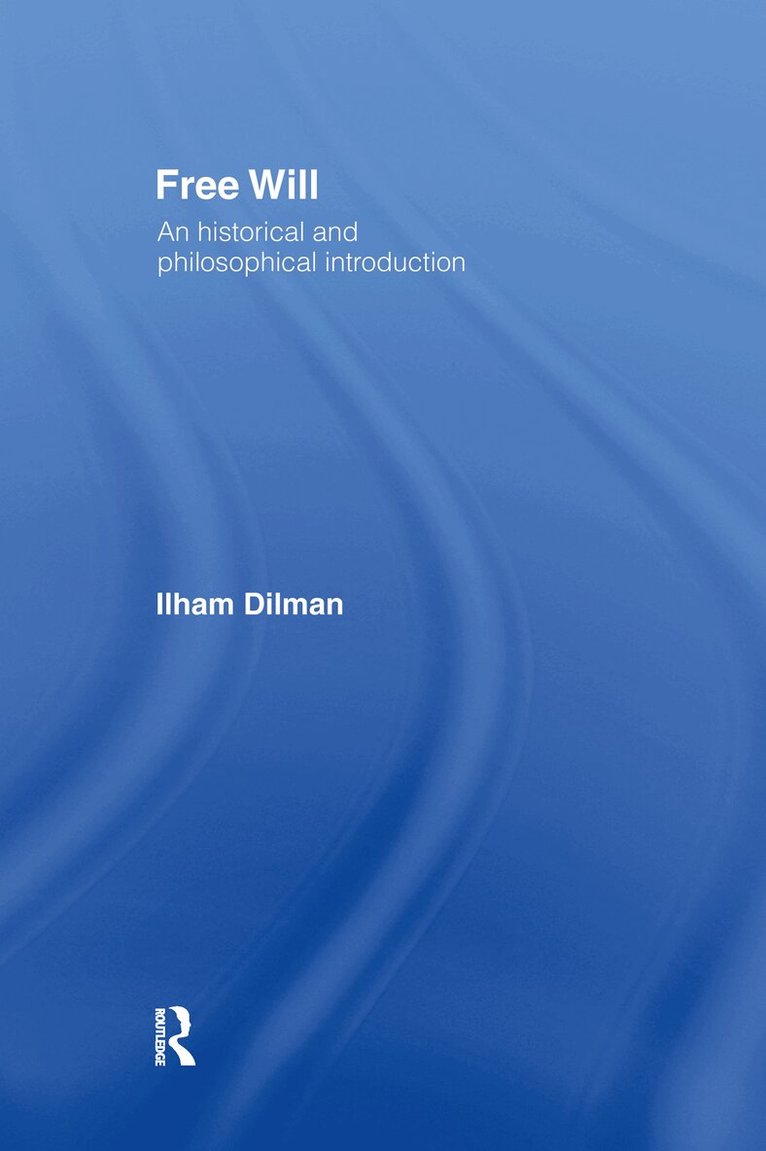
What is the place of human free will in our lives if all our actions are the result of some other cause? Does our processing unconscious beliefs or desires make us less free? Is our free will necessarily restricted if we do not choose our own beliefs? The debate between free will and its opposing doctrine, determinism, is one of the key issues in philosophy. Free Will: An historical and philosophical introduction provides a comprehensive introduction to this highly important question and examines the contributions made by sixteen of the most outstanding thinkers from the time of early Greece to the twentieth century:*Homer *Sophocles *Platto *Aristotle *St Augustine *St Thomas Aquinas *Descaartes *Spinoza *Hume *Kant *Schopehauer *Freud *Sartre *Weil *Wittgenstein *Moore Ilham Dilman brings together all the dimensions of the problem of free will with examples from literature, ethics and psychoanalysis. Drawing out valuable insights from both sides of the free will-determinism divide, and he provides an accessible and highly readable introduction to this perennial problem.
561 kr
Skickas inom 10-15 vardagar
What is the place of human free will in our lives if all our actions are the result of some other cause? Does our processing unconscious beliefs or desires make us less free? Is our free will necessarily restricted if we do not choose our own beliefs? The debate between free will and its opposing doctrine, determinism, is one of the key issues in philosophy. Free Will: An historical and philosophical introduction provides a comprehensive introduction to this highly important question and examines the contributions made by sixteen of the most outstanding thinkers from the time of early Greece to the twentieth century:*Homer *Sophocles *Platto *Aristotle *St Augustine *St Thomas Aquinas *Descaartes *Spinoza *Hume *Kant *Schopehauer *Freud *Sartre *Weil *Wittgenstein *Moore Ilham Dilman brings together all the dimensions of the problem of free will with examples from literature, ethics and psychoanalysis. Drawing out valuable insights from both sides of the free will-determinism divide, and he provides an accessible and highly readable introduction to this perennial problem.
2 103 kr
Skickas inom 10-15 vardagar
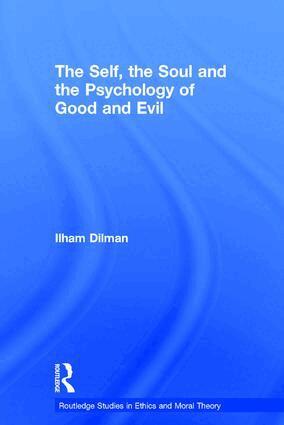
The way an individual's psychology is intertwined with their morality is the subject of this fascinating book from the pen of the late Ilham Dilman.Dilman convincingly argues that evil, though it cannot be reduced to psychological terms (it is a moral concept) is explicable in terms of an individual person's psychology. Goodness, by contrast, comes from the person and not their psychology.Philosophers the world over will want to read this book and see how Dilman skilfully defends his arguments.
764 kr
Skickas inom 10-15 vardagar
The way an individual's psychology is intertwined with their morality is the subject of this fascinating book from the pen of the late Ilham Dilman.Dilman convincingly argues that evil, though it cannot be reduced to psychological terms (it is a moral concept) is explicable in terms of an individual person's psychology. Goodness, by contrast, comes from the person and not their psychology.Philosophers the world over will want to read this book and see how Dilman skilfully defends his arguments.
309 kr
Skickas inom 3-6 vardagar
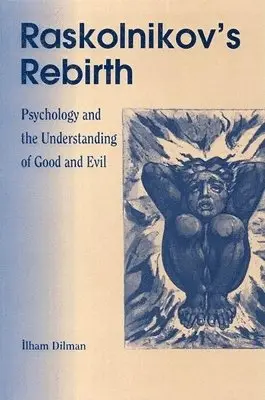
Author Ilham Dilman explains why a "thoughtful psychology," encompassing the varied modes of being experienced by humans, is the best tool for investigating the nature of good and evil. To illustrate, he employs Raskolnikov, Dostoyevsky's axe-murdering protagonist in Crime and Punishment, following his alienation from goodness, his return to it, and finally, his ethical rebirth.
356 kr
Tillfälligt slut
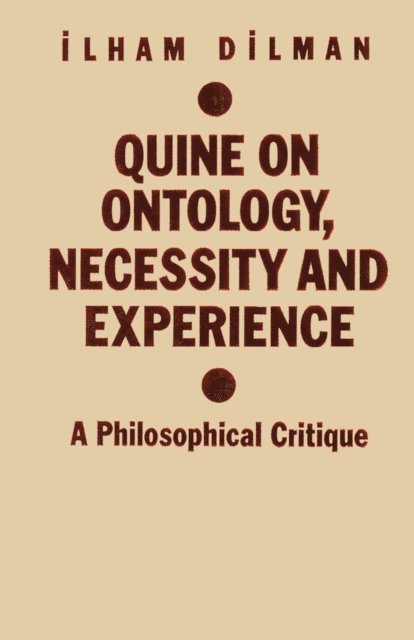
This study is a critique of Quine's views on three interrelated topics that figure prominently in his work and on which he has developed very distinctive opinions. Dr. Dilman provides detailed criticism of these views and contrasts them with Wittgenstein's understanding of the same topics. Throughout this systematic analysis, the author questions basic assumptions on which the Quinean edifice rests.The book argues that Quine's notion of ontology is riddled with inconsistencies and singles out examples for discussion. It argues that Quine's rejection of the distinction between necessary and contingent truths is unwarranted, and that the notion of analyticity, in terms of which he conducts this discussion, is a red herring. And it argues that the notion of experience and subordinate notion of the senses, which Quine uses to discuss the confirmation of propositions and to expound his brand of empiricism, are crude.
488 kr
Skickas inom 10-15 vardagar
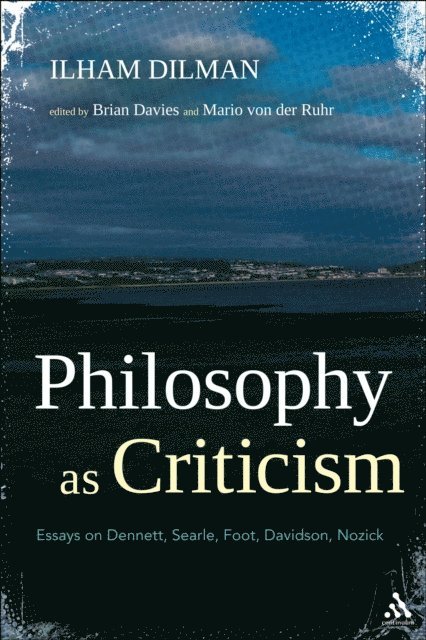
In this, his final book, noted philosopher Ilham Dilman offers sharp critiques of his major contemporaries. "Philosophy of Criticism" is both the final word from a celebrated philosopher on his distinguished career and an attempt, through critiques of his major contemporaries, to explore the future of philosophy. Born in Turkey, Ilham Dilman spent the majority of his working life teaching philosophy in the United States and Great Britain and published widely in moral philosophy and psychology, most notably on Wittgenstein and Freud. After an autobiographical introduction, in which Dilman reflects on how he came to become a philosopher, he moves, chapter by chapter, into an incisive critique of key contemporary thinkers and movements in philosophy. Dilman asks us to review afresh the contributions of Dennett, Searle, Foot, Davidson and Nozick to the modern debate. The result is a vital and urgent engagement with the core questions of philosophy and a re-instatement of the centrality of criticism in philosophy.
1 833 kr
Skickas inom 10-15 vardagar
In this, his final book, noted philosopher Ilham Dilman offers sharp critiques of his major contemporaries. "Philosophy of Criticism" is both the final word from a celebrated philosopher on his distinguished career and an attempt, through critiques of his major contemporaries, to explore the future of philosophy. Born in Turkey, Ilham Dilman spent the majority of his working life teaching philosophy in the United States and Great Britain and published widely in moral philosophy and psychology, most notably on Wittgenstein and Freud. After an autobiographical introduction, in which Dilman reflects on how he came to become a philosopher, he moves, chapter by chapter, into an incisive critique of key contemporary thinkers and movements in philosophy. Dilman asks us to review afresh the contributions of Dennett, Searle, Foot, Davidson and Nozick to the modern debate. The result is a vital and urgent engagement with the core questions of philosophy and a re-instatement of the centrality of criticism in philosophy.
1 593 kr
Skickas inom 10-15 vardagar
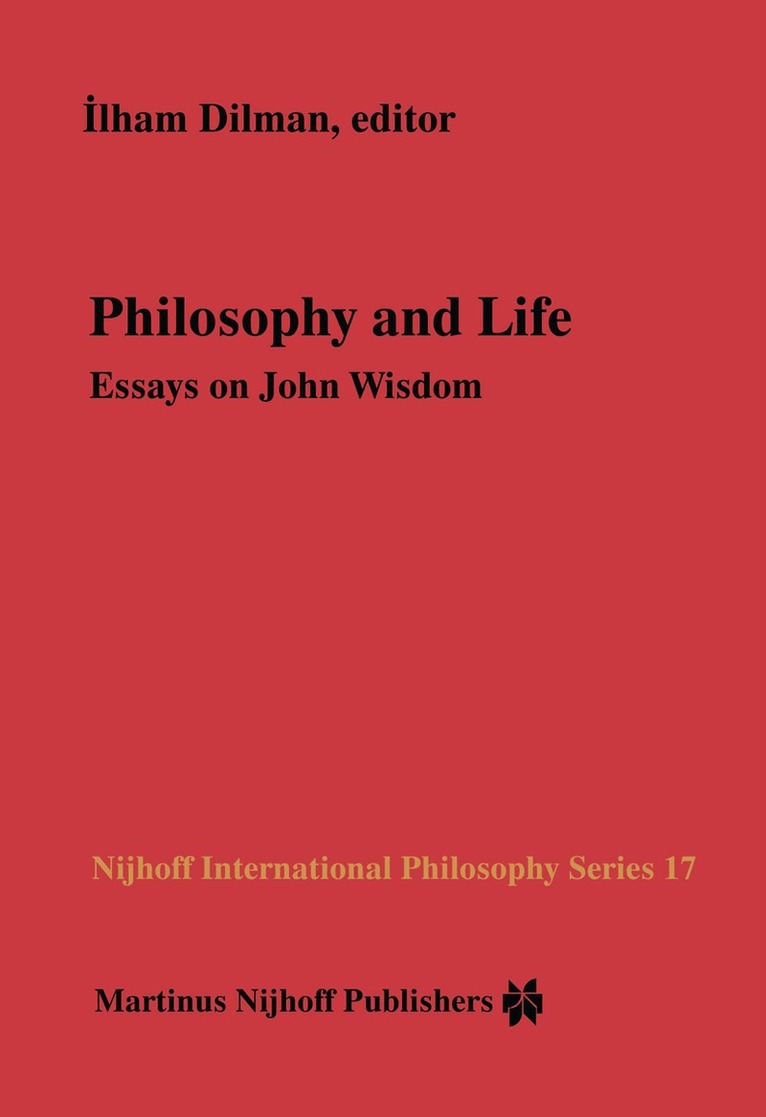
JOHN WISDOM AND THE BREADTH OF PHILOSOPHY hham Dhman 1. THE ESSAYS IN THIS VOLUME The essays following the two pieces by John Wisdom have all been written by philosophers who are former students or friends of Wisdom or who have a high regard for his work. Their contributions were all written with him in mind and to be discussed at a conference honouring his work. This conference was held in August 1983 at Trinity College, Cambridge, of which Wisdom has been a fellow since 1935. Wisdom is a master of discursive reasoning and one of his distinctive contributions in philosophy has been to examine its various forms and their interconnections, particularly the form it takes in philosophical inquiry and the way it advances our understanding there. His concern to bring out the links between all that is abstract in such reasoning and the concrete and particular is well known and represented in many of the essays in this volume. But Wisdom has also a deep appreciation of the kind of understanding that is advanced non-discursively. As he puts it in the first piece in this volume: However skilled a good critic 'I am sure that much of what makes "Hamlet" "Hamlet" will run between his fingers'. He has himself advanced our understanding on many questions in philosophy in this way, not simply by what he has said, but also by what he has suggested 'between the lines'.
1 593 kr
Skickas inom 10-15 vardagar
JOHN WISDOM AND THE BREADTH OF PHILOSOPHY hham Dhman 1. THE ESSAYS IN THIS VOLUME The essays following the two pieces by John Wisdom have all been written by philosophers who are former students or friends of Wisdom or who have a high regard for his work. Their contributions were all written with him in mind and to be discussed at a conference honouring his work. This conference was held in August 1983 at Trinity College, Cambridge, of which Wisdom has been a fellow since 1935. Wisdom is a master of discursive reasoning and one of his distinctive contributions in philosophy has been to examine its various forms and their interconnections, particularly the form it takes in philosophical inquiry and the way it advances our understanding there. His concern to bring out the links between all that is abstract in such reasoning and the concrete and particular is well known and represented in many of the essays in this volume. But Wisdom has also a deep appreciation of the kind of understanding that is advanced non-discursively. As he puts it in the first piece in this volume: However skilled a good critic 'I am sure that much of what makes "Hamlet" "Hamlet" will run between his fingers'. He has himself advanced our understanding on many questions in philosophy in this way, not simply by what he has said, but also by what he has suggested 'between the lines'.