Ingemar J. Cox – författare
Visar alla böcker från författaren Ingemar J. Cox. Handla med fri frakt och snabb leverans.
5 produkter
5 produkter
E-bok
PDF, Engelska, 20121 069 kr
Läs direkt efter köp
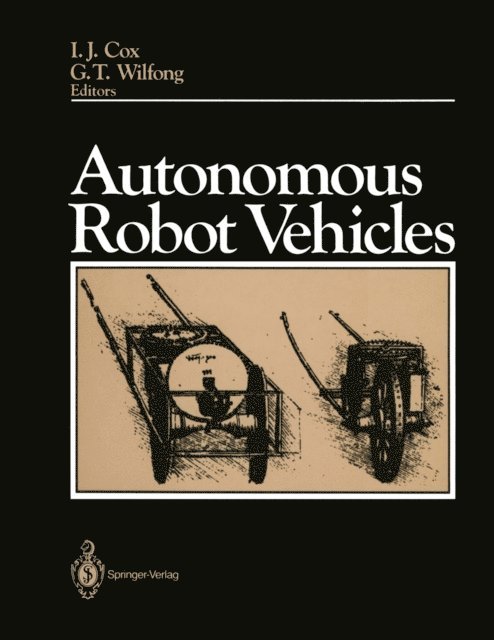
Autonomous robot vehicles are vehicles capable of intelligent motion and action without requiring either a guide or teleoperator control. The recent surge of interest in this subject will grow even grow further as their potential applications increase. Autonomous vehicles are currently being studied for use as reconnaissance/exploratory vehicles for planetary exploration, undersea, land and air environments, remote repair and maintenance, material handling systems for offices and factories, and even intelligent wheelchairs for the disabled. This reference is the first to deal directly with the unique and fundamental problems and recent progress associated with autonomous vehicles. The editors have assembled and combined significant material from a multitude of sources, and, in effect, now conviniently provide a coherent organization to a previously scattered and ill-defined field.
Häftad, Engelska, 2004
1 114 kr
Skickas inom 10-15 vardagar
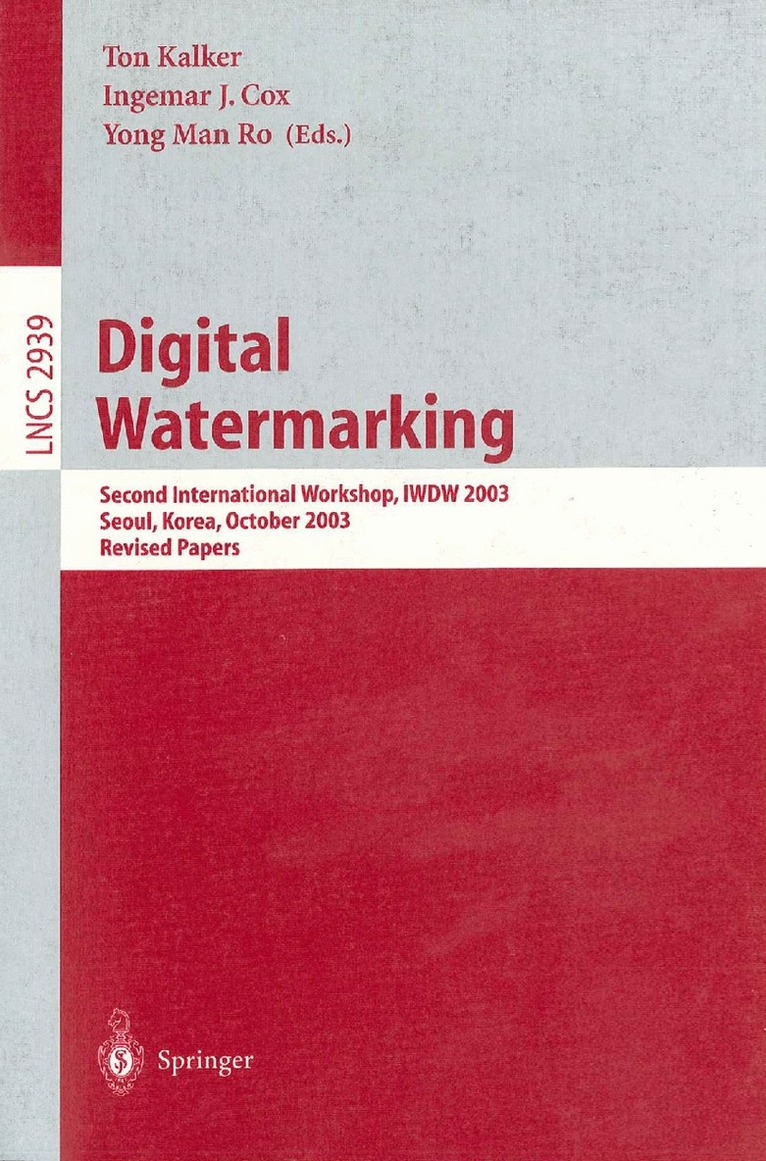
This book constitutes the thoroughly refereed postproceedings of the Second International Workshop on Digital Watermarking, IWDW 2003, held in Seoul, Korea, in October 2004.The 44 revised full papers presented together with 4 invited articles were carefully selected during two rounds of reviewing and improvement from more than 90 submissions. The papers address all current aspects of digital watermarking, in particular theoretical modeling, robustness, capacity, imperceptibility and the human perceptual system, security and attacks, watermarking systems and implementations, and integration of digital watermarking in digital rights management.
E-bok
PDF, Engelska, 20041 408 kr
Läs direkt efter köp
We are happy to present to you the proceedings of the 2nd International Workshop on Digital Watermarking, IWDW 2003. Since its modern re-appearance in the academic community in the early 1990s, great progress has been made in understanding both the capabilities and the weaknesses of digital watermarking. On the theoretical side, we all are now well aware of the fact that digital waterma- ing is best viewed as a form of communication using side information. In the case of digital watermarking the side information in question is the document to be wat- marked. This insight has led to a better understanding of the limits of the capacity and robustness of digital watermarking algorithms. It has also led to new and improved watermarking algorithms, both in terms of capacity and imperceptibility. Similarly, the role of human perception, and models thereof, has been greatly enhanced in the study and design of digital watermarking algorithms and systems. On the practical side, applications of watermarking are not yet abundant. The original euphoria on the role of digital watermarking in copy protection and copyright prot- tion has not resulted in widespread usage in practical systems. With hindsight, a n- ber of reasons can be given for this lack of practical applications.
Häftad, Engelska, 2005
561 kr
Skickas inom 10-15 vardagar
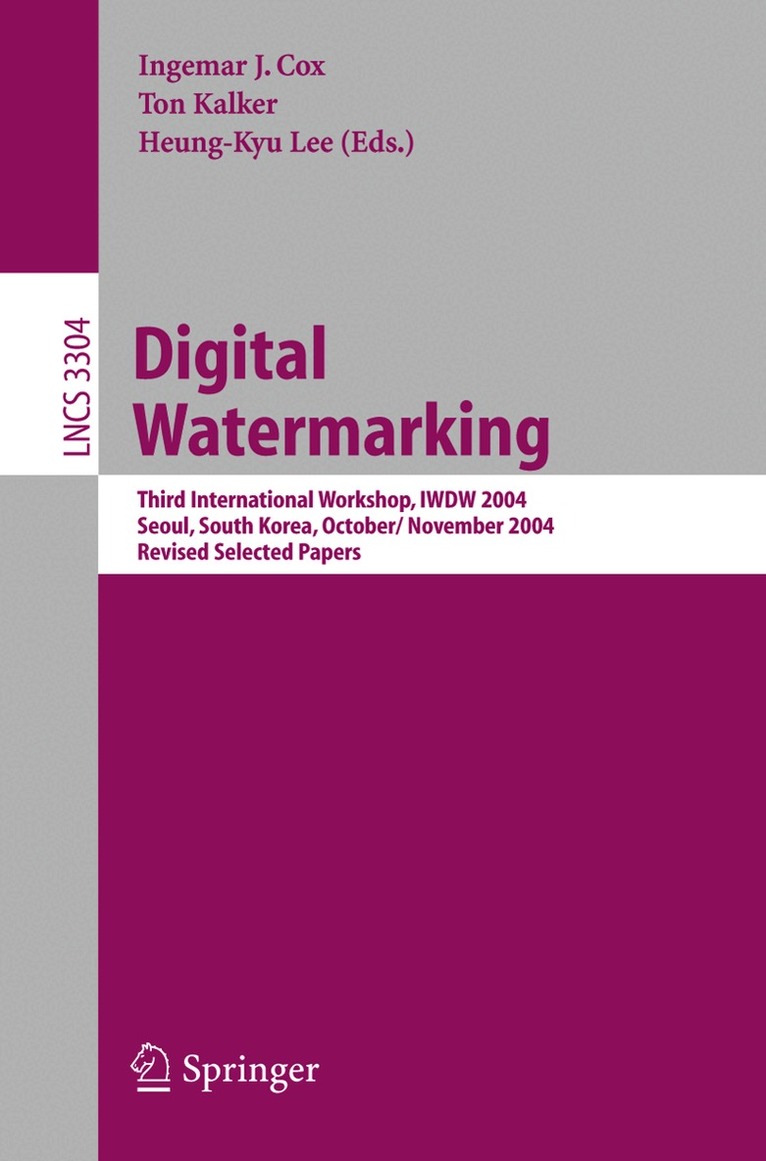
We are happy to present to you the proceedings of the 3rd International Workshop on Digital Watermarking, IWDW 2004. Since its modern reappearance in the academic community in the early 1990s, great progress has been made in understanding both the capabilities and the weaknesses of digital watermarking. On the theoretical side, we all are now well aware of the fact that digital watermarking is best viewed as a form of communication using side information. In the case of digital watermarking the side information in question is the document to be watermarked. This insight has led to a better understanding of the limits of the capacity and robustness of digital watermarking algorithms. It has also led to new and improved watermarking algorithms, both in terms of capacity and imperceptibility. Similarly, the role of human perception, and models thereof, has been greatly enhanced in the study and design of digital watermarking algorithms and systems. On the practical side, applications of watermarking are not yet abundant. The original euphoria on the role of digital watermarking in copy protection and copyright protection has not resulted in widespread use in practical systems. With hindsight, a number of reasons can be given for this lack of practical applications.
E-bok
PDF, Engelska, 2005708 kr
Läs direkt efter köp
We are happy to present to you the proceedings of the 3rd International Workshop on Digital Watermarking, IWDW 2004. Since its modern reappearance in the academic community in the early 1990s, great progress has been made in understanding both the capabilities and the weaknesses of digital watermarking. On the theoretical side, we all are now well aware of the fact that digital watermarking is best viewed as a form of communication using side information. In the case of digital watermarking the side information in question is the document to be watermarked. This insight has led to a better understanding of the limits of the capacity and robustness of digital watermarking algorithms. It has also led to new and improved watermarking algorithms, both in terms of capacity and imperceptibility. Similarly, the role of human perception, and models thereof, has been greatly enhanced in the study and design of digital watermarking algorithms and systems. On the practical side, applications of watermarking are not yet abundant. The original euphoria on the role of digital watermarking in copy protection and copyright protection has not resulted in widespread use in practical systems. With hindsight, a number of reasons can be given for this lack of practical applications.