Ioannis Pitas - Böcker
Visar alla böcker från författaren Ioannis Pitas. Handla med fri frakt och snabb leverans.
7 produkter
7 produkter
662 kr
Skickas inom 10-15 vardagar
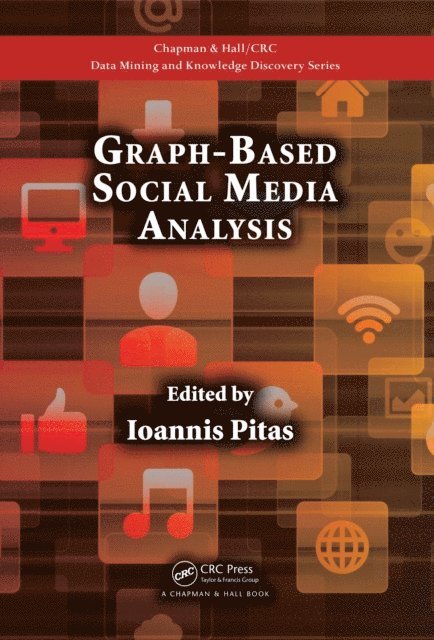
Focused on the mathematical foundations of social media analysis, Graph-Based Social Media Analysis provides a comprehensive introduction to the use of graph analysis in the study of social and digital media. It addresses an important scientific and technological challenge, namely the confluence of graph analysis and network theory with linear algebra, digital media, machine learning, big data analysis, and signal processing. Supplying an overview of graph-based social media analysis, the book provides readers with a clear understanding of social media structure. It uses graph theory, particularly the algebraic description and analysis of graphs, in social media studies.The book emphasizes the big data aspects of social and digital media. It presents various approaches to storing vast amounts of data online and retrieving that data in real-time. It demystifies complex social media phenomena, such as information diffusion, marketing and recommendation systems in social media, and evolving systems. It also covers emerging trends, such as big data analysis and social media evolution.Describing how to conduct proper analysis of the social and digital media markets, the book provides insights into processing, storing, and visualizing big social media data and social graphs. It includes coverage of graphs in social and digital media, graph and hyper-graph fundamentals, mathematical foundations coming from linear algebra, algebraic graph analysis, graph clustering, community detection, graph matching, web search based on ranking, label propagation and diffusion in social media, graph-based pattern recognition and machine learning, graph-based pattern classification and dimensionality reduction, and much more.This book is an ideal reference for scientists and engineers working in social media and digital media production and distribution. It is also suitable for use as a textbook in undergraduate or graduate courses on digital media, social media, or social networks.
1 958 kr
Skickas inom 7-10 vardagar
A comprehensive survey of techniques and applications in image andvideo processing and analysis A widely varied selection of experts provides extensive coverage ofnonlinear model-based techniques in image and video processing andanalysis. This volume not only details new techniques in stillimage and digital video but also discusses applications in computervision, multimedia, and visual information retrieval systems. Allnonlinear, model-based techniques are detailed, and a complete andup-to-date accounting of the most important and effectivealgorithms is included for every application and techniquediscussed. The applications described also include such real-world uses asmultimedia information retrieval, automatic surveillance, liptracking, and much more. Analytical techniques such as Boolean andstack filters, rational functions, mathematical morphologytechniques, and adaptive order statistic filtering receive detailedtreatment as they apply to specific uses such as image compression,segmentation, old motion picture restoration, image/videointerpolation, and noise smoothing. Chapters include:* Optimal Design of Boolean and Stack Filters and Their Applicationin Image Processing* Image Processing Using Rational Functions* Mathematical Morphology and Motion Picture Restoration* Adaptive Order Statistic Filtering of Still Images and ImageSequences* Video Segmentation Based on Multiple Features for Interactive andAutomatic Multimedia Applications* Invariant Features in Pattern Recognition-Fundamentals andApplications* Image Models for Facial Feature Tracking Students, engineers, and scientists will appreciate both the widerange of expert opinion in this comprehensive volume and thedetailed coverage of the algorithms and mathematical models used instate-of-the-art image and video processing.
1 261 kr
Skickas inom 7-10 vardagar
Thorough, up-to-date, comprehensive coverage of 3-D image processing This authoritative guide presents and explains numerous 3-D image processing, analysis, and visualization techniques, including volume filtering, interpolation, 3-D discrete Fourier transform, evaluation of topological and geometrical features, region segmentation and edge detection, skeletonization and registration, and visualization. Necessary theoretical background is provided for each topic, along with a number of algorithms, selected on the basis of their acceptance by the scientific community. The presentation of each technique includes a commented implementation, either in C code or in C-like pseudocode. Though presented in an almost ready-to-run form, the C code is simplified to expose the structure of the processing algorithms, rather than their programming details. This combination of theoretical treatment and C code implementation allows readers to gain a thorough insight into these techniques. Important features of 3-D Image Processing Algorithms include:* A demo version of EIKONA 3D image processing software* Lab exercises based on EIKONA 3D* Accompanying transparencies summarizing the most important topics. The material can be downloaded from an ftp site Based on the authors' long experience in research and teaching of 2-D/3-D image processing, 3-D Image Processing Algorithms is an indispensable resource for electrical, computer, and biomedical engineers, as well as computer graphics professionals and programmers.
2 135 kr
Skickas inom 11-20 vardagar
A unique collection of algorithms and lab experiments for practitioners and researchers of digital image processing technology With the field of digital image processing rapidly expanding, there is a growing need for a book that would go beyond theory and techniques to address the underlying algorithms. Digital Image Processing Algorithms and Applications fills the gap in the field, providing scientists and engineers with a complete library of algorithms for digital image processing, coding, and analysis. Digital image transform algorithms, edge detection algorithms, and image segmentation algorithms are carefully gleaned from the literature for compatibility and a track record of acceptance in the scientific community. The author guides readers through all facets of the technology, supplementing the discussion with detailed lab exercises in EIKONA, his own digital image processing software, as well as useful PDF transparencies. He covers in depth filtering and enhancement, transforms, compression, edge detection, region segmentation, and shape analysis, explaining at every step the relevant theory, algorithm structure, and its use for problem solving in various applications. The availability of the lab exercises and the source code (all algorithms are presented in C-code) over the Internet makes the book an invaluable self-study guide. It also lets interested readers develop digital image processing applications on ordinary desktop computers as well as on Unix machines.
1 582 kr
Skickas inom 10-15 vardagar
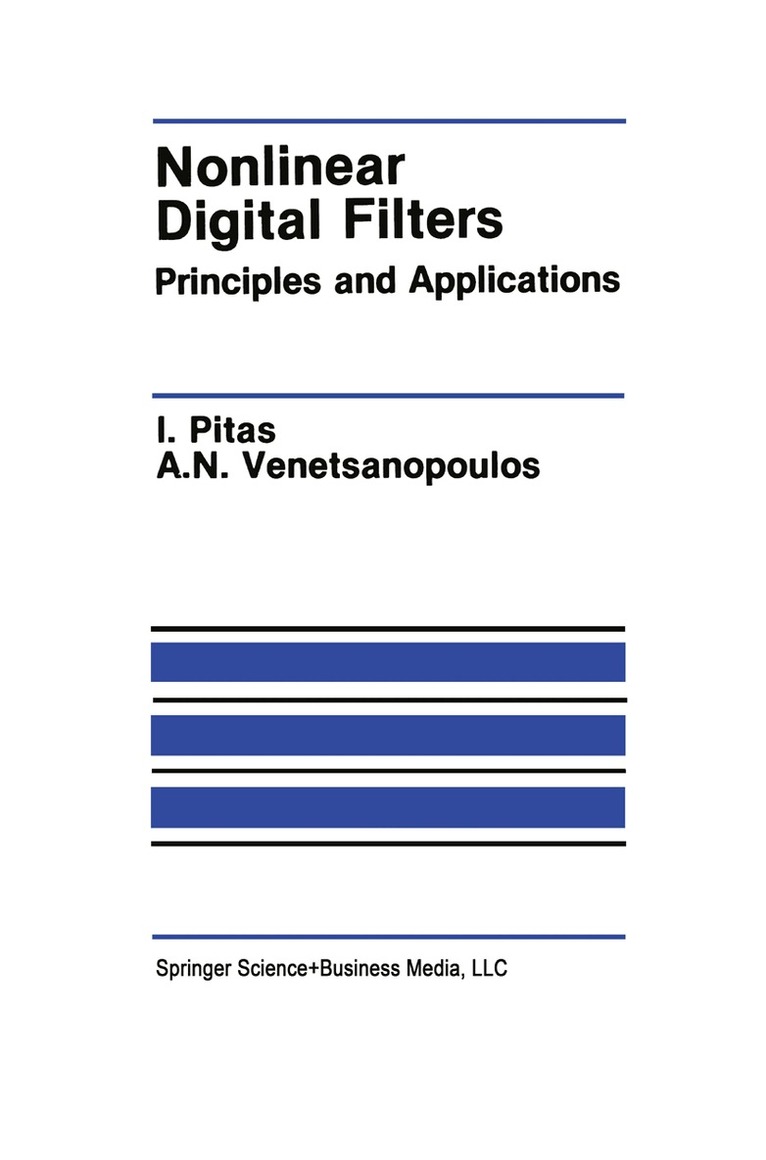
The function of a filter is to transform a signal into another one more suit able for a given purpose. As such, filters find applications in telecommunica tions, radar, sonar, remote sensing, geophysical signal processing, image pro cessing, and computer vision. Numerous authors have considered deterministic and statistical approaches for the study of passive, active, digital, multidimen sional, and adaptive filters. Most of the filters considered were linear although the theory of nonlinear filters is developing rapidly, as it is evident by the numerous research papers and a few specialized monographs now available. Our research interests in this area created opportunity for cooperation and co authored publications during the past few years in many nonlinear filter families described in this book. As a result of this cooperation and a visit from John Pitas on a research leave at the University of Toronto in September 1988, the idea for this book was first conceived. The difficulty in writing such a mono graph was that the area seemed fragmented and no general theory was available to encompass the many different kinds of filters presented in the literature. However, the similarities of some families of nonlinear filters and the need for such a monograph providing a broad overview of the whole area made the pro ject worthwhile. The result is the book now in your hands, typeset at the Department of Electrical Engineering of the University of Toronto during the summer of 1989.
1 590 kr
Skickas inom 10-15 vardagar
The function of a filter is to transform a signal into another one more suit able for a given purpose. As such, filters find applications in telecommunica tions, radar, sonar, remote sensing, geophysical signal processing, image pro cessing, and computer vision. Numerous authors have considered deterministic and statistical approaches for the study of passive, active, digital, multidimen sional, and adaptive filters. Most of the filters considered were linear although the theory of nonlinear filters is developing rapidly, as it is evident by the numerous research papers and a few specialized monographs now available. Our research interests in this area created opportunity for cooperation and co authored publications during the past few years in many nonlinear filter families described in this book. As a result of this cooperation and a visit from John Pitas on a research leave at the University of Toronto in September 1988, the idea for this book was first conceived. The difficulty in writing such a mono graph was that the area seemed fragmented and no general theory was available to encompass the many different kinds of filters presented in the literature. However, the similarities of some families of nonlinear filters and the need for such a monograph providing a broad overview of the whole area made the pro ject worthwhile. The result is the book now in your hands, typeset at the Department of Electrical Engineering of the University of Toronto during the summer of 1989.
1 609 kr
Skickas inom 10-15 vardagar
Focused on the mathematical foundations of social media analysis, Graph-Based Social Media Analysis provides a comprehensive introduction to the use of graph analysis in the study of social and digital media. It addresses an important scientific and technological challenge, namely the confluence of graph analysis and network theory with linear algebra, digital media, machine learning, big data analysis, and signal processing. Supplying an overview of graph-based social media analysis, the book provides readers with a clear understanding of social media structure. It uses graph theory, particularly the algebraic description and analysis of graphs, in social media studies.The book emphasizes the big data aspects of social and digital media. It presents various approaches to storing vast amounts of data online and retrieving that data in real-time. It demystifies complex social media phenomena, such as information diffusion, marketing and recommendation systems in social media, and evolving systems. It also covers emerging trends, such as big data analysis and social media evolution.Describing how to conduct proper analysis of the social and digital media markets, the book provides insights into processing, storing, and visualizing big social media data and social graphs. It includes coverage of graphs in social and digital media, graph and hyper-graph fundamentals, mathematical foundations coming from linear algebra, algebraic graph analysis, graph clustering, community detection, graph matching, web search based on ranking, label propagation and diffusion in social media, graph-based pattern recognition and machine learning, graph-based pattern classification and dimensionality reduction, and much more.This book is an ideal reference for scientists and engineers working in social media and digital media production and distribution. It is also suitable for use as a textbook in undergraduate or graduate courses on digital media, social media, or social networks.