Irina V. Uvarova – författare
Visar alla böcker från författaren Irina V. Uvarova. Handla med fri frakt och snabb leverans.
6 produkter
6 produkter
Del 16 - NATO Science Series II: Mathematics, Physics and Chemistry
Functional Gradient Materials and Surface Layers Prepared by Fine Particles Technology
Inbunden, Engelska, 2001
1 091 kr
Skickas inom 10-15 vardagar
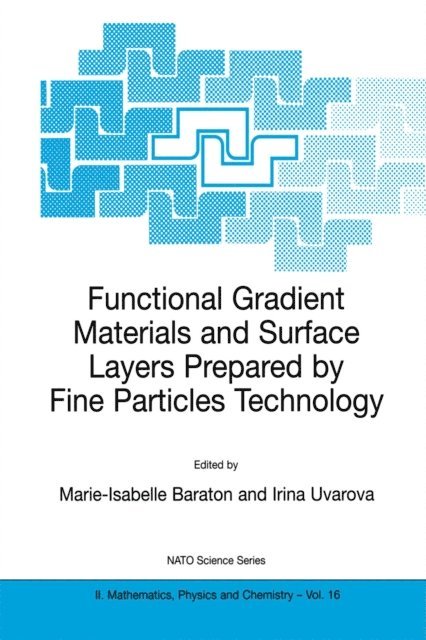
The NATO Advanced Study Institute on "Functional Gradient Materials and Surface Layers Prepared by Fine Particles Technology" was held in Kiev (Ukraine) on June 18- 28, 2000 where more than 90 participants, ranging from Ph.D. students to experienced senior scientists, met and exchanged ideas. This meeting was aimed at stimulating the research work across traditional disciplinary lines by bringing together scientists from diverse research areas related to functional gradient materials and surface layers. It also intended to give opportunities for initiating collaborative works between scientists from NATO and Partner countries and to trigger fruitful and exciting discussions between experienced and young researchers. In this respect, this NATO-ASI has been quite successful. The term of functional gradient materials which originates from Japan in the 1980's describes a class of engineering materials with spatially inhomogeneous microstructures and properties (MRS Bulletin, 1995,20, N°l). These materials can be successfully utilized in various applications like electronic devices, optical films, anti wear and anti-corrosion coatings, thermal barrier coatings, biomaterials, to name only a few. Although these functional gradient materials are not fundamentally new, the use of nanoparticles in their fabrication and in surface layers as well has greatly improved their performances to meet challenging requirements for industrial applications.
Del 16 - NATO Science Series II: Mathematics, Physics and Chemistry
Functional Gradient Materials and Surface Layers Prepared by Fine Particles Technology
Häftad, Engelska, 2001
1 091 kr
Skickas inom 10-15 vardagar
The NATO Advanced Study Institute on "Functional Gradient Materials and Surface Layers Prepared by Fine Particles Technology" was held in Kiev (Ukraine) on June 18- 28, 2000 where more than 90 participants, ranging from Ph.D. students to experienced senior scientists, met and exchanged ideas. This meeting was aimed at stimulating the research work across traditional disciplinary lines by bringing together scientists from diverse research areas related to functional gradient materials and surface layers. It also intended to give opportunities for initiating collaborative works between scientists from NATO and Partner countries and to trigger fruitful and exciting discussions between experienced and young researchers. In this respect, this NATO-ASI has been quite successful. The term of functional gradient materials which originates from Japan in the 1980's describes a class of engineering materials with spatially inhomogeneous microstructures and properties (MRS Bulletin, 1995,20, N°l). These materials can be successfully utilized in various applications like electronic devices, optical films, anti wear and anti-corrosion coatings, thermal barrier coatings, biomaterials, to name only a few. Although these functional gradient materials are not fundamentally new, the use of nanoparticles in their fabrication and in surface layers as well has greatly improved their performances to meet challenging requirements for industrial applications.
Inbunden, Engelska, 2003
1 633 kr
Skickas inom 10-15 vardagar
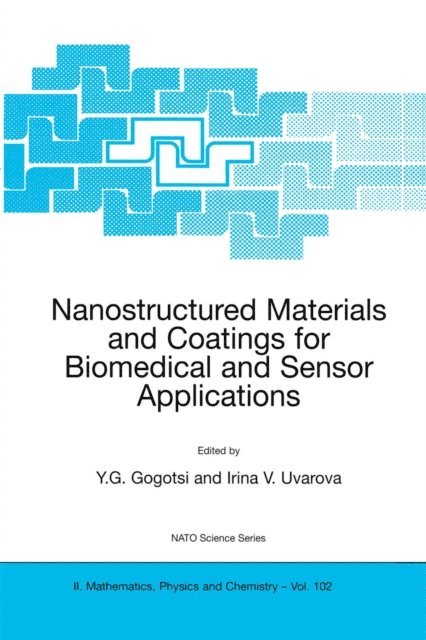
The latest international research from materials scientists for 2002 is presented in this book, which also provides further information on bioceramics specifically for medical applications. New materials for sensors are also discussed. Nanostructured materials and coatings for biomedical and sensor applications contribute to the dissemination of state-of-the-art knowledge about the application of nanostructured materials and coatings in biotechnology and medicine, as well as that of sensors for the chemical and biomedical industries. The research presented here addresses the fundamental scientific problems that must be resolved in order to take advantage of the nanoscale approach to creating new materials.
Häftad, Engelska, 2003
1 633 kr
Skickas inom 10-15 vardagar
This volume contains papers that were presented at the NATO Advanced Research Workshop on Nanostructured Materials and Coatings for Biomedical and Sensor Applications held in Kyiv, Ukraine, 4-8 August, 2002. A total of 104 scientists from 14 countries participated in our ARW, making it a really international event. Participants ranged from graduate students to senior researchers. They presented 16 tutorial lectures, 20 short talks and more than 70 posters. Invited speakers, from NATO and Partner countries, presented some of the most recent developments in physics, chemistry and technology of nanosized materials. A broad range of speakers having international standing and representing NATO and partner countries, as well as university, industrial and govemment research laboratories participated in this meeting and wrote papers for this volume. Foregoing ARW gathered together the scientists working in the area of nanosized materials and coatings and their applications in biomedicine and sensors. The first objective of this AR W was to discuss the current research covering a wide range of physical and chemical properties of biomaterials and their use. Active discussion of oral presentations and posters, and the round table discussion gave a good opportunity to researchers from academia and industry to discuss the achievements in this field and outline future directions in terms of technological developments and product commercialisation in the fields of biomedicine and sensors. Particularly, advanced ceramics and nanostructured carbons were covered in many presentations.
E-bok
PDF, Engelska, 20122 036 kr
Läs direkt efter köp
This volume contains papers that were presented at the NATO Advanced Research Workshop on Nanostructured Materials and Coatings for Biomedical and Sensor Applications held in Kyiv, Ukraine, 4-8 August, 2002. A total of 104 scientists from 14 countries participated in our ARW, making it a really international event. Participants ranged from graduate students to senior researchers. They presented 16 tutorial lectures, 20 short talks and more than 70 posters. Invited speakers, from NATO and Partner countries, presented some of the most recent developments in physics, chemistry and technology of nanosized materials. A broad range of speakers having international standing and representing NATO and partner countries, as well as university, industrial and govemment research laboratories participated in this meeting and wrote papers for this volume. Foregoing ARW gathered together the scientists working in the area of nanosized materials and coatings and their applications in biomedicine and sensors. The first objective of this AR W was to discuss the current research covering a wide range of physical and chemical properties of biomaterials and their use. Active discussion of oral presentations and posters, and the round table discussion gave a good opportunity to researchers from academia and industry to discuss the achievements in this field and outline future directions in terms of technological developments and product commercialisation in the fields of biomedicine and sensors. Particularly, advanced ceramics and nanostructured carbons were covered in many presentations.
E-bok
PDF, Engelska, 20121 367 kr
Läs direkt efter köp
The NATO Advanced Study Institute on "Functional Gradient Materials and Surface Layers Prepared by Fine Particles Technology" was held in Kiev (Ukraine) on June 18- 28, 2000 where more than 90 participants, ranging from Ph.D. students to experienced senior scientists, met and exchanged ideas. This meeting was aimed at stimulating the research work across traditional disciplinary lines by bringing together scientists from diverse research areas related to functional gradient materials and surface layers. It also intended to give opportunities for initiating collaborative works between scientists from NATO and Partner countries and to trigger fruitful and exciting discussions between experienced and young researchers. In this respect, this NATO-ASI has been quite successful. The term of functional gradient materials which originates from Japan in the 1980''s describes a class of engineering materials with spatially inhomogeneous microstructures and properties (MRS Bulletin, 1995,20, N°l). These materials can be successfully utilized in various applications like electronic devices, optical films, anti wear and anti-corrosion coatings, thermal barrier coatings, biomaterials, to name only a few. Although these functional gradient materials are not fundamentally new, the use of nanoparticles in their fabrication and in surface layers as well has greatly improved their performances to meet challenging requirements for industrial applications.