Isao Ando – författare
Visar alla böcker från författaren Isao Ando. Handla med fri frakt och snabb leverans.
4 produkter
4 produkter
E-bok
PDF, Engelska, 19988 244 kr
Läs direkt efter köp
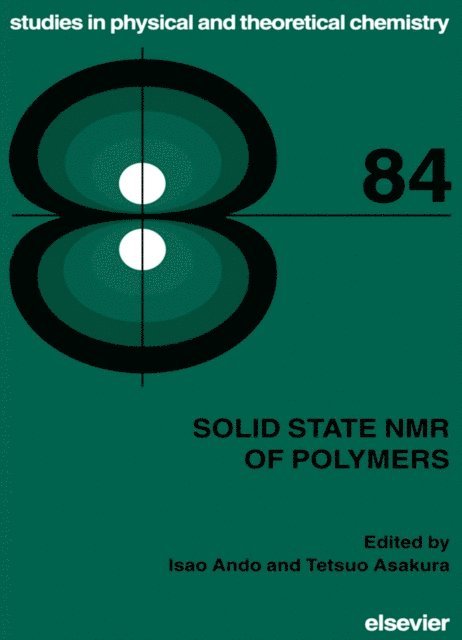
In polymer science and technology, the advanced development of various new polymer materials with excellent properties and functions is desirable. For this purpose it is necesary to determine the exact relationship between physical properties and molecular structure-dynamics with powerful techniques. One such technique is solid state NMR. Recently, high resolution NMR studies of solids have been realized by using advanced pulse and mechanical techniques, which has resulted in a variety of structural and dynamical information on polymer systems. Solid state NMR has provided characteristic information which cannot be obtained by other spectroscopic methods.This book is divided into two parts. The first part covers the principles of NMR, important NMR parameters such as chemical shifts, relaxation times, dipolar interactions, quadrupolar interactions, pulse techniques and new NMR methods. In the second part, applications of NMR to a variety of polymer systems in the solid state are described.Features of this book:• Contains an up-to-date and comprehensive account of solid state NMR of polymers by leading researchers in the field• Provides a compilation of solid state NMR of polymers, which makes it an ideal reference book for both NMR researchers and general polymer scientists.This book will be of interest to the NMR community, and will be invaluable for both the beginner and the expert.
Inbunden, Engelska, 2006
1 619 kr
Skickas inom 10-15 vardagar
‘‘Biopolymers’’ are polymeric materials of biological origin, including globular, membrane, and fibrous proteins, polypeptides, nucleic acids, po- saccharides, lipids, etc. and their assembly, although preference to respe- ive subjects may be different among readers who are more interested in their biological significance or industrial and/or medical applications. Nevert- less, characterizing or revealing their secondary structure and dynamics may be an equally very important and useful issue for both kinds of readers. Special interest in revealing the 3D structure of globular proteins, nucleic acids, and peptides was aroused in relation to the currently active Structural Biology. X-ray crystallography and multidimensional solution NMR sp- troscopy have proved to be the standard and indispensable means for this purpose. There remain, however, several limitations to this end, if one intends to expand its scope further. This is because these approaches are not always straightforward to characterize fibrous or membrane proteins owing to extreme difficulty in crystallization in the former, and insufficient spectral resolution due to sparing solubility or increased effective molecular mass in the presence of surrounding lipid bilayers in the latter.
E-bok
PDF, Engelska, 20061 977 kr
Läs direkt efter köp
‘‘Biopolymers’’ are polymeric materials of biological origin, including globular, membrane, and fibrous proteins, polypeptides, nucleic acids, po- saccharides, lipids, etc. and their assembly, although preference to respe- ive subjects may be different among readers who are more interested in their biological significance or industrial and/or medical applications. Nevert- less, characterizing or revealing their secondary structure and dynamics may be an equally very important and useful issue for both kinds of readers. Special interest in revealing the 3D structure of globular proteins, nucleic acids, and peptides was aroused in relation to the currently active Structural Biology. X-ray crystallography and multidimensional solution NMR sp- troscopy have proved to be the standard and indispensable means for this purpose. There remain, however, several limitations to this end, if one intends to expand its scope further. This is because these approaches are not always straightforward to characterize fibrous or membrane proteins owing to extreme difficulty in crystallization in the former, and insufficient spectral resolution due to sparing solubility or increased effective molecular mass in the presence of surrounding lipid bilayers in the latter.
Häftad, Engelska, 2010
1 605 kr
Skickas inom 10-15 vardagar
When considering the biological significance and industrial and medical applications of biopolymers, it is crucial to know details of their secondary structure, dynamics and assembly. The biopolymers include globular, membrane and fibrous proteins, polypeptides, nucleic acids, polysaccharides and lipids. Solid state NMR spectroscopy has proved to be the most suitable and unrivaled means for investigations of biopolymers. The major advantage of solid state NMR spectroscopy is that the resulting line widths can be manipulated experimentally and are not influenced by motional fluctuation of proteins under consideration as a whole. Solid State NMR Spectroscopy for Biopolymers: Principles and Applications provides a comprehensive account on how the conformation and dynamics of such biopolymers can be revealed by solid state NMR spectroscopy. Special efforts have been made towards the historical and chronological consequences of a variety of applications and the dynamic aspects of the biopolymer system.In particular, the authors emphasise how important it is to record the most simple DD-MAS (one pulse excitation with high power decoupling) as a means of locating very flexible portions of membrane proteins and membrane associated peptides. The authors also demonstrate that dynamic features of membrane proteins with a timescale of fast (108 Hz) and intermediate (104 -105 Hz) fluctuation motions can be revealed easily by specific suppression of peaks.