István Deák - Böcker
Visar alla böcker från författaren István Deák. Handla med fri frakt och snabb leverans.
8 produkter
8 produkter
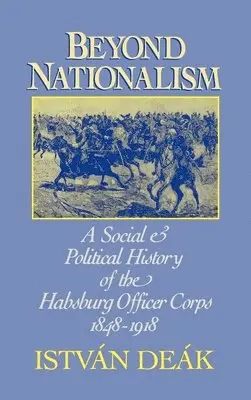
Beyond Nationalism
A Social and Political History of the Habsburg Officer Corps 1848-1918
Inbunden, Engelska, 1990
1 325 kr
Skickas inom 5-8 vardagar
István Deák examines the Habsburg officer corps and the way in which it became the foremost preserver of the multi-ethnic Austro-Hungarian empire from the mid-nineteeth century to the empire's defeat in 1918. The officer corps was an important cohesive force in the empire, for it created a unified and loyal army from recruits representing all the different nationalities and ethnic groups of Austro-Hungary.The policies, character, social structure, and self-image of the Habsburg army have been neglected in the extensive literature on the origins of the First World War. Deák provides the most comprehensive social and cultural portrait to date of this important institution.
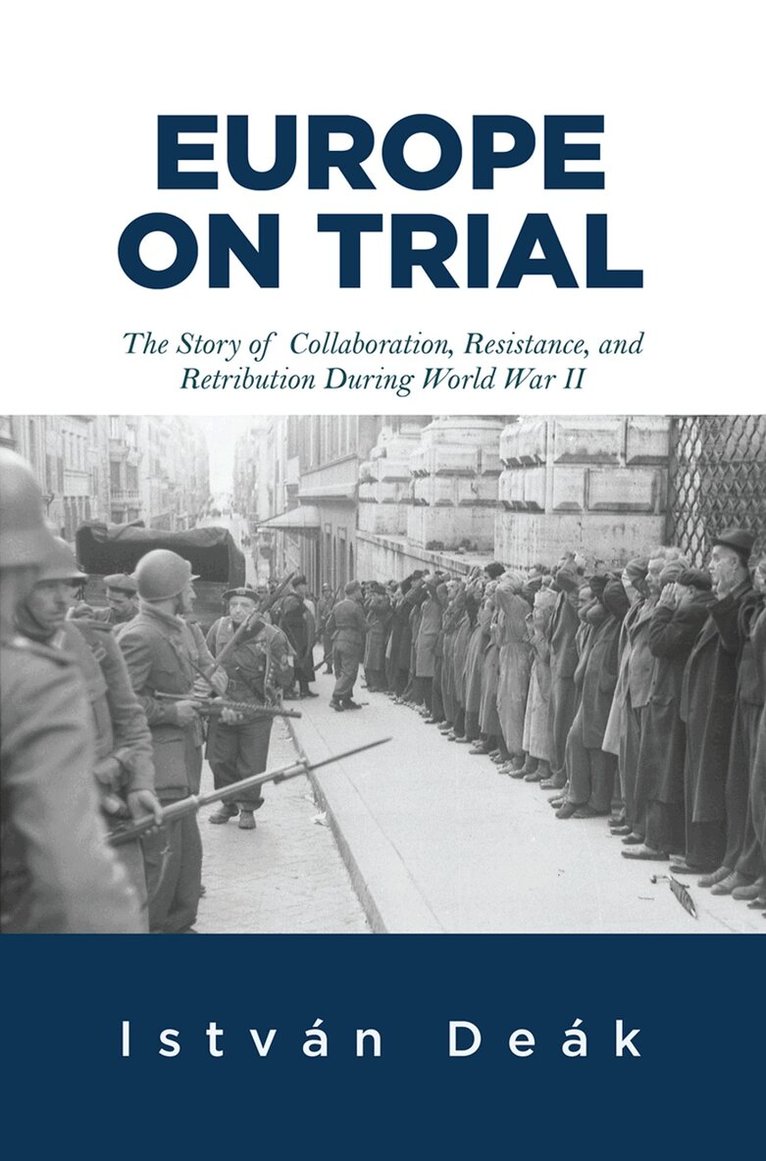
Europe on Trial
The Story of Collaboration, Resistance, and Retribution during World War II
Inbunden, Engelska, 2019
2 166 kr
Skickas inom 10-15 vardagar
Europe on Trial explores the history of collaboration, retribution, and resistance during World War II. These three themes are examined through the experiences of people and countries under German occupation, as well as Soviet, Italian, and other military rule. Those under foreign rule faced innumerable moral and ethical dilemmas, includin
Weimar Germany's Left-Wing Intellectuals
A Political History of the Weltbühne and Its Circle
Häftad, Engelska, 2022
835 kr
Skickas inom 3-6 vardagar
The Germany between the two world wars, which produced some of the greatest literary lights of the century, also produced a forum worthy of them: the brilliantly edited, crusading, lef-oriented (but not party-affiliated) Weltbühne. The present book tells the history of this weekly Berlin journal, discusses the men that ran it and wrote it, and outlines the causes for which it fought. The Weltbühne had three editors--the uncompromising style-conscious Siegfried Jacobsohn, the sharp-tongued, satirical Kurt Tucholsky, and the enigmatic, aristocratic Carl von Ossietzky, martyred by the Nazis. The radical, intellectual elite of Germany (and to come extent outside Germany) contributed to the journal -- Heinrich Mann, Alfred Polgar, Erich Kästner, Alfred Doblin, Bertolt Brecht, Leonhard Frank, Theodor Plievier, Rene Schickele, Lion Feuchtwanger, Ernst Toller, Arnold Zweig; also Arthur Koestler, Romain Rolland, Henry Barbusse, and Leon Trotsky. These men stood for the demilitarization of Germany, the purge of the reactionary administration and judiciary, the end of all restraints on human rights (including the restraints on abortion and homosexuality), complete equality of women, pacifist educational policies, the intellectualization of politics and politicization of the intellectuals, unity of the working-class parties, and socialism. When, on May 11, 1933, on Opera Square in Berlin, the stormtroopers burned books of fifteen authors sinning against the German Volk, thirteen of them had made contribution to the Weltbühne; and since many of them were Jews, the auto-da-fé gave special pleasure to the mob. Mr. Deak recreates with unusual empathy the atmosphere of the era, characterized by terrific social and political issues, which eventually lead to the disaster of the Thirties. The campaigns of the Weltbühne failed, and the contributors were killed or went into exile, with the journal itself moving from Berlin to Vienna to Prague to Paris before it died. Mr. Deak makes a lasting contribution to history by opening to a broader public the records preserved in the pages of this important but largely ignored journal, by selecting and interpreting the issues, and by brining to life the personalities that gave the era its intellectual profile. And understanding of the Weltbühne campaigns is indispensable for an appraisal of Central European politics in the first half of our century. Mr. Deak, in this readable book written with the passionate interest of a person who seems to have been a participant rather than a chronicler, makes this understanding possible by a lucid exposition and a searching analysis of the events. This title is part of UC Press's Voices Revived program, which commemorates University of California Press's mission to seek out and cultivate the brightest minds and give them voice, reach, and impact. Drawing on a backlist dating to 1893, Voices Revived makes high-quality, peer-reviewed scholarship accessible once again using print-on-demand technology. This title was originally published in 1968.
Weimar Germany's Left-Wing Intellectuals
A Political History of the Weltbühne and Its Circle
Inbunden, Engelska, 2022
776 kr
Skickas inom 7-10 vardagar
The Germany between the two world wars, which produced some of the greatest literary lights of the century, also produced a forum worthy of them: the brilliantly edited, crusading, lef-oriented (but not party-affiliated) Weltbühne. The present book tells the history of this weekly Berlin journal, discusses the men that ran it and wrote it, and outlines the causes for which it fought. The Weltbühne had three editors--the uncompromising style-conscious Siegfried Jacobsohn, the sharp-tongued, satirical Kurt Tucholsky, and the enigmatic, aristocratic Carl von Ossietzky, martyred by the Nazis. The radical, intellectual elite of Germany (and to come extent outside Germany) contributed to the journal -- Heinrich Mann, Alfred Polgar, Erich Kästner, Alfred Doblin, Bertolt Brecht, Leonhard Frank, Theodor Plievier, Rene Schickele, Lion Feuchtwanger, Ernst Toller, Arnold Zweig; also Arthur Koestler, Romain Rolland, Henry Barbusse, and Leon Trotsky. These men stood for the demilitarization of Germany, the purge of the reactionary administration and judiciary, the end of all restraints on human rights (including the restraints on abortion and homosexuality), complete equality of women, pacifist educational policies, the intellectualization of politics and politicization of the intellectuals, unity of the working-class parties, and socialism. When, on May 11, 1933, on Opera Square in Berlin, the stormtroopers burned books of fifteen authors sinning against the German Volk, thirteen of them had made contribution to the Weltbühne; and since many of them were Jews, the auto-da-fé gave special pleasure to the mob. Mr. Deak recreates with unusual empathy the atmosphere of the era, characterized by terrific social and political issues, which eventually lead to the disaster of the Thirties. The campaigns of the Weltbühne failed, and the contributors were killed or went into exile, with the journal itself moving from Berlin to Vienna to Prague to Paris before it died. Mr. Deak makes a lasting contribution to history by opening to a broader public the records preserved in the pages of this important but largely ignored journal, by selecting and interpreting the issues, and by brining to life the personalities that gave the era its intellectual profile. And understanding of the Weltbühne campaigns is indispensable for an appraisal of Central European politics in the first half of our century. Mr. Deak, in this readable book written with the passionate interest of a person who seems to have been a participant rather than a chronicler, makes this understanding possible by a lucid exposition and a searching analysis of the events. This title is part of UC Press's Voices Revived program, which commemorates University of California Press's mission to seek out and cultivate the brightest minds and give them voice, reach, and impact. Drawing on a backlist dating to 1893, Voices Revived makes high-quality, peer-reviewed scholarship accessible once again using print-on-demand technology. This title was originally published in 1968.
452 kr
Skickas inom 7-10 vardagar
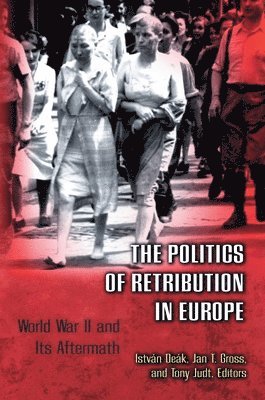
The presentation of Europe's immediate historical past has quite dramatically changed. Conventional depictions of occupation and collaboration in World War II, of wartime resistance and post-war renewal, provided the familiar backdrop against which the chronicle of post-war Europe has mostly been told. Within these often ritualistic presentations, it was possible to conceal the fact that not only were the majority of people in Hitler's Europe not resistance fighters but millions actively co-operated with and many millions more rather easily accommodated to Nazi rule. Moreover, after the war, those who judged former collaborators were sometimes themselves former collaborators. Many people became innocent victims of retribution, while others--among them notorious war criminals--escaped punishment. Nonetheless, the process of retribution was not useless but rather a historically unique effort to purify the continent of the many sins Europeans had committed.This book sheds light on the collective amnesia that overtook European governments and peoples regarding their own responsibility for war crimes and crimes against humanity--an amnesia that has only recently begun to dissipate as a result of often painful searching across the continent. In inspiring essays, a group of internationally renowned scholars unravels the moral and political choices facing European governments in the war's aftermath: how to punish the guilty, how to decide who was guilty of what, how to convert often unspeakable and conflicted war experiences and memories into serviceable, even uplifting accounts of national history. In short, these scholars explore how the drama of the immediate past was (and was not) successfully "overcome." Through their comparative and transnational emphasis, they also illuminate the division between eastern and western Europe, locating its origins both in the war and in post-war domestic and international affairs. Here, as in their discussion of collaborators' trials, the authors lay bare the roots of the many unresolved and painful memories clouding present-day Europe.Contributors are Brad Abrams, Martin Conway, Sarah Farmer, Luc Huyse, Laszlo Karsai, Mark Mazower, and Peter Romijn, as well as the editors. Taken separately, their essays are significant contributions to the contemporary history of several European countries. Taken together, they represent an original and pathbreaking account of a formative moment in the shaping of Europe at the dawn of a new millennium.
Europe on Trial
The Story of Collaboration, Resistance, and Retribution during World War II
Häftad, Engelska, 2013
566 kr
Skickas inom 10-15 vardagar
Europe on Trial explores the history of collaboration, retribution, and resistance during World War II. These three themes are examined through the experiences of people and countries under German occupation, as well as Soviet, Italian, and other military rule. Those under foreign rule faced innumerable moral and ethical dilemmas, including the question of whether to cooperate with their occupiers, try to survive the war without any political involvement, or risk their lives by becoming resisters. Many chose all three, depending on wartime conditions. Following the brutal war, the author discusses the purges of real or alleged war criminals and collaborators, through various acts of violence, deportations, and judicial proceedings at the Nuremberg International Military Tribunal as well as in thousands of local courts. Europe on Trial helps us to understand the many moral consequences both during and immediately following World War II.
535 kr
Skickas inom 10-15 vardagar
The objective is the modelling and calculation of optimal daily scheduling of power generation, by thermal power plants, to satisfy all demands at minimum cost, in such a way that the generation and transmission capacities as well as the demands at the nodes of the system appear in an integrated form.
430 kr
Skickas inom 10-15 vardagar
The book contains description of a real life application of modern mathematical optimization tools in an important problem solution for power networks. The objective is the modelling and calculation of optimal daily scheduling of power generation, by thermal power plants, to satisfy all demands at minimum cost, in such a way that the generation and transmission capacities as well as the demands at the nodes of the system appear in an integrated form. The physical parameters of the network are also taken into account. The obtained large-scale mixed variable problem is relaxed in a smart, practical way, to allow for fast numerical solution of the problem.