Itkonen Esa Itkonen – författare
Visar alla böcker från författaren Itkonen Esa Itkonen. Handla med fri frakt och snabb leverans.
5 produkter
5 produkter
E-bok
Engelska, 20191 353 kr
Läs direkt efter köp
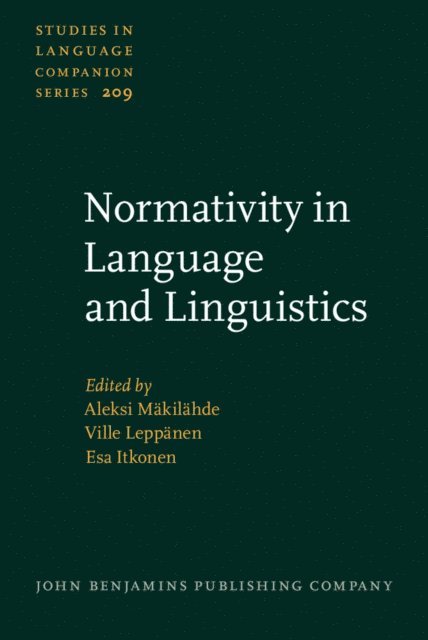
This volume sets out to discuss the role of norms and normativity in both language and linguistics from a multiplicity of perspectives. These concepts are centrally important to the philosophy and methodology of linguistics, and their role and nature need to be investigated in detail. The chapters address a range of issues from general questions about ontology, epistemology and methodology to aspects of particular subfields (such as semantics and historical linguistics) or phenomena (such as construal and code-switching). The volume aims to further our understanding of language and linguistics as well as to encourage further discussion on the metatheory of linguistics. Due to the fundamental nature of the issues under discussion, this volume will be of interest to all linguists regardless of their background or fields of expertise and to philosophers concerned with language or other normative domains.
E-bok
PDF, Engelska, 19911 651 kr
Läs direkt efter köp
This wide-ranging book presents the linguistic achievements of four major cultures to readers presumably conversant with modern theoretical linguistics. The chapter on India discusses in detail Pāṇini''s (c. 400 B.C.) grammar Ast-adhy-ay-i as well as the work of his commentators Kātyāyana, Patanjali, and Bhartṛhari. In the Chinese tradition, the Confucian doctrine of the Rectification of Names'' is singled out for treatment. Arabic linguistics is represented by Sibawaihi''s (d. 793) grammar al-Kitāb, in particular its syntax, as well as the subsequent commentary tradition. The chapter on Europe, which is the most comprehensive of the four, covers the time span from antiquity to the 20th century; special attention is devoted to the contributions of Plato, Aristotle, the Stoics, Varro, Apollonius Dyscolus, and the Modistae. The achievements of the cultures in linguistics are treated throughout from a deliberately value-laden point of view. The achievements of Western antiquity and the Middle Ages are shown to be much more than the average linguist is inclined to believe. Even more importantly, it is shown that the Indian and the Arab traditions have been superior to the European tradition at least until the 20th century. The fact that a linguistic theory created some 2,400 years ago is fully as adequate as our best theories today must have far-reaching implications for the notion of ''scientific progress''. More precisely, it proves necessary to distinguish between ''progress in the human sciences'' and ''progress in the natural sciences''. These issues, which pertain to the general philosophy of science, are treated in the final chapter of the book.
E-bok
PDF, Engelska, 19781 711 kr
Läs direkt efter köp
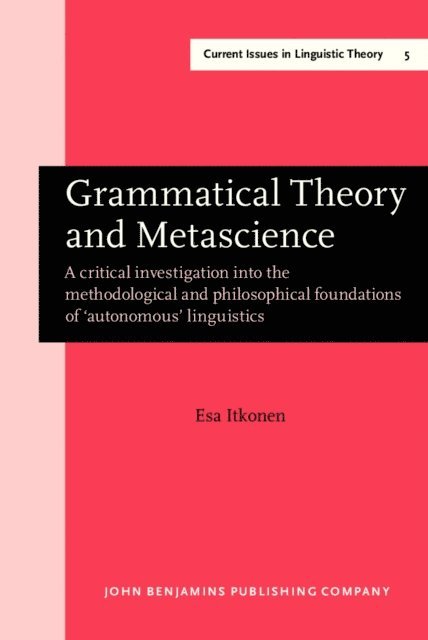
In this book, the author analyses the nature of the science of grammar. After presenting some methodological and historical background, he sets forth a theory of language and of grammar, showing that the science of grammar is not an empirical, but a normative science, comparable to logic and philosophy, characterized by the use of the method of explication.
E-bok
PDF, Engelska, 20081 305 kr
Läs direkt efter köp
The cognitive and language sciences are increasingly oriented towards the social dimension of human cognition and communication. The hitherto dominant approach in modern cognitive science has viewed “social cognition” through the prism of the traditional philosophical puzzle of how individuals solve the problem of understanding Other Minds. The Shared Mind challenges the conventional “theory of mind” approach, proposing that the human mind is fundamentally based on intersubjectivity: the sharing of affective, conative, intentional and cognitive states and processes between a plurality of subjects. The socially shared, intersubjective foundation of the human mind is manifest in the structure of early interaction and communication, imitation, gestural communication and the normative and argumentative nature of language. In this path breaking volume, leading researchers from psychology, linguistics, philosophy and primatology offer complementary perspectives on the role of intersubjectivity in the context of human development, comparative cognition and evolution, and language and linguistic theory.
E-bok
PDF, Engelska, 20051 405 kr
Läs direkt efter köp
The concept of analogy is of central concern to modern cognitive scientists, whereas it has been largely neglected in linguistics in the past four decades. The goal of this thought-provoking book is (1) to introduce a cognitively and linguistically viable notion of analogy; and (2) to re-establish and build on traditional linguistic analogy-based research.As a starting point, a general definition of analogy is offered that makes the distinction between analogy-as-structure and analogy-as-process. Chapter 2 deals with analogy as used in traditional linguistics. It demonstrates how phonology, morphology, syntax, semantics, and diachronic linguistics make use of analogy and discusses linguistic domains in which analogy does or did not work. The appendix gives a description of a computer program, which performs such instances of analogy-based syntactic analysis as have long been claimed impossible.Chapter 3 supports the ultimate (non-modular) ‘unity of the mind’ and discusses the existence of pervasive analogies between language and such cognitive domains as vision, music, and logic. The final chapter presents evidence for the view that the cosmology of every culture is based on analogy. At a more abstract level, the role of analogy in scientific change is scrutinized, resulting in a meta-analogy between myth and science.